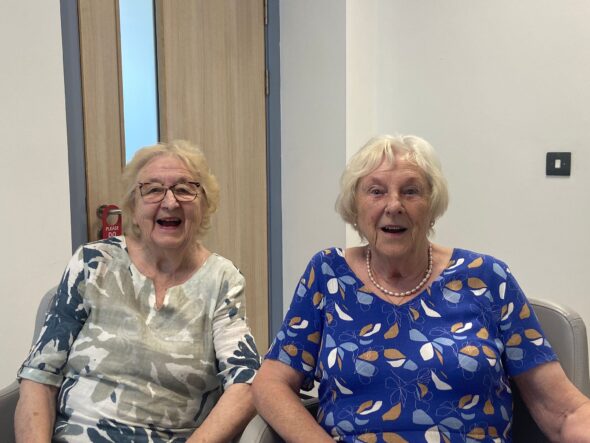
I've always thought that really fundraising to help hospitals, in research, and whatever was needed, was very important as well
Listen 00:14:05
Story: Dorothy Scholfield, Gaynor Hughes - Oswestry, ShropshireStories of volunteers supporting the health service since 1949
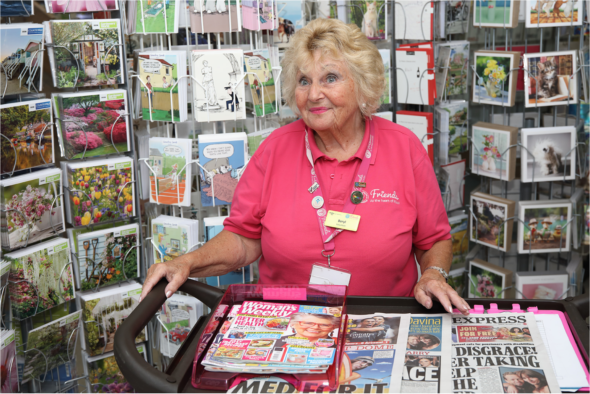
Beryl Angel - Oswestry, Shropshire
you know, you get a lot more out of it than you put inBeryl Angel
On retirement from the NHS, the next logical step for Beryl was to begin volunteering for the Friends. The Flower Guild, arranging flowers in the Chapel, was a good starting point, but Covid brought this opportunity to an end.
Today Beryl regularly volunteers on the ward trolley service, and welcome desk. Both of which appeal to her clear desire to help people.
Most recently she took part in an abseil.
It is clear that Beryl does everything she can to help, even when it comes at a personal cost.
Interviewer
Okay. So could I start by asking you your name?
Beryl Angel
I’m Beryl Angel.
Interviewer
And could I ask how old you are, Beryl?
Beryl Angel
I’ll be 81 next month.
Interviewer
And could I ask what group we are talking about today?
Beryl Angel
I cover going around the wards with the shop trolley, and also the help desk at the main entrance.
Interviewer
Okay, brilliant. Thank you. And what first got you involved in volunteering?
Beryl Angel
It was 15 years ago when I retired from the NHS. I’d worked full time, and I thought I can’t just go from working full time to being at home. There’s nothing to do. So about a month before I retired, I came here, and said that I’d like to do some voluntary work. So I got that set up about a month before I actually retired.
Interviewer
And did you work on this site?
Beryl Angel
No, I worked in Shrewsbury
Interviewer
Okay. So did you know this hospital?
Beryl Angel
Oh yes, I knew the hospital. I’d never been before.
Interviewer
Okay.
Beryl Angel
Here, but I knew it obviously existence. Yes, of course.
Interviewer:
So effectively you were drawing on your knowledge of Friends generally. And you, I mean, they’ve got a big group at Shrewsbury. And you thought, “oh, I could do that locally To me.”
Beryl Angel
Yes, yes.
Interviewer
And do you think, so you’ve been around 15 years? Do you think the Friends, have changed over the last 15 years?
Beryl Angel
Yes, because the hospital has, it’s increased in size. So, for example, when I came none of this, this area here was here at all. And the coffee… I did actually work in the coffee shop, when I first started, which was sort of bottom… down at the bottom there, a much smaller area. And we actually sort of made the coffee and the tea and all the other things and toasted tea cakes, and things, which they actually don’t do now. They, they’ve got a machine now that does the drinks and things. So that was, that was different. I also joined the Flower Guild as well. Well when I first came, and at that stage there were fresh flowers in different spots all around the hospital, changed twice a week. We actually did them once a month. So I did two, two lots in two different places to begin with.
Beryl Angel
And then later on I did them in the chapel, and we did that, the flowers up until Covid. And then obviously everything stopped at Covid. Since then, they, they don’t have fresh flowers now, they’re silk flowers and they, they’re not changed. So I obviously don’t do that anymore. I’ve done the trolley around the wards pretty well from the time I started, because you are not allocated a specific day or days when you first start, because other people have got the slots. So they’ll call you in, you know, as and when they need cover. So I did that for a little while till I got my own my own slot, which I’ve done, which has changed over the years, obviously a bit.
Interviewer
So how often are you here?
Beryl Angel
I do Monday and Tuesday mornings with the trolley around the wards, and then in the afternoon at the help desk at, at the main entrance. And just at the moment I’m covering a Friday morning slot with the trolley. Okay. So, yes, two and a half days.
Interviewer
And in some ways they’re quite different things, aren’t they? The trolley versus the help desk? So tell me what’s good about doing the trolley?
Beryl Angel
It’s just that so, so many people are so appreciative of, of the trolley going around. I don’t know whether some of the other hospitals continue to do it. I think they did prior to COVID… COVID changed everything. I don’t think the Shrewsbury hospital that the trolley goes round anymore, they have got their shops. But yes, the, it’s just sometimes, the patients just want to have a chat, you know, they… the staff are sort of, you know, too busy to stop and chat and whatnot. So that sometimes takes up my time, because yes, I do stop and chat and if that makes somebody feel better, then that’s, that’s great. Mostly every time that I go round, people will say, even if they don’t want to buy anything, they’ll say, “Thank you very much for coming.” They…it’s appreciated. And that, you know, you get a lot more out of it than you put in. Most definitely.
Interviewer
Okay. and what’s it like, say for example, being on the welcome desk? What…
Beryl Angel
Equally as satisfying, because some people are coming in there, they’re really quite nervous, you know, they don’t know what to expect. They’ll become forgetful because they’re nervous. They’ll come in. Usually I ask them if they’ve got their letter with them, times they haven’t, they’ve forgotten it, they’ve left it at home or whatever. And then I’ll have a look at what the letter says and then direct them, more often than not, down to the main desk, the main check-in desk. Or if I know they don’t have to go to there, then I can direct them to where they, for example, if it’s children, the children’s outpatients is right at the end of the corridor. So about as far away from here, as they could possibly be <laugh>. So you can, they don’t have to check in, you see. So they can go straight there.
Beryl Angel
Or if they’ve come in for physio, I’ll say, go to location 26. You know, so sometimes they’ll come in, you know, quite elderly people on their own, and they’ll come in for an infusion which is up on Sheldon Ward on the first floor, and they need a wheelchair. So I’ll try and locate a wheelchair. Sometimes they’re a bit like gold dust, and then wheel them down there, and up on the lift and whatnot. And or if it’s an injection, I, I wait because it only takes a few minutes, and then I’ll wait with them, and bring them back. A lot of people actually come on their own, and need wheelchairs. So that, that’s quite a big part of what we do, you know, which is, again, satisfying. You know, it’s if we… if you’ve been able to help someone or even sort of wheel them to the loo, you know, that sort of thing, or get them a coffee or something to eat, you know, and sometimes people aren’t able to do anything with their hands very much.
Beryl Angel
So it’s all just being helpful. Another aspect of the desk, people come by ambulance transport, and for whatever reason they have to wait quite a long time. I mean, three hours is, is, you know, quite often quite normal. So I keep an eye on how long they’ve been sitting there, and then I’ll say, you know, “are you waiting for ambulance transport?” And “yes.” So I’ll go down to the main desk, and ask them if they’ll ring through, and try and find out how long it’s going to be. That’s helpful, because at least, you know, we can say, well, it’s going to be another half an hour or an hour, or whatever it might be. So there are all sorts of just being generally helpful.
Interviewer
You know, helping people feel comfortable really about what’s going on today?
Beryl Angel
Yes, that’s right. Yes. Yes.
Interviewer
Excellent. Now, a lot about Leagues of Friends, is to do with fundraising. Do you get involved in that at all?
Beryl Angel
I did, quite recently.
Interviewer
Okay. Tell me about that.
Beryl Angel
I did something that I think, as Jules told you?
Interviewer
No, tell me.
Beryl Angel
Oh, right, okay. Well, the weekend before last, so week, last Saturday and Sunday, there was an abseil From a crane in the car park, 150 feet up. So I volunteered!
Interviewer
Had you done Abseiling before?
Beryl Angel
Never in my life before. A moment of madness. Total and utter madness.
Interviewer
And did you get much training for it or did you just like, get up there and off you go?
Beryl Angel
You can’t, you know. It’s so… I did it. I said, I’d do it, as long as I could be first up! Because, if I’d had to watch other people going up… I’d be saying, “I can’t do this.” So, I did, I was first up. So I’ve done that.
Interviewer
And another question people are bound to ask is, do they do any health checks before you do it?
Beryl Angel
They asked us various questions, you know, were we on any medication and that sort of thing. They had this, this crew came with it, and there were about five of them. I think they were excellent. Absolutely. Really did try and reassure you. But yes, I think they did say, do you suffer from a… one was high blood pressure. And I do. So I, take a tablet a day for that. They say anything, you know. They just… so, I just did it.
Interviewer
And did you enjoy it?
Beryl Angel
That’s… no. I think it was more relief.
Interviewer
Okay.
Beryl Angel
More relief. But I went up in, in the, it was like a cage. My son and daughter-in-law, came up with me not to abseil. So we got to the top, My son said, oh look, you can see the church at Stratton Hills. It could have been the Alps as far as I was concerned. Anyway, they, they get you to, to put your heels out over, you’ve got a harness and everything, obviously helmet, and all this, your heels over the edge. And then they say to you, lean back and there’s this… quite thin rope. I expected the rope to be bigger than it was. Anyway, they assured me that this rope would take two and a half tons. So you felt safe. We were all right. I felt safe. Well, yes, the worst bit actually was the coming off at the top. But then you let yourself down by holding.
Beryl Angel
If you held tight onto the rope, it stopped you. Or as soon as you released it a little bit, it let you down. I have my eyes closed the entire time. I didn’t see a thing <laugh> and I, when I got, I thought, “oh, I must be getting nearer the bottom”, because I could hear voices, you know, people clapping and shouting and all this. So I thought, “oh, I’m, I must be getting, getting nearer there.” Anyway, I got done. I got done, I did it. I was, I was pretty pleased myself. I’d done it.
Interviewer
So did you have to fundraise individually or was it a group thing or how did that work?
Beryl Angel
Individually it was to raise funds for the outside area of the children’s ward. So, you know, the whole thing was, was very, very worthwhile. because Some children spend a lot of time here. They’re educated here.
Interviewer
And do we know how much they’re hoping to raise from the whole event?
Beryl Angel
Well, at, at the moment I think it’s in excess of £13,000. They…over the two days, and my contribution is a little bit over a thousand. I was really very, very pleased. Yes,
Interviewer
Well done!
Beryl Angel
Yes.
Interviewer
Well done, So do you have any, I mean, that’s a big memory, but over the years, any other favourite memory of volunteering here?
Beryl Angel
The whole thing. Every time I come, I look forward to coming because everyone, the staff, the volunteers, it’s such a friendly place, and it’s just really great to come here. And I enjoy every moment of it. I really do.
Interviewer
So if you were somebody outside of the hospital listening to this recording and they’re thinking about volunteering, what would you say to encourage them?
Beryl Angel
I would urge anyone to come, and have a go, and they’d find they’d enjoy it as much as I do.
Interviewer
Yes. And there’s lots of different things they can do, isn’t there?
Beryl Angel
Yes. There are ward friends who actually give drinks to the patient, especially on the spinal injury unit. Some people aren’t able to feed themselves, you know, so they go along and feed them and give them drinks and that sort of thing there. Oh, there’s Horatio’s garden, which is, it’s run slightly differently, but it, it’s all part of that scheme. So people can work in there, in the shop or in the past I’ve done bit of shelf stacking, and that sort of thing in the shop, the coffee shop, of course. So yes, there are that, and, the veteran center as well.
Interviewer
Excellent. Yes. So when you were thinking that you were coming to speak to me today, is there anything else that you thought you might like to say you haven’t had the chance to say yet?
Beryl Angel
I don’t think so. No, I think I’ve covered it. Thank you.
Interviewer
That’s great.
| Contributor: | Beryl Angel |
| Recorded on: | 8 January 2025 |
| Role: | |
| Setting: | Hospital |
| Organisation: | |
| Hospital: | |
| Location: | |
| Themes: | |
| Decade: |
Listen 00:14:05
Story: Dorothy Scholfield, Gaynor Hughes - Oswestry, Shropshire
Listen 00:11:32
Story: Ivor Ashley, Sheila Ashley - Oswestry, Shropshire
Listen 00:07:27
Story: Jayne Vaughan - Oswestry, Shropshire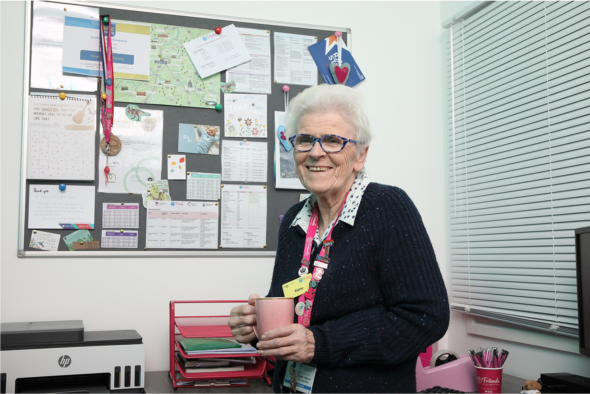
Listen 00:07:25
Story: Elaine Tinsley - Oswestry, Shropshire
Listen 00:10:23
Story: Elaine Leek - Oswestry, Shropshire
Listen 00:14:34
Story: Gordon Williams - Oswestry, Shropshire