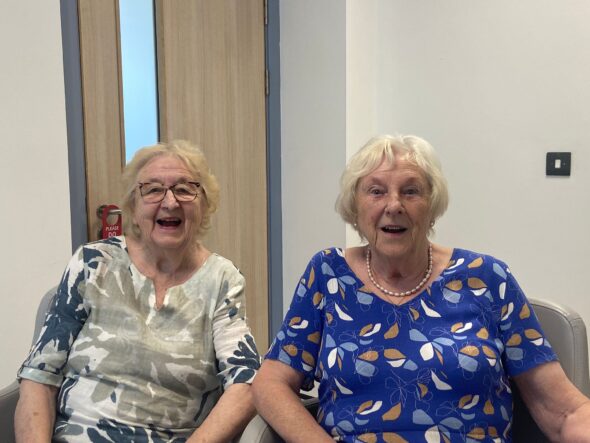
I've always thought that really fundraising to help hospitals, in research, and whatever was needed, was very important as well
Listen 00:14:05
Story: Dorothy Scholfield, Gaynor Hughes - Oswestry, ShropshireStories of volunteers supporting the health service since 1949
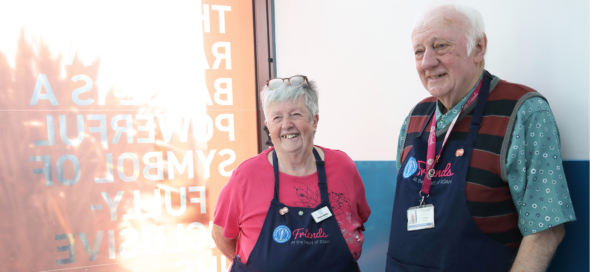
Ivor Ashley, Sheila Ashley - Oswestry, Shropshire
In the mid 1990’s it was the simple request of a friend that got Ivor and Sheila involved in volunteering for their local hospital.
Some 30 years later, their sense of pride in the hospital and the community it serves shines through. Alongside contributing, there is a sense of real responsibility for the buildings, the staff, the patients and their wider community.
Currently their key service is in the coffee shop. It isn’t just about serving coffee, and a cake with a smile, it’s about spending time with people, and reassuring them at a stressful time.
Interviewer
So, could I start by asking your names?
Sheila Ashley
I’m Sheila Ashley
Ivor Ashley
I’m Ivor Ashley.
Interviewer
And could I ask how old you are?
Sheila Ashley
I’m 78.
Ivor Ashley
Interviewer
And could I ask what group we’re talking about today?
Sheila Ashley
A coffee shop.
Interviewer
Okay.
Ivor Ashley
Same here.
Sheila Ashley
And I’m on the local branch of the, League of Friends.
Interviewer
Okay.
Ivor Ashley
She’s secretary there.
Interviewer:
Excellent, thank you. So first of all, could you tell me a bit about the history of the hospital?
Sheila Ashley:
A local lady from around here, Agnes Hunt, founded a hospital, the original Park Hall. And when that burnt down, local people raised enough money, to build a new hospital. She got very… She got Robert Jones from… He was a surgeon from Liverpool to come down and do operations here. And that’s how it got the name Agnes Hunt and Robert Jones.
Interviewer:
Oh, okay. So there’s a sense, that the local community paid for this hospital?
Sheila Ashley:
They did. They did. And whenever they have anything, we do massive fundraising things.
Interviewer:
And how did you get involved?
Ivor Ashley:
Oh, me?
Interviewer:
Both of you.
Sheila Ashley:
I was on the local council and one of the clerks wife was a nurse here and she asked me to get involved. So I got involved with a patient’s panel, and a League of Friends. And then eventually, I started working here.
Ivor Ashley:
She used to go around interviewing patients for the hospital, and do a report.
Sheila Ashley:
For the patient’s panel.
Ivor Ashley:
For the patient’s panel. Okay. Yes.
Interviewer:
So how long ago did you start volunteering?
Ivor Ashley:
I started on the Council in 95, the year Liz died, because we had a daughter, and we lost her in 95. And so that was, she died, just after I started in 95. And I was on until 2015, I only went for 12 months. I got bullied into staying, I didn’t want to do it, and I enjoyed it, and now I’m stuck there.
Sheila Ashley:
So I must have joined here about 96, something like that.
Interviewer:
Okay.
Ivor Ashley:
But we’d done other work for the thing, before that.
Interviewer:
So you knew all about the Friends before you ever got involved?
Sheila Ashley:
I told you, the community hospital, we regard it as ours.
Interviewer:
And, and what made you, as it were, sort of, raise your game and get more involved? What made that happen?
Sheila Ashley:
It was such a worthy cause.
Interviewer:
Okay.
Sheila Ashley:
It was such a friendly place to work. Everybody looks after each other. One of the first times I was here, two of the cleaners asked if we’d got any funny nail vanish. “What do you want that for?”, I said. “Mrs. So-And-So’s a bit down. We thought we’d do her nails for her.” And that’s the sort of…typical of the caring. Apart from the nursing act. It’s very caring.
Interviewer:
Yes. I’ve already picked up, there’s a real sense that, people keep their personalities here, and they’re treated as individuals.
Sheila Ashley:
They are people, not numbers. .
Interviewer:
And I picked that up, and it’s obviously why you’re so successful, I have to say.
Ivor Ashley:
We are all friends, all the volunteers, we’re all friends. We’ve just been joking, Beryl just now, she’s always pulling my leg, and I give her a bit of stick, back. That’s how it is though. For years, she called me Eric, and I’m Ivor. So she’s telling her friend “Oh, I always thought he was Eric, So my grandson’s Eric,” I said “No, I’m Ivor” so she always says “Hello Eric. I know you’re Ivor.”
Ivor Ashley:
Beryl is just, leaning on the door here now. She’s a lovely lady. She is.
Interviewer:
So you both, are in the coffee shop now?
Sheila Ashley:
Yes.
Ivor Ashley:
Yeah. We’re going to be working this afternoon.
Interviewer:
So tell me about the coffee shop. Why do you think that’s important?
Sheila Ashley:
Everyone that comes into hospital, this is my theory. Everyone that comes into hospital is frightened, especially the patients, but also, visitors coming in, and, having a smiling face there’ and if somebody’s really, you can tell tight, I’ll say to them, “I like your blouse”, or “I like that necklace”. Just to break the ice, and get them to just calm down a bit. It seems to work.
Interviewer:
And you’re in a really good location here as well, for people coming in.
Sheila Ashley:
We, we, this is not, I’ll tell you later…a lot going on.
Interviewer:
And it, it feels like there’s a sort of a good dynamic, between you’ve got the reception desk opposite, and you’ve got you, and you’ve got the shop a bit further. So there, there’s always extra pairs of hands, if then, if something needs extra pairs of hands.
Sheila Ashley:
Yes. And also there’s three or four staff in the office, so if we are short, one of them will come down.
Ivor Ashley:
We’ve been on our own, once or twice, and they have come and helped?
Sheila Ashley:
Yes.
Interviewer:
Leagues of Friends shops, and hospitals. They have different hours, depending on the hospital. So what sort of hours are you open here?
Sheila Ashley:
I think they open at about, half past seven. And we shut the machines down, about five. But I’m usually here at about six. So when I’m here, they can have tea, or, instant coffee afterwards. But there is a slot machine, down by Denbigh, so they can get something, 24 hours day,
Ivor Ashley:
If somebody is desperate, we make them a cup of tea, don’t we, when the machines are down. They can’t stop them having a cup of tea.
Interviewer:
Yes, absolutely.
Ivor Ashley:
Yes. Just to be nice to people.
Interviewer:
And, is that five days a week or seven days a week?
Sheila Ashley:
Saturday and Sunday I think it, they work from… Oh, it 10am till 3pm, something like that. In the week, it’s till half past seven, half past six, I think
Ivor Ashley:
We, basically do from 12 till six or whatever on a Friday. But today we are on relief, because somebody’s not there. So, we feel like we do a bit of relief, but that’s our main day, is Friday.
Interviewer:
And I suppose for some people listening to this to help them understand. So you are an orthopaedic hospital, a specialist hospital, so, you don’t have emergency admissions, as such?
Sheila Ashley:
If somebody breaks their leg here, they still have to go to Shrewsbury. We only have planned operations here.
Ivor Ashley:
They have the… What do you call them? Helicopter pad there. I was talking to the switchboard there, Mary, she’s retired now, and she said most of the people there, are going from the emergency, going out, going somewhere else. Not coming in. She said no, they’re mostly, that’s what they are.
Interviewer:
That means, that you can have a much more planned service as well, with things like the coffee shop, because you’re not having it. You can’t, you’re not having emergency admissions at two o’clock in the morning, and somebody needs a cup of coffee. It just doesn’t work like that.
Ivor Ashley:
They got the machines and that then, and the nurses.
Sheila Ashley:
The sort of operations, I suppose, it’s all operations, but the operations we do, it’s not just the surgeons, it’s the anesthetists, and everybody else. They need a team there. So it’s got to be planned. A lot of operations, take hours don’t they?
Interviewer:
And you, you talked, I think about being involved in one of the branches, is that?
Sheila Ashley:
There used to be about 20, I suppose, local branches, that raised money for the hospital. I was Secretary of the Oswestry branch. We are not doing anything very much at the moment.
Ivor Ashley:
There’s only you left, they all disappeared.
Sheila Ashley:
There are a lot of branches still doing raising money. Ludlow, Shrewsbury etc.
Ivor Ashley:
Down in the valley.
Interviewer:
But for groups like that, I think Covid changed a lot of things.
Ivor Ashley:
It did, it changed tremendously.
Sheila Ashley:
People that were sort of elderly before, they were old after Covid, and they didn’t come back, you know.
Ivor Ashley:
It’s changed everything though. As in our local village and all, it has changed everything. People who used to come, don’t come, and some got older, some passed away….
Interviewer:
Well, people who were, I was going to say, who were still sociable, became less sociable almost. Didn’t they? You know, they don’t attend so many things, they don’t get so involved. And that makes fundraising harder potentially. Certainly in the branches.
Sheila Ashley:
I’d imagine so. But also young people, most young people, go out to work, you know, especially, we are in the farming community, and the farmer’s wives used to be at home, and they did a lot of the work, but all the farmer’s wives go out to work now, they can’t afford to stay at home.
Okay. That’s interesting. Thank you. So between you or, or even separately, do you have a favourite memory of volunteering?
Sheila Ashley:
Oh, there’s many!
Ivor Ashley:
No. Just people like, yes.
Sheila Ashley:
People, are just so lovely.
Ivor Ashley:
So lovely. I met a lady in the shop working there. She, somebody, she was paralysed, from her neck down, laying in the chair, and she screamed and her husband left her on the, join in the foot, and then her chair moved. I said, “all right, you’re okay?” I talked to her, for about 20 minutes. Somebody had done her nails, she looked beautiful, and she said that, I said, you haven’t grumbled the whole time I’ve talking to you. She said, “I’ve got nothing to grumble about.” And it’s just hit me here, when I see that she’s paralysed from the neck down. And she realised that. And then we talked and she said, “I wish… If you pull my arm,” there I am, pulling her arm, “pull my arm. I can feel that, but I can’t move it.” And she was going home that day, You gave her a nice present, didn’t you? And yes, she’s, I don’t know how she’s got on, but she said, “I wish I could write” and Sheila said, “why don’t you try to do it with your mouth?” so she said, “oh, might try that”, she said And she was such a lovely lady, but she didn’t grumble, even though, she was in that wheelchair, you know. Yes.
Sheila Ashley:
There’s one lady comes here from Stafford, about once a month, and she has to wait hours for hospital transport. She loves it, because it’s the only time she ever gets out to meet anybody.
Interviewer:
Okay.
Sheila Ashley:
And she was telling somebody, and after the person was gone, she said, “you know, she got her husband off of the internet.” I said, “it’s amazing what you can get on the internet these days.”
Sheila Ashley:
But we meet so many lovely, lovely people.
Ivor Ashley:
Out of all the patients, I keep meeting… I met a chap, I haven’t seen him for, since we were young lads, weren’t we? Went back 60 years ago, and of course in days, he come here for some treatment, and brought his wife.
Interviewer:
Because, I’m sure that there’s been a lot of change. But it still feels, talking to the volunteers we’ve met so far today, that a lot, a lot of families stay around the area.
Sheila Ashley:
Oh yes, very much so.
Interviewer:
So it’s still got that, generation after generation, of community, as well as whatever the community is, that’s being created today.
Ivor Ashley:
It’s an interesting thing. I was born in a village in South Shropshire. And our village shop, was, Mrs. Powell, run the shop. Her eldest daughter, was a Matron here, really high up.
Sheila Ashley:
Mary Powell.
Ivor Ashley:
Mary Powell. And she died a few years ago. Her younger sister, was a lot younger, and I knew her sister, I knew her mother, when I was a kid. But Mary Powell, was what the story… Agnes Hunt, didn’t want to put the wages up for the nurses, and Mary fought it.
Sheila Ashley:
Agnes Hunt, said it should be a vocation. Mary Powell, said they should be paid.
Ivor Ashley:
I know I say this all the time, but Mary Powell got the wages up, for the nurses. She was a bit of a strict sort of lady, you know, the old fashioned type, but, I know her sister. I think her sister might be still alive, I know she’s friends with my brother who’s living out there now.
Interviewer:
So a real sense of community.
Ivor Ashley:
That’s right.
Sheila Ashley:
Very Right. It is very much a community.
Ivor Ashley:
It’s funny that she come, from about 30 miles away and she’s one of the heads here, in the early days. Small world.
Interviewer:
So if somebody is listening to this recording, and is thinking about volunteering, and thinks, “perhaps I could help at the hospital,” what would you say to encourage them?
Sheila Ashley:
It’s such a friendly, caring thing. Not only do we care for the patients, and visitors, we care for each other. And loneliness, is the worst illness there is, isn’t it? And come on and join in it. You will be looked after, you’ll have friends and you’ll be doing something worthwhile.
Interviewer:
Good. Now, when you were thinking you were coming to speak to me today, is there anything that you wanted to tell me that you haven’t had the chance to say yet?
Ivor Ashley:
Not really, no.
Interviewer:
That’s been enormously helpful. Thank you.
| Contributor: | Ivor Ashley, Sheila Ashley |
| Recorded on: | 8 January 2025 |
| Role: | |
| Setting: | Hospital |
| Organisation: | |
| Hospital: | |
| Location: | |
| Themes: | |
| Decade: |
Listen 00:14:05
Story: Dorothy Scholfield, Gaynor Hughes - Oswestry, Shropshire
Listen 00:07:27
Story: Jayne Vaughan - Oswestry, Shropshire
Listen 00:07:25
Story: Elaine Tinsley - Oswestry, Shropshire
Listen 00:10:23
Story: Elaine Leek - Oswestry, Shropshire
Listen 00:14:34
Story: Gordon Williams - Oswestry, Shropshire