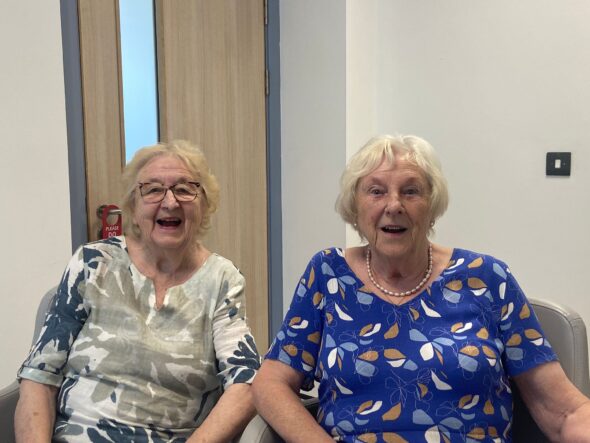
I've always thought that really fundraising to help hospitals, in research, and whatever was needed, was very important as well
Listen 00:14:05
Story: Dorothy Scholfield, Gaynor Hughes - Oswestry, ShropshireStories of volunteers supporting the health service since 1949

Elaine Leek - Oswestry, Shropshire
At the back of her Church, Elaine discovered an advert for more volunteers at the local hospital.
I think they’re just wonderful, and they’ve got such a great sense of a team here, which they’ve worked very hard at.Elaine Leek
Her roles have developed and changed. Her smile and enthusiasm is infectious as she talks about the satisfaction she gets from the small tasks helping with patients every day needs.
Interviewer
Perhaps I could start by asking your name.
Elaine Leek
My name is Elaine. Elaine Leek.
Interviewer
Could I ask how old you are Elaine?
Elaine Leek
71.
Interviewer
And could I ask what group we’re talking about today?
Elaine Leek
My role here is called Ward Friend with the League of Friends.
Interviewer
Thank you. And could I ask what got you first involved in volunteering?
Elaine Leek
If we go back to 2014, I had been thinking for a while that I had a little bit more time from work. I do still work, but I thought I had a little bit more time from work, and I’ve always thought I’d quite like to do some sort of volunteering, and I’ve always felt drawn to work in a hospital setting, partly because all my professional life I’ve worked in medical publishing and I just feel a sort of affiliation with the medical scene really. So I had been thinking maybe I might explore opportunities here. And then I saw a letter on the back table at my church where they tend to put letters that come, looking for volunteers for this and that, and they were trying to set up a group to read to patients on the spinal injuries unit, and I thought, oh, I could do that.
Elaine Leek
Because I like reading. I thought I could do that. And I imagined this role was that you would come, and perhaps sit by a patient’s bedside, and read to them from the newspaper or something. Anyway, so I volunteered, and I came along to a meeting. There were about six or eight of us there, and they tried to set this up, but it didn’t really work because it wasn’t really what the patients wanted. The idea was that the patients would be brought to this one place where they would sit while a group of literary people read to them. And that didn’t actually quite appeal to me, and neither did it appeal to the patients. So that didn’t progress very far. But I enjoyed having come here, and met Victoria who was running the League then. So I said, “could they find any other role for me, something else I could do?”
Elaine Leek
So they channeled me into the library, which used to run at that time, and that went during Covid, and didn’t come back. They channeled me into the library at the time they were mid cataloging. So it seemed to make a good use of skills that I had in the book area. I sort of moved into that, did that for a while, and then one day quite out of the blue, Victoria came, and said would I like to give her a hand doing something on spines because I think, I think a member of staff, a housekeeper or someone had gone on long term sick and they were having difficulty serving drinks to the patients, because the staff were very busy. So I said, I can do that. I can make a cup of tea. So I remember the very first time I went round, I went, that would be, we’d be in 2015 by now, and I went round with Victoria.
Elaine Leek
I really enjoyed it, because this was actual contact with actual patients, and I liked that if I’m, if I’m volunteering, I like to feel that it’s directly useful. Not that everything that everybody does here isn’t directly useful, but I like contact with the people. So I started doing that and carried on doing that, and it expanded onto the neighboring ward. I started on Wrekin, now I’m Wrekin and Gladstone, and that went on like that for several years until Covid came, and stopped the whole thing. And then when we came back from Covid, they’d created this new role that they were calling Ward Friend, which was more than just going round with the drinks trolley was the idea. It was that we would just be somebody who would do anything for anybody that they would like done that maybe the staff didn’t have time to do. So when we came back from Covid, I said, “yes, I’d like to do that.” And then that was a shift and a defined shift. So I do once a week, 10 o’clock till one o’clock, something like that. I’ve been doing that now for, when did we come back? After Covid? I don’t know. 2021. Yes. Been doing that since then.
Interviewer
And what sort of things do they ask you to do as a Ward Friend? What have you ended up doing?
Elaine Leek
Truth to tell, it is still largely a bit of a catering role. And I think possibly some people feel drawn to this idea of Ward Friend and then they discover that they’re going to have to do quite a lot of making tea and coffee, and going around with them. We help serve lunch as well, and we also help feed, well I do, because I’m perfectly happy to do it. Some people are less confident, but we also feed patients who need feeding actually. But other than that, it really is anything that, so I just say to people, is there anything else I can do for you? This might be simple things like putting their phone onto charge or doing something with their iPad that I’m not very good at. Cleaning their spectacles, you know, picking something up that’s dropped on the floor, helping them perhaps with clothes, sometimes hanging things in their locker. I mean these are people who are very restricted in what they can do. We go to the shop for them, they might, you know, give you a five pound note and say, could you go to the shop and buy a birthday card for my grandson? That could be a bit testing.
Elaine Leek
I tend to go back with a selection, and then put the others back, you know. But I’ve done that. I’ve written in cards for people. I’ve bought stamps and posted them. I’ve cleaned somebody’s false teeth. I mean, it really, you don’t know what somebody might ask you to do or you just have a chat. Oh, I’ve done crosswords with people occasionally. But often if you’ve got the time for somebody, it’s just nice to share a bit of conversation with someone who’s out there outside, because they’re stuck in there, you know.
Interviewer
So what’s kept you doing it for 10 years?
Elaine Leek
Well, I enjoy it. I rarely go home thinking, “Ooh, that was a chore.” If I’m going to be absolutely honest, and it’s not something that I can say in all contexts, certainly not on the ward. One of the reasons I wanted to volunteer, and I told you I saw the thing in church, was for me, it does have a Christian ethos to it. I believe that we are called to serve and therefore I want to serve. And I suppose that’s one of the things that keeps me doing it, because I feel it’s something that I should do. I have a couple of other volunteering roles as well, but I should do. So that’s why I think even if I woke up one morning, and thought, “oh, I don’t feel like it”, I would still go because I feel called to do. That’s not something that I can say on the ward because we’re not allowed to express those particular aspects
Interviewer
But service is practical…
Elaine Leek
Yes. It’s practical service. It’s service in action.
Interviewer
Yes.
Elaine Leek
Which is what people need to do.
Interviewer
And I have to say in a variety of context here, I’ve heard people talking about showing love to other people. And that is generally what all these services are about?
Elaine Leek
Yes, it is what it’s all about. Where, where your desire to show that love comes from, can be different, but that is what it’s about. Yes. It’s about, and particularly on spines where people are in such a predicament, you know, I mean, I could equally well serve drinks on one of the other wards, and I would do that happily, but someone who’s come in to have a hip replacement, say they are going to go out in a couple of days relieved from chronic pain, looking forward to their future. The people on spines have had a bit of a sentence really haven’t they? They’ve got a life sentence, that their life changed in an instant, and it’s not going to be the same again. And I just think they need as much support, and as much sort of loving support as we can give them, which the staff do wonderfully as well.
Interviewer
So if somebody is listening to this, who is thinking about volunteering in a hospital what would you say to encourage them?
Elaine Leek
Well, just, I mean, I just feel if your life is going along okay, then you just get so much back from feeling you are doing something to help somebody’s life, that isn’t going quite so well, maybe, you know. I don’t think people need to be afraid of being in a hospital environment. I think some people are. You do have to abide by regulations. You can get things wrong. I have got a couple of things wrong in my time. You know, had a little bit of a ticking off for it. So you do have to be careful what you’re doing. And I think that some people find that a little bit, “oh, I don’t think I’d like to go on the wards. I don’t think I could, you know, do this and that.” So you have to be sort of quite confident about yourself, I think, to do it.
Elaine Leek
But there are just huge rewards from what you get back from the patients who are almost uniformly so grateful, and which is lovely. You don’t do it for their gratitude, but it’s so lovely, you know, some of the things that they say to you, and you go home thinking, yes, you know, I did a good thing today. So yes, I would encourage people to give it a go. I mean, I think we’ve taken quite a few people around the ward to try it out. And I think some think it’s not for them, particularly the feeding, a lot of people don’t feel they can do that, but it is a very rewarding thing to do.
Interviewer
But if they don’t, if they come, and they don’t like that opportunity, there are other things?
Elaine Leek
I mean, yes, I’ve known people who’ve come around with me, and then they work in the shop or they, you know, there’s plenty of other opportunities here. All of which are supportive, aren’t they? You know, maybe slightly less directly, but it’s all supportive.
Interviewer
So when you knew you were going to be speaking to me today, is there anything else you wanted to tell me you haven’t had the chance to say yet?
Elaine Leek
Not particularly. I think the League of Friends is a truly wonderful organisation. Well, I mean, as far as I know about it here in RJAH, I think they’re just wonderful, and they’ve got such a great sense of a team here, which they’ve worked very hard at, you know, to buy pink shirts and all the rest of it. But they’re very good at giving us little, occasionally we will have a sort of like a little drinks evening, or something, as a thank you, which, you know, we don’t need. But it’s really nice and they’ve got a really great spirit here, I think amongst all the volunteers, which is fantastic.
| Contributor: | Elaine Leek |
| Recorded on: | 8 January 2025 |
| Role: | |
| Setting: | Hospital |
| Organisation: | |
| Hospital: | |
| Location: | |
| Themes: | |
| Decade: |
Listen 00:14:05
Story: Dorothy Scholfield, Gaynor Hughes - Oswestry, Shropshire
Listen 00:11:32
Story: Ivor Ashley, Sheila Ashley - Oswestry, Shropshire
Listen 00:07:27
Story: Jayne Vaughan - Oswestry, Shropshire
Listen 00:07:25
Story: Elaine Tinsley - Oswestry, Shropshire
Listen 00:14:34
Story: Gordon Williams - Oswestry, Shropshire