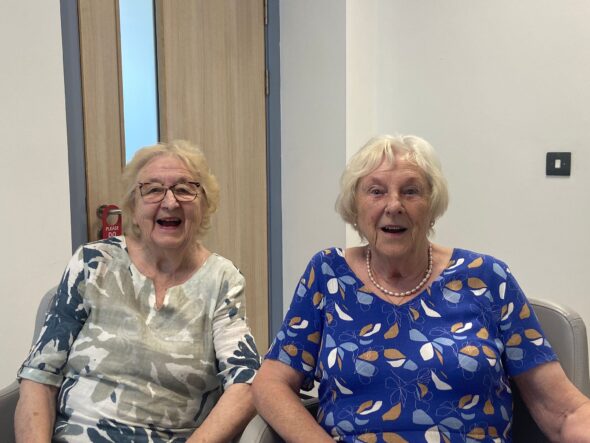
I've always thought that really fundraising to help hospitals, in research, and whatever was needed, was very important as well
Listen 00:14:05
Story: Dorothy Scholfield, Gaynor Hughes - Oswestry, ShropshireStories of volunteers supporting the health service since 1949

Gordon Williams - Oswestry, Shropshire
Gordon was in the armed forces for twelve years, and you can tell the moment you meet him. It’s something to do with the bearing, the approach. It’s the same with all the volunteers on the Veterans unit.
The pride they have in the service they are offering to Veterans is tangible, you can feel it.
Gordon’s stories are all about people. Veterans who have come to use the service. Veterans he has sat and chatted to. Veterans who he has helped in their time in the unit.
I heard this place was opening up, they asked for volunteers to come along, and listen to what they had got to say. So I came along and I thought to myself, “well, I can do that”. I got the experience to talk to people.Gordon Williams
Interviewer:
So could I ask your name?
Gordon Williams:
Gordon Williams.
Interviewer:
And could I ask your age, Gordon?
Gordon Williams:
Oh, I’m 74. 75 this year.
Interviewer:
Okay.
Gordon Williams:
In August.
Interviewer:
Brilliant. And what group are we talking about today?
Gordon Williams:
The League of Friends in Gobowen Hospital. Okay. And I’m the one of the veterans in the Veteran Centre.
Interviewer:
Okay. So that sounds interesting because I’ve not come across the Veteran Centre before. So tell me a bit about Veteran Centres. What are they all about?
Gordon Williams:
We come into existence under Colonel Meyers. He’s been doing it now eight years. I think he said, But he’s a Colonel in the Reserves. The Centre is there for the people, that leave the army, who can come and get advice on housing, benefits, mental health. And if these people can’t get help from us, we know people that can help them. It’s a very rewarding job.
Interviewer:
So I’m imagining that they’re not always that old. Some of these people who come to you?
Gordon Williams:
Oh God, no. No. You are a veteran if you’ve been in the army for, or in the forces for a day. Once you, once you leave, you are a veteran. So you only did 12 years. You come out, you’re a veteran.
Interviewer:
So you could have people in their, their twenties and thirties coming to you realistically?
Gordon Williams:
Yes, Yes. Especially if they’ve been in Afghanistan or in Iraq. Both them always did bring a few wounded people back.
Interviewer:
So how many volunteers do you have there? Roughly?
Gordon Williams:
We have 24. All ex-service, working down there in the Centre. I do Monday mornings, Thursday afternoons, Friday morning, four hour stints. Sometimes, like last week, I did all day Monday, all day Thursday, <laugh> Friday morning. So I get myself into it a lot.
Interviewer:
So I’m assuming that these are, these volunteers are going to be predominantly men?
Gordon Williams:
Ladies as well.
Interviewer:
Okay.
Gordon Williams:
We covered the three services. Navy, Army, Air Force. A young lady with me this morning. She is ex RAF. We got the two coming in this afternoon. One’s an ex Company Sargeant Major and the other one is a Fireman in the Royal Air Force. Okay. That’s this afternoon. But as I said, well I would say we’ve got more ladies than we have men, Mm-Hmm. <Affirmative> roughly.
Interviewer:
Which probably isn’t totally representative of our armed forces, realistically. What brought you into volunteering? because this sounds a really interesting project, but what made you decide to get involved?
Gordon Williams:
Well, to believe it or not. Right. I never volunteered until this place in Gobowen
Interviewer:
Okay. To the Robert Jones and Agnes Hunt,
Gordon Williams:
Yes. Down the Centre there. Okay. Okay. I’d done 12 years myself in the army, Welsh Guards. Mm-Hmm. <affirmative> Thoroughly enjoyed that. I ended up as a policeman, so I used to lock people up.
Interviewer:
So, military police or police outside?
Gordon Williams:
No, police in the regiment. Regimental Police. Okay. But I used to work with the RMP.
Interviewer:
How you got involved?
Gordon Williams:
Yes. So when this, I heard this place was opening up, they asked for volunteers to come along, and listen to what they had got to say. So I came along and I thought to myself, “well, I can do that”. I got the experience to talk to people. I love talking to the very old veterans, the ones who’ve been in the Second World War, and the First War, the stories they come out with. And of course they talk to us because we’ve been there. They don’t talk to their families. So the families don’t know until they come with them to the Centre, and they hear us talking, and that’s when they first hear the things that their parents had gone through in the forces. So I thought to myself, I’ve come out of the army, I’ve got all my bits, I can talk, I can walk, throw things, <affirmative>. But a lot of people come in and they’ve got missing limbs. I thought to myself, “well, I’m a lot more fortunate than them, so I shall volunteer to help those people less fortunate than myself”.
Interviewer:
Okay. So I’ve, I’ve heard a bit about, you know, you chat to people and that sort of thing, but what sort of things do the volunteers do as part of the Centre?
Gordon Williams:
We are there basically to listen to people. If somebody comes along with a problem and we don’t actually know the answer, we ask them to give us a few minutes, or an hour. And we’ll find out an answer for them. If it’s mental health, then we, we do know people that will help mental health and that comes under op care, I think. There’s all these different organisations that we can put in touch with and we cover a lot of things.
Interviewer:
I’m trying to build up my understanding of this picture, of this Centre. So do the veterans that come in, do they just sort of like drop in and out or do they stay there for a period of time? Or how does that work?
Gordon Williams:
Well, if they get lucky enough to be transferred, or referred to the Centre to be for their operations under Colonel Meyer and his team, they come, and they don’t have to, but they can bring their families. Okay. Yes. And they come and they can come any time, sit down, have a coffee. It’s just a fantastic way of getting to know people. I love meeting different people, if they’ve been in the army or the, any of the forces, they’re welcome here.
Interviewer:
Okay. So do you have any favourite memory of your time while you were volunteering and you could have more than one?
Gordon Williams:
Yes, I know that. I had a gentleman in, and he comes from the Isle of Man. And he got here and his appointment was at half past one in the afternoon. And he’d been on the go since five o’clock that morning to get from Isle of Man to here. He could barely walk. He was on crutches. So he spent most of his time in the wheelchair that we provide. And I got talking to him, and he said, “what’s your name”? I said, “my name’s Gordon”. Well, I said, “what’s your name”? He said, “Michael”. I said, “okay Michael”. I said “what would we like to do”? He said, well I’m here for an appointment at half past one. “you’re early”, I said. <laugh>.
Gordon Williams:
He said, “right”, we’ve got talking. He used to ride motorbikes, couriers. Mm-Hmm. <Affirmative>. He said, “I need some help with a couple of things”. I said to him, I said, I’ll stop you there”. I said, “have you got one of them”? And I showed him my badge, “yes, I’ve got one of them”. “Have you got your veterans’ ID card”? “No. What’s one of them”? I said, “well, when you was in the regular Army, and, I said, you had an ID card”? I said, “now the veterans”, I said, “get their own ID card, to say they were in the army or the forces. Right”. I said, “you’ve got no problem with your living conditions”. He said, “no”. He said, ” I’m alright over there in the Isle of Man”. Okay. He said, “I do go around the island giving out leaflets that I’ve been given by the veteran shed”.
Gordon Williams:
That’s very kind of you. But anyway, he turned around, and he said, “It looks like I’m going to be here all day”. I said, “not if we can help it”. I said, “we’ll see if we can get you in earlier”. So my counterpart then went down to the bottom, saw the Colonel’s representative, and said, “can we get this gentleman in to see the Colonel before half past one? Because he’s got to go back to Isle of Man”. Lo and behold, after saying that, he was sent for his X-ray, then he come back from, I took him up there for his X-ray. He come back, we sit there having a coffee. Lo and behold, he was called through to go, and see the Colonel. And this was 12 o’clock or no, 11 o’clock in the morning. And he’d come out of there and he was almost in tears.
Gordon Williams:
I said, “what’s the matter”? “The way I’ve been treated here”. He said, “goes over, and above, and beyond what we expect”. I said, “that’s what we are here for”. I said, “if we can help you”, I said, “we help you”. I said, “if somebody comes in here”, I said, “for an appointment” I said, “we get you in early if we can”. And he couldn’t believe the treatment he’d had. And I said, “well, all I’d like you to do”. I said, “when you leave here and you go back”, I said, “you tell the people that you know, ex forces, that they’re entitled to come here, as long as they get referred by the doctor”. I always do that <laugh>. Lovely guy, you know, and excellent. And he’d done his, he’d done his part in the Second World War, and it ended up in actual fact, he’d done 32 years and his last tour was 2003.
Interviewer:
So it, I can hear the, the pride that you have in the service that you offer to the veterans when they come to the service. If I was a veteran listening to this, and I was thinking about potentially doing some volunteering. Yes? What would you say to encourage me to sign up and get involved?
Gordon Williams:
To be a veteran, you have to be open, caring, you’re no better than anybody else. And actually, sometimes veterans come in here, can come in here, and they can overwhelm you with their stories how they lost their limbs, and whatever. We, I guess to be honest, don’t tell a load of war stories. You listen too. What we are here for is to listen. We are a listening post. You can give advice, when you think you are capable of giving the advice. You know, don’t spiel off something then find out that you’ve been totally wrong. Check up on all your stuff you say, before you say it, be open, caring, be a good listener, and not only that you do, you’re doing the job because you want to help others. And that’s what, to me it’s about.
Interviewer:
So just picking up on one point you made, you said it can be a bit overwhelming sometimes? Yes. Is there support for the volunteers if they feel a bit overwhelmed? Yes?
Gordon Williams:
Down in the Centre, we have two quiet rooms, and if a veteran loses it, we talk to him, quiet him down. Ask him if he wants to go into a quiet room, so he can have a blowout in there, if he wants. But we don’t let them suffer in public. Yes. Because there’s other people in the cafe.
Interviewer:
Absolutely. But what about if, if I was volunteering, and I felt a bit emotional because of the stories that I was hearing, is there support for the volunteers as well?
Gordon Williams:
Yes, other, the other veterans? Yes, Yes, Yes.
Interviewer:
So it’s a really mutually supportive group?
Gordon Williams:
Yes, Yes, Yes. Oh yes. We all been there. We’ve both seen atrocities in our time, in the forces. So we are well capable of looking after each other. It’s a family, and we treat everybody who comes in like a family.
Interviewer:
Excellent. So when you were thinking about coming here today, is there anything else that you wanted to tell me that you haven’t had the chance to say yet?
Gordon Williams:
No, I think I’ve covered it all really. <Laugh>.
Interviewer:
Well, I’ve really enjoyed meeting you. Thank you ever so much. <Silence>.
| Contributor: | Gordon Williams |
| Recorded on: | 8 January 2025 |
| Role: | |
| Setting: | Hospital |
| Organisation: | |
| Hospital: | |
| Location: | |
| Themes: | |
| Decade: |
Listen 00:14:05
Story: Dorothy Scholfield, Gaynor Hughes - Oswestry, Shropshire
Listen 00:11:32
Story: Ivor Ashley, Sheila Ashley - Oswestry, Shropshire
Listen 00:07:27
Story: Jayne Vaughan - Oswestry, Shropshire
Listen 00:07:25
Story: Elaine Tinsley - Oswestry, Shropshire
Listen 00:10:23
Story: Elaine Leek - Oswestry, Shropshire