Please let us know what you think of our website by completing our quick one-minute survey Leave feedback

Friends Voices

Stories of volunteers supporting the health service since 1949

Steve Bench, The Guild of the Royal Hospital of St Bartholomew - London

Steve Bench, The Guild of the Royal Hospital of St Bartholomew

Steve Bench - London

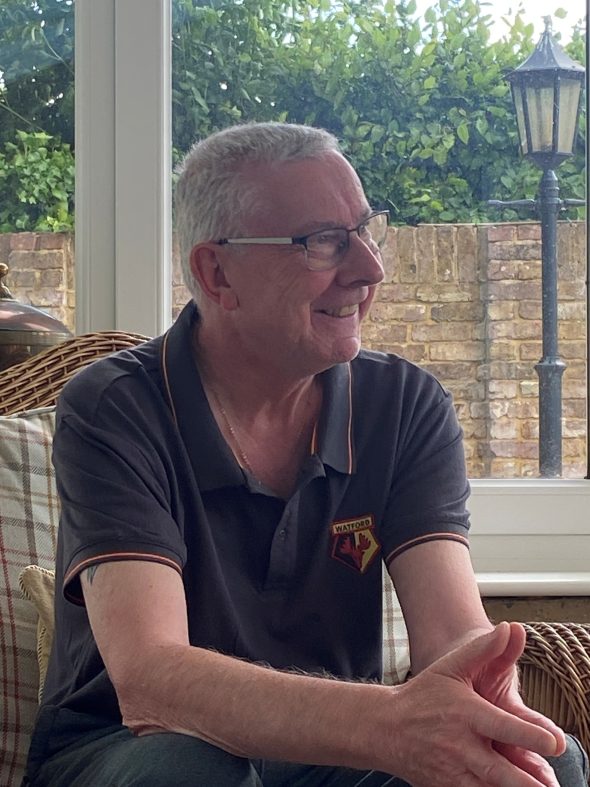
When Steve Bench lost his wife to cancer, he wanted to do something to give back to the hospital that treated her. He has been volunteering with the Guild and helping to run the trolley service for twenty years.

If I was really honest, the thing I would say is I never finish the trolley on a Tuesday and don’t feel about eight foot high when I leave. I always feel good after the trolley service, you know, because there’s always at least one patient or member of staff who will say “I so appreciate you coming around today.”

Although the stock and methods of payment might have changed over the last 20 years, the appreciation and thanks from both patients and staff  remains steadfast and Steve is keen to share his knowledge of helping to run the trolley with other Friends groups.

Steve's career and volunteering background

Interviewer

Good morning. Could I start by asking your name?

Steve Bench

Steve Bench.

Interviewer

And your date of birth?

Steve Bench

5th of July, 1960.

Interviewer

And which hospital are we talking about today?

Steve Bench

St. Bart’s Hospital.

Interviewer

Brilliant. So Steve, in your early life, did you have much experience in volunteering? Did you get involved in volunteering?

Steve Bench

Not really at all, if I’m honest.

Interviewer

And you didn’t see it around you in the family or anything else?

Steve Bench

Not really. Growing up, I mean obviously, like most kids, my generation played football and cricket, things like that. But it’s not something that I probably saw first hand.

Interviewer

And what did you do for your working career?

Steve Bench

I worked for British Gas. All my working career. Started off as a heating engineer apprentice, heating or gas fitter in those days, and then progressed through to managing the engineers and then finished up working in headquarters, the last seven or eight years of my career.

Interviewer

Excellent. And what brought you into volunteering at Barts?

Steve's wife and her battle with cancer

Steve Bench

My wife Carolyn was diagnosed with adrenal cancer. Which is a very, very rare cancer. And when she was diagnosed at my local hospital, there was no treatment, no knowledge of it. But the doctor there knew a Professor Grossman, who was based at Barts. He was the only one, apparently in the country, who knew anything really about it. We got referred there and my wife spent a fair amount of time at the hospital. I mean, it was really just all experimental things. There was no real treatment or cure or anything like that.

Interviewer

And were you working at this point?

Steve Bench

I was still working at that stage and I’d go up and see her every night. And my first experience with the trolley was I’d come in every day and I’d bring magazines, drinks, whatever, each evening. And there would be something on the bed or on the tray, that my wife had bought from the trolley that came around that day. And I used to say, “well, why are you buying these things? You know, I can bring them in at night.” You know you don’t understand but the trolley makes such a difference coming around. And I used to go home at night thinking she’s just becoming a bit institutionalised. It made no sense to me, to my shame. And then unfortunately she deteriorated really quickly and I lost her back in 2007.

Interviewer

A long time ago now.  And you were a young man still?

Steve Bench

Yes, but because the staff were so fantastic, they were incredible to her and to me, I was determined to do something. And the old Barts before its new building was built, we used to walk down the stairs from the ward she was in, and the little shop for the Guild was right at the bottom of the stairs. And there was a little note in the window about volunteering. It was never open because it was in the evening. So I took the number down and I phoned them up. And initially the lady said she thought it was too soon. I’m a person who knows what I can do, when I can do it, I know myself.

Introduction to the Guild

Steve Bench

So I started doing a Saturday morning. So I did two Saturday mornings a month. And this is 20 years ago. Probably early 2008. Just in the shop on a Saturday morning, normally two ladies would come around and do the trolley and I would work with another lady in the shop on a Saturday morning up to about two o’clock or something. And  I’ve never done any retail, never been in my skillset. And it fascinated me really, like anything that you can organise and there’s a structure to it.

Interviewer

And was it busy on a Saturday?

Steve Bench

Not over busy, but in those days we could sell between 20 and 30 papers on a Saturday. You know, where you think now we struggle to sell two, it’s a change in newspapers. Incredible. And then one Saturday, the people who were doing the trolley couldn’t make it.

Unfortunately, we didn’t have a sale or return policy with the newspapers. And the lady who ran the shop, she’d gone through the Second World War, so she was very direct, she had a great way about her, but she was also quite firm. So, you know, she said, “well, if we don’t sell the newspapers we’re going to  lose 20 or 30 quid,  you’re going to have to take the trolley around, Steve.” And I said, “yes, but I can’t go to the fourth, because that’s where my wife was, on the fourth floor.” But I thought, I can’t have the charity losing money. So I took the trolley around, and I did go into the ward where my wife had been and the staff came around me like I was the long lost friend that had turned up and the second I took the trolley around the wards, the only ever light bulb moment, my head just went bang. I suddenly realised what my wife had said, why it made a difference. Because people they’re half asleep and they’re going to have whatever drugs in them and then suddenly the trolley appears and even if it’s just a chocolate bar or drink or just a chat about what was on last night, the football or whatever, and I suddenly realised what an impact that made.

Working with the trolley

Interviewer

So I’m imagining that taking the trolley round could take a bit of time if there’s some chatting to be done on the way round?

Steve Bench

Yes, I mean, in those days, it wasn’t that big a round then. And it was quite convoluted when I started doing it properly, because there are underground passages in Barts and we used to have another building, the Queen Elizabeth building, which was sold off. So you’d go through all these tunnels turning right and left and suddenly appearing in a totally different building. We could go in rooms with PPE. So if you needed a mask or apron or gloves, we would wear all that and still go into the rooms, where now we don’t do that anymore for our own safety, which I understand.

How has it changed over the years

Interviewer

Has the stuff that you stock on electronics, has that changed over the years?

Steve Bench

Not vastly. I mean, yes. Okay. Electronic stuff, that’s obviously changed as everyone’s got a smartphone, so that sort of thing has more modern things like protein bars and things like that would come in. But in general we stock more variety, but I don’t think the general items have changed tremendously. The actual trolley changed from what it was, it was a simple cash box when I started, I’m sure you’ve seen them about, 12 inches by 6 inches, about 4 inches deep. You know, you just lift the lid and put the money in. And that’s all we had to start with.

Interviewer

So what do you have now then?

Steve Bench

Because you had to take a sheet of pricing and the problem is the more you sell on the trolley, the bigger that sheet gets and it becomes two sheets and three sheets and then when you’re selling stuff to people, you then have to find that item on the list. You then have to add up. We started looking at having a tablet exactly like an iPad, a retail programme built into it. And then you can have all the prices on the system, it becomes easy. We’ve got a company who put the retail on fairly quickly.  We then worked out that actually we should be able to take some sort of credit card payment. The problem with that is that the internet signal at Barts, for the public one anyway, is dreadful. It didn’t work on what would’ve been 3 or 4G, it was probably 3G at the time. We then had to convince the hospital that we needed an internal network to have our credit card machine on. Took a fair amount of time for us to convince them of that.

Interviewer

But logically would benefit the patients as well?

Steve Bench

Yes. We probably didn’t approach the right people.

Interviewer

That’s often the case.

Steve Bench

That’s not the hospital’s fault. I think that’s ours, for not really thinking who do we really want to get? We got stuck down in with people who probably can’t escalate it fast enough. And then once we got that, it made a huge difference because probably 60% or 70% of our sales are card now, 30% are cash. And that worked for a while. But then we had a problem with the till. Because if you imagine a till in a normal shop and we’ve just got a mini version. Basically, it’s designed to open automatically. It’s not designed to be opened by a key, but to have it opened automatically, you need to have a special programme built in to get it to open automatically. And there’s only certain credit card machines. So then we moved to that function  so that every time there’s a purchase as in a shop, the till opens. So that again moved us forward, another stage.

Interviewer

So it’s been a bit almost like baby steps ?

Steve Bench

Yes, yes. Exactly.

Interviewer

To get it to where it is now.

Steve Bench

Yes, exactly. And we’re still moving, even now, every little while we look at different things and where do we move to and we have a backup system with a Sum Up card machine, which you can just buy from a normal retailer. £30, and they’re great backups because there are no monthly charges on them. Once you’ve bought it, you just pay per transaction. There’s a greater cost per transaction. But they are great backup.

Interviewer

No, so it’s really good. So 20 years you’ve been there at the moment. How much time do you spend on the trolley?

Steve Bench

Two days a week. I do the trolley on a Tuesday. So I did the trolley yesterday. And I do the shop on a Thursday.

Interviewer

Okay. So you kept your hand in in the shop as well?

Steve Bench

Yes. I like to be involved.

The trolley's impact on Steve

Interviewer

Okay. And 20 years is a long time. What has kept you involved?

Steve Bench

I think there’s a number of things. I think the answer people would expect to hear would be the memory of my wife. When you get told thank you for coming around with the trolley, it’s doing what you do. And they obviously have an impact, but in reality I’ve got really good friends there. The volunteers have become really good friends. I think I go as much see them than I do for the other things in life.

Interviewer

Well, having met some of the team at Barts, they’re a great bunch.

Steve Bench

Yes, yes they are.

Interviewer

If you’ve been there 20 years, you’ve got to know them quite well.

Steve Bench

Yes, yes.

Interviewer

Now do you have any favourite story of your time volunteering?

Steve Bench

Not really. If I was really honest, the thing I would say is I never finish the trolley on a Tuesday and don’t feel about eight foot high when I leave. I always feel good after the trolley service, you know, because there’s always at least one patient or member of staff who will say, “I so appreciate you coming around today.” And that, you know, just makes your day. One of the very early lessons I learned when I took the trolley around, particularly when you do something every week, and you get the same person. They buy the same paper and the same thing each week,  and then when you come to the fourth week or fifth week, and they’re not there. You never ask what happened. You learn just to move on. But I was given one piece of advice before I did the trolley. One of volunteers who was a really good friend of mine and I’d had a really terrible work week. And I’d come in that Saturday and my head was still going around with my work and she said to me, “before you get into the gates at Barts,” she said, “you need to leave all those troubles out there because no one’s interested in your trouble Steve. These people are in here because they’re not well. So you need to forget about that. You need to put on your happy face, do your volunteering, and then pick up your troubles when you leave the hospital.” And I’ve never forgotten that.

Interviewer

It’s really interesting because in the current young people’s language, what you’ve just described would be described as mindfulness. It’s actually focusing on something as opposed to all the other noise that’s going on in your life. And I often think that is underappreciated, that volunteering really can take you away from what ever else is going on.

Steve Bench

Absolutely.

Interviewer

Excellent.

Steve Moreton

Can I ask a question?

Steve Bench

Of course.

Steve Moreton

When you left your troubles at the gates at Barts  and did your volunteering. Were your troubles exactly the same when you went back and got them or had they moved about a bit?

Steve Bench

I think most of the time they weren’t real troubles if I was honest. I think most of the time it made you look at them in a totally different perspective, which I think you do anyway in life. You know, if you are down, all your troubles are 20 times heavier than they really are. When you are up, you get on with it and go, right, how do I organise this? What do I do? And yes, you get on with it

Steve Moreton

Sounds like we need more gates of Barts for us to walk through.

Steve Bench

I just think that you know, that doesn’t just apply to volunteering, it probably, applies to anything in life really.

Sharing knowledge and experience

Interviewer

So when you knew we were coming today was there anything that you wanted to tell us that you haven’t had the chance to say yet?

Steve Bench

I think the only thing I wanted to say, because this is what I started it off initially when I first contacted you, was it occurred to me late last year, 2025, that there must be quite a few hospitals who’ve got trolley services or are even thinking of starting a trolley service, but don’t know where to start or don’t know where to progress or have got a trolley service which is far better than the one we’ve got. And I just think there should be somewhere where that information can be shared or somewhere where there’s a contact where people can say, “Right, I’ll contact that person and see what information they can give me instead of trying to reinvent the wheel.”

Interviewer

And you definitely made us think at the national office, so thank you for that. So, we’ve already talked before we started recording about a hospital that are thinking of starting a trolley service and we’ve put them in touch with you, and two other groups. So they’ve got three different ones to look at and compare. And we are going to do some writing up about that and we’re going to include it in the newsletter and hopefully just start to create a bit of a network realistically. And potentially prompt groups that perhaps used to do a trolley service. Trolley services were more prevalent before COVID and then they didn’t want to spread it so they sort of got shut down. And people thought, “oh, well they’re not necessarily profitable,” but what they need to understand is, it’s, as your wife Carolyn said, “it’s not about how much you spend, it’s about the difference in the stimulation and the conversation that comes with the visit to the ward.”

Steve Bench

Yes. And 50% of our sales are the staff, so they look forward to it virtually as much as the patients do.

Interviewer

Well, thank you for your time today.

Steve Bench

No problem.


About this story

Contributor: Steve Bench
Recorded on: 21 October 2026
Role:
Setting: Hospital
Organisation:
Hospital:
Location:
Themes:
Decade:

Related

Volunteer spotlight – A Lifetime of Service: A Tribute to Ann Wickham

News - 12 Jan 2026
Image of two people standing outside the entrance to the Friends shop inside the hospital, with a laden ward trolley beside them

The Guild of the Royal Hospital of St Bartholomew

The Guild of St Bartholomew’s is a group of volunteers established to ‘help the Hospital by personal service and by the provision of such amenities for the patients, staff, and students that would not be available for them under the NHS.’ While the hospital staff tend to the medical needs of the patients, the Guild tends to their spiritual ones.

Organisation

People have no idea how to get into the NHS, who to speak to....... and I think one of the most important things about Leagues of Friends is that they are gatekeepers and trusted local faces that people can recognise.

Listen 00:17:04

Story: Ian McDowell - Central London

My husband was on the staff of St Bartholomew's Hospital and his immediate consultant's wife happened to be the Chairman of the Guild. And she suggested I come along to a meeting in 1966, and I haven't left since.

Listen 00:08:22

Story: Ann Wickham - Central London

I've certainly learned a lot about human nature, and come to admire my fellow human beings very much because of the courage I've seen.

Listen 00:10:51

Story: Jan O'Neill - Central London