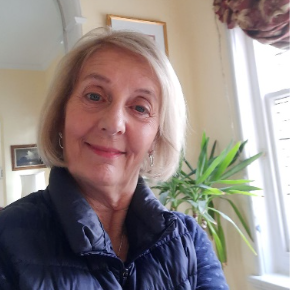
So there was, you know, an interest for me, as well as perhaps giving time to the hospital.
Listen 00:23:42
Story: Cynthia Burton - Central LondonStories of volunteers supporting the health service since 1949
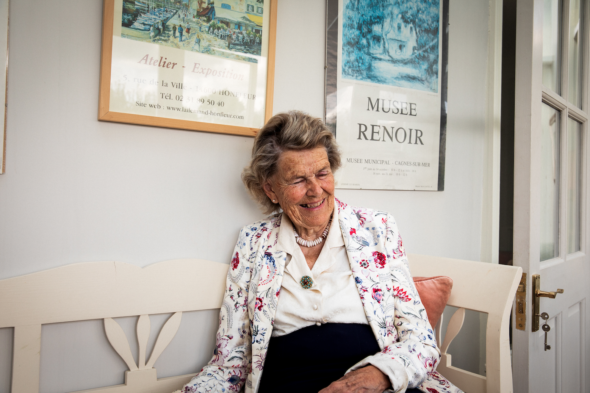
Marigold Cleveley - Central London
Personal convictions, and those of her friends, meant that Marigold first found herself volunteering nearly 50 years to support Homeopathic medicine, and those in the community wanting to access such services.
We got a kettle, a roll of Fablon, and found some old tables, and put a sign up saying “coffee and buns”
Throwing herself into the community of Friends, she found herself doing everything from writing minutes, to serving tea and buns.
Interviewer
So good afternoon. Could I ask your name?
Marigold Cleveley
My name is Marigold Cleveley.
Interviewer
And could I ask what Friends group we talking about today?
Marigold Cleveley
We’re talking about the Friends group now, of the lovely hospital in London called the Royal Hospital for Integrated Medicine, which in my day, was called the Royal London Homeopathic Hospital.
Interviewer
And could I ask how old you are?
Marigold Cleveley
I am 89.
Interviewer
So that thought about, you talked about “your day”. So what was your day with the Royal Homeopathic Hospital?
Marigold Cleveley
How did I really start taking interest in it? Yes, well, homeopathy was of course what took me there. I had young children, we used homeopathic remedies, through a friend of mine who was called Eleanor Speight. Now you probably haven’t heard of her, but in fact she was one of the really founding members of the Friends. I had an operation at the Homeopathic Hospital myself. And she said to me afterwards, “Well, why don’t we see about a League of Friends for this hospital?” And at that time, it had just been taken over by the National Health. And so the Board of the Hospital still wanted to take an interest in the hospital. So the Chairman of the hospital who had been running it, a man called Sir Colville Barclay, became the Chairman of the Friends.
Marigold Cleveley
And they literally set it up themselves by deciding that the Treasurer, would become the Treasurer of the Friends. The Secretary of the hospital became Secretary. He was a London solicitor, busy man. So he, and they, set it up, and she said to me, “I’m going to go and see what it’s all about.” And so she put a little hat on, and she went up to London, and she came back, and she said, “Well, we’ve got to do it and I’ll be the Membership Secretary, and you can be the Secretary, Secretary.” So I took the minutes of the meetings, which consisted of three people in the Boardroom at the hospital, the Chairman, the Treasurer, the Secretary and me.
Marigold Cleveley
Indeed. Because the whole hospital was homeopathy. There were wards up on the first, second, third, I don’t know how exactly how many floors there were, I think four probably. And then under, in the downstairs, in the sort of so-called basement, was the Outpatients Department. And we had full surgeries in the Outpatients Department, and we decided, that we would turn a corner of it into a snack bar. So we literally went out, and got a kettle and a roll of fablon and found some old tables, and stuck the fablon on the table, and put a sign up saying “Coffee and Buns.” And we literally did it like that. And that was how we sort of established ourselves. And then of course we had many more. The Outpatients Department was full of people who wanted homeopathy. And we had a box saying, “Please, if you would like to be a member, put your name in the box.” And, and that’s how we built up membership.
Interviewer
So I think about homeopathy as sort of Holland and Barrett, or something like that. Yes? Have I got totally the wrong idea? Tell me a bit more about it!
Marigold Cleveley
Well I think, I think in, with respect, now you probably have: Holland and Barrett might have been like that many years ago before they were, I think taken over. And they’re now huge, of course, part of, I think they’re Russian owned, aren’t they? Or Chinese or something? Anyway, but homeopathy really was strong. We had quite a lot of foreign patients, and elderly people, who the Royal Family had led the way. There was always a King’s physician. The Queen Mother of course, used homeopathy tremendously. And we had a strong structure of doctors being trained. Well of course, I don’t know if they still do train them. So it was a really functioning London Hospital, and very different from what it is now. And it really closed… well we perhaps don’t need to go onto that, but it closed sort of really from the inside by the NHS, refusing to find people to go there. And then the NHS being stopped from well… Sato will have told you all about that.
Interviewer
So we have this strong belief set of people who are very passionate about the benefits of homeopathy?
Marigold Cleveley
Oh indeed. That’s why they came there. It was entirely. Some of the surgeons were not necessarily homeopathic, but, it was entirely the centre for homeopathic medicine. You chose it because of that.
Interviewer
And I imagine you attracted all sorts of different styles of people to become volunteers?
Marigold Cleveley
Yes. How did I, I’m a bit hazy on how. Cynthia’s probably better at that than I am, on how we attracted our volunteers. And Enora, sadly has gone on now, but we did. It was always going to be difficult to attract volunteers. Not like being in a country town, or in perhaps part of London, where the are people, Because not a lot of people live around there, so it was quite… we used to have Bazaars and yes, we did get Friends, but I, I’m actually slightly hazy as to how we got them. I think they’ve mostly been ex-patients. Of course they had, if you joined, if you were a patient, you did it because you wanted homeopathy and then you wanted to keep in touch.
Interviewer
So do you have any favorite memories of things that you got involved with or things that the Friends group did?
Marigold Cleveley
We had regular meetings, once every three months. But we were never enormous, I don’t think there were an enormous number of people, but that we were the small, dedicated and then the staff of course. But I can’t really honestly say that I can give you a lot of knowledge about, that because I don’t really know how we expanded it. I think it was really through ex-patients.
Interviewer
Okay. That’s good. So we’ve got, we’ve got this sort of organisation. You run a coffee shop?
Marigold Cleveley
Indeed, we do. Now we, when it started, as I’m telling you, I say it was in the basement because the Out-patients were there. Then gradually the Outpatients got moved. Well of course, we went through a state of flux where the hospital closed, which you probably know about, but we kept going all the way through. It’s a little bit after my time, to be honest with you, the coffee bar. But it was a great source of inspiration. And just by advertising, they got people and they came in to do the coffee, and then they took an interest in the Hospital.
Interviewer
So when we were talking before we started recording, you mentioned Enid?
Marigold Cleveley
Enid. Have you not heard of Enid?
Interviewer
No, I’ve not heard of Enid. So tell me a bit about her.
Marigold Cleveley
Well, Enid was the general…Chief Executive, I should have thought, of the Homeopathic Association. She had, was steeped, in homeopathy. She had worked in Nelson’s, which is one of the big homeopathic pharmacies. And she was the queen bee. And when, I cannot remember quite what happened at the Homeopathic, how it turned about. But anyway, she was stopped doing that. And so I said to her, “Come and run the Friends.” And she was a, a terrific inspiration. Peter Fisher, have you heard of Dr. Fisher? He was the Chief Medical Officer of the hospital, and Enid, in it was a very, a very pivotal part of it. And I’m sure if you get back to Cynthia, and they could tell you more.
Interviewer
Okay. And, and I’ve also heard some very sort of enthusiastic mentions of Jane, as well?
Marigold Cleveley
Jane was a terrific character. Jane did a lot for homeopathy. Again, she was absolutely dedicated to homeopathy, and started up clinics, in London. She worked very hard for the hospital, and she used to wear a badge on her saying “homeopathy is best”. And she was a, a Jewish lady who was always supporting the Palestinians, and she lived to be a hundred and she was an absolute… She worked very, very hard for the hospital long time.
Interviewer
That, that, that’s the stuff I find interesting, because we have some people as volunteers who, you know, commit time on a weekly basis for years on end, because they believe in the hospital.
Interviewer
Absolutely
Marigold Cleveley
Homeopathy obviously does. And the Queen Mother was 101 I think too. There’s a lot to be said for Homeopathy.
Interviewer
Well, absolutely. And you, you yourself are a good example of it, it’s something that it benefits. So are you still involved in the Friends group today?
Marigold Cleveley
I’m not, because I just simply live too far away. I’m still a Vice President.
Interviewer
So if you were talking to one of your Friends, you’ve got. You are now in a beautiful part of the countryside, and they said they were thinking about volunteering for Friends groups. Would you say that you still think there’s a value in that? How do you see that?
Marigold Cleveley
Well, very much a value in, in helping in a hospital, But yes, I would definitely say that it’s a marvelous way to keep in touch, and to offer your services, and to be a support for so many different ways. Not just fundraising, but ideas and contributions of experience. You just got so much to offer. I would encourage it very much.
Interviewer
Now, when you knew you were going to be invaded this afternoon, was there anything that you thought I really would like to say that you haven’t had the chance to say yet?
Marigold Cleveley
No, I, I think really for me, I’m mostly reminiscing, aren’t I, I can remember going to the meeting in the big hall in London and trying to decide whether we wanted to pay the money to join Attend.
Interviewer
Oh okay.
Marigold Cleveley
We had a very good, then we used to have a very good president called Sir Gerard Vaughan. We heard of him who was a, he was a doctor, so we were very proud of him because he loved homeopathy as well. So, no, I just say that it’s a very good way of contributing to…
Interviewer
Well, I think from our perspective, and you know, I being involved in Attend, I’m very proud of the contribution of each of our member groups do. But I am particularly proud of the, that when I hear some of the things that you have done at the Homeopathic as part of your organisation. You’ve definitely not only raised funds, but you’ve given voice, you’ve given voice to people who care about homeopathic medicine and you’ve made sure as much as you possibly can, that, the voice is heard by the NHS. So thank you ever so much.
Marigold Cleveley
Well, thank you very much David. And I have to say, I really do admire the work you’re doing, and I think we’re all very, very fortunate that you are doing it.
Interviewer
Thank you.
| Contributor: | Marigold Cleveley |
| Recorded on: | 13 February 2023 |
| Role: | |
| Setting: | Hospital |
| Organisation: | |
| Hospital: | |
| Location: | |
| Themes: | |
| Decade: |
Listen 00:23:42
Story: Cynthia Burton - Central LondonListen 00:31:38
Story: Sato Liu - Central London