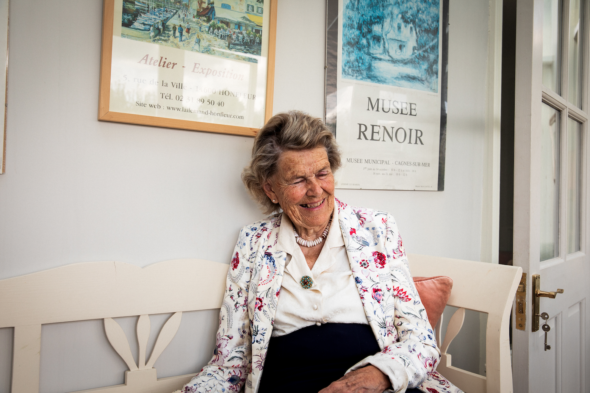
We got a kettle, a roll of Fablon, and found some old tables, and put a sign up saying "coffee and buns"
Listen 00:13:58
Story: Marigold Cleveley - Central LondonStories of volunteers supporting the health service since 1949
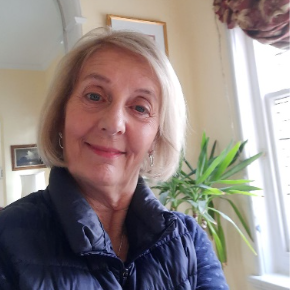
Cynthia Burton - Central London
Returning from time abroad, when getting involved in the community was a part of everyday life, Cynthia found herself with time on her hands. A lifelong supporter of homeopathy meant the League of Friends at the then “Royal London Homeopathic Hospital” was a good place to start.
So there was, you know, an interest for me, as well as perhaps giving time to the hospital.
Cynthia describes being a part of a community, rather than transactional volunteering: a group of people committed to a common cause, or a set of values, as well as developing genuine relationships, and care for each other which extends to genuine support of each other.
Interviewer
Well, good morning. Could I ask your name?
Cynthia Burton
My name is Cynthia Burton.
Interviewer
And which Friends group are we talking about today?
Cynthia Burton
We’re talking about the Friends of the Royal London Hospital for Integrated Medicine, quite a mouthful, and it’s situated in Great Ormond Street.
Interviewer
Excellent. And could I ask how old you are?
Cynthia Burton
I’m 74.
Interviewer
Well, it’s lovely to meet you this morning. So what first inspired you to get involved in Friends groups?
Cynthia Burton
My inspiration came from a friend of mine, who at the time was herself about my age, and she was volunteering at this Hospital in London, which was then called the Royal London Homeopathic Hospital. And she was looking for people to go and help, either in the office, or running the snack bar, or being a trustee. Now, I had recently come back from living abroad, and I had got a bit of time on my hands, and I thought, “Okay, I’ll do this.” But what particularly interested me was the fact that it was the Homeopathic Hospital. And one of my sort of passions in life was complementary medicine, particularly homeopathy. So here was, here was a way in to see how the Hospital worked, and whether I could learn something from it. So there was, you know, an interest for me, as well as perhaps giving time to the Hospital. So along I went, she said, “Well, come along to a meeting or just see how it works.” Went along to the meeting. And somehow before I knew it, I was elected the secretary. It’s like, “Oops, how did that happen?” So I became the paid Secretary, not Honorary Secretary. I was the paid Secretary to do about six hours work a week at the princely sum of six pounds an hour. Wow.
Interviewer
And how long ago with this?
Cynthia Burton
This was in 1992.
Interviewer
Okay.
Cynthia Burton
So I went along every week I did my sort of six hours, and I worked for the Chairman who was called Sir Michael Barralough, who was a Lieutenant Colonel in the Army, who had retired. And I think that happened quite a lot, used to find Chairman were retired military people, who then went on to do good works. So I worked for him, and I became the Secretary, and I attended the meetings, did the minutes and, you know, subscriptions, and that sort of thing, and then helped to manage the snack bar, which we ran upstairs. And that was mostly run by our lovely, my lovely friend, Jane, who sadly died at the age of 101, but was still volunteering up to about a year before she died.
Interviewer
I feel this project has come slightly too late, because we should have interviewed Jane shouldn’t we?
Cynthia Burton
Definitely, she would be loving this. She would, you probably would’ve had about a six hour interview with Jane!
Interviewer
Okay. So, so you start doing this role, and you are, you’re sort of interested in what goes on in the Hospital. Did you know much about volunteering before you went into the Hospital?
Cynthia Burton
Yes, because I had lived abroad with my then husband. Very often, you know, he was the one at work, and I was the one at home looking after the children, albeit abroad. So it was very nice, but you know, ladies who are live abroad often do other, you know, good works, and there were Associations and things to join. And I was part of those. So I was quite used to a sort of volunteering role, and I helped out at our sports club, and the church. So it was sort of just part of my everyday life, really.
Interviewer
I, I think speaking to Fiona Aird, who’s obviously been part of your world as well. I think she described it to me is, “but this is what we are born to do.” And, and I love that sort of sense. This was, it wasn’t something that was a decision, it was just what you did.
Cynthia Burton
Yes, it was. And I understand Fiona, because I know Fiona, she had a particularly big role to play. I mean, mine wasn’t as great as hers, but it was a good role. And I was learning about the Hospital and what it did, and about homeopathy, which I was interested in. So it was a two-way, it was a two-way thing.
Interviewer
And were there lots of sort of active volunteers at that point?
Cynthia Burton
There were quite a number of volunteers who perhaps came from being patients, and then wanted to give something back. There were also, so there was that role where we became trustees, or there was the role where you decided you want to do something practical, and work behind the snack bar. And at that stage we used to have about 20 people working in the snack bar, sort of, there were five days a week, four volunteers a day, two in the morning, and two in the afternoon. And that worked quite well. Sadly, you know, the snack bar is no longer open, because obviously it was closed during lockdown. And quite honestly, I doubt it will ever open again.
Interviewer
That does seem to be a common thread. I have to say. There’s lots that has, has stopped realistically. And people have who perhaps were doing things, have got out of the routine, and are not going to get back into that routine.
Cynthia Burton
But there’s also, as in all other activities, there’s a whole lot more sort of admin, and things that you have to abide to. Whereas we used to get away with our ladies turning up, putting on their own pinafore, you know, washing their hands, they make sandwiches as they would make them at home, you know, spread the butter, put the cheese, make boil the eggs at home, make the eggs… It was as though you were working from home. Now of course health and safety came into factor. They would look around and say, “Oh, you can’t do that. You can’t, oh, you can’t touch them without, you know, you can’t touch money and you know, sandwiches.” And there was a whole lot of restrictions.
Interviewer
I definitely feel that’s changed. Although sometimes…
Cynthia Burton
For the better, you know, often!
Interviewer
Yes, exactly. There’s probably less food poisoning. But, but I, I, I think that one of the things, because the, the reality is that what’s, we’ve been replaced with in those environments is quite often a commercial outlet, you know? A Costa Coffee or whatever.
Cynthia Burton
Costa Coffee, because it makes more money, but it has no heart, it has no soul.
Interviewer
And there, there seem to bit when I talk to Friends groups that actually the volunteers quite often found the time to sit and talk to patients if they needed it.
Cynthia Burton
Tea and sympathy was a big, you know, that was our motto ‘Tea and sympathy’ and people, the patients love to come up, and see the same people all the time and, and, you know, it’s, “oh, well where’s so, and so”, you know, what’s happened to that volunteer? And they were just as much interested in us as we were in them.
Interviewer
And…
Cynthia Burton
And that’s probably, what’s sort of missing nowadays.
Interviewer
But it’s difficult for there to be continuity in many settings, not these because we don’t seem to go in and see anybody anymore. We talked to them on the zoom or on the phone and you know, our whole relationship with the health services changed. Yes. Realistically, I, I often think and I have no real idea what the Homeopathic Hospital was like at that point, but I always think they’re almost like a, a village of their own with their own inhabitants. Oh yes. That you, you get to know people. Yes. So you start off doing six hours a week doing some admin mm-hmm <affirmative> does it stay at that? How does it change?
Cynthia Burton
It certainly increased in hours. I did more hours. I personally became more involved, as I got to know the people, you know, I do sort of work at home. I got to know the, the Trustees of the Friends, as well as the staff. Ah, so suddenly you’ve got a whole new social life mm-hmm because then in those days there would be social events within the Hospital usually, which were funded by the Friends so it’d be Christmas parties, and be quizzes. There’d be, you know, pantomimes. I can remember putting on a, song. We did a song where all the, my volunteers dressed up as the volunteers singing a song at Christmas about, you know, “I like coffee”, you know, “I like tea”, and we made the made up a song, which was nice. So there was a social life, and everybody knew it was a small Hospital.
Cynthia Burton
So everybody knew everybody. There was a canteen upstairs, real old fashioned canteen, you know, roast chicken and potatoes, and sponge and custard. So which the then Chairman, Michael…, he loved, you know, to come up to London, have the meeting go up and have lunch. And, and the other thing that always made me laugh was we used to fund various things in the Hospital, like water fountains, and chairs, simple things. And one of, I always remember was the goldfish. Do you remember most Hospitals would have goldfish tanks. Yes. Soothing, calming. Now, they have obviously a video or something. But no, you had goldfish tank. Now, I don’t know where all these goldfish went to, but every time we had a meeting, we seem to be funding more goldfish. Oh dear, so I think this man would come along every so often, fish out the dead ones, and replace them. But we seem to spend a lot of money on the, on funding goldfish but of course they’ve all gone there.
Interviewer
They were definitely a thing of their time.
Cynthia Burton
Oh yes. Of their time. They were, yes.
Interviewer
Yes. Even in GP surgeries sometimes. Yes. see a goldfish tank. It keeps people sort of occupied while they’re waiting.
Cynthia Burton
Oh yes, Soothing.
Interviewer
Yes, absolutely. Yes. So looking at that, do I understand that there’s been some sort of merger gone on with the Hospitals, and has that affected the Friends groups at all?
Cynthia Burton
Well, it did affect the other groups in London, but the Homeopathic Hospital at the time decided not to join specifically, not to join the Friends of the University College Hospitals, because we felt that our raison d’etre was slightly different. Whereas there they were putting in their money and they were putting it in a pot and spending it on things as they saw fit, we had a specific aim and objective to further and advance homeopathy and complimentary medicine. So our, our aim and objectives were slightly different. So we decided not to join the main group and stay as a separate entity, which I think was right and proper because, you know, we knew that homeopathy was always under attack. You know, from NHS England and the government and everybody else. And of course they have virtually managed to wipe out a lot of the complementary medicines that we were able to supply, which people wanted, but the powers that be decided that they weren’t necessary.
Interviewer
I, I think it’s really interesting because the world, again, as the world is changing, I feel that they’ve taken those issues away. But actually there are more and more people who think they’re important.
Cynthia Burton
Well, they do.
Interviewer
And so they’ve become a part of the self-funded health service haven’t they, That we’ve developed over the years?
Cynthia Burton
Yes. People really loved coming to our hospital. But when they decided, when NHS England decided to stop any form of medicine, homeopathic medicine being paid for by the NHS, it meant that you could go for consultation, but your consultant couldn’t then supply you with the drugs. The homeopathic drugs or whatever he suggested you had to do that privately. So we were really upset by this, and we decided to take NHS England to, you know, to court, which obviously is not something that’s a normal Friends of the Hospital would do, but we did. And we took them to court and we’d had a Judicial Review and unfortunately we lost, but we felt it was necessary to bring, to highlight the fact that people did still want this service that’s unfortunately we, we lost,
Interviewer
But I, I think there is something around everything that Friends group do across the country, which is about sometimes trying to bring the people’s voice forwards when the NHS professionals don’t always quite hear it. Yes. Which isn’t always welcome, but it is something that is important to do.
Cynthia Burton
Well, I think that’s why when Sato joined, Sato, we employed her as a project manager to try and bring, , homeopathy and the Hospital into, the sort of light of the media, so that they could see what we were doing and to get our patients and staff and doctors and the public behind us So she was employed to do that. And it was, it was quite successful, but gradually, as you know, as they NHS came back, and kept on cutting, cutting, cutting back our services, and not re-employ doctors, when they left it gradually diminished to what it is today, which is still an important part of UCLA, but very limited services, very limited access to it.
Interviewer
And, and what does the Friends Group feel like then today? I mean, obviously COVID has affected how lots of things have happened, but how does it feel for the Friends Group today?
Cynthia Burton
It’s sad. Mm-Hmm, <affirmative>, it’s sad because obviously in March, 2020, we had to shut the snack bar because you know, the Hospital said, right, we can’t have it open. So that was it. We probably had maybe eight volunteers who were running the snack bar, but they were very loyal. I mean, all our volunteers who’ve run the snack bar, so loyal and they’ve been coming a long time, very loyal. They were delighted when we had a visit from Her Majesty the Queen in 1999, and there must have been about 12 or 15 volunteers. Then I asked them and they were a bit upset by this. I said, please put on your tabards, blue tartan. So they all stood there with their tabards on and along, came the Queen and smiled at them all.
Interviewer
That’s lovely.
Cynthia Burton
And, and Prince Charles as well, he came and said to the one man who was there, he said, “Oh, and why aren’t you wearing a tabard?”
Interviewer
It’s not a good look for a man.
Cynthia Burton
No, I know
Cynthia Burton
So yes. So it is sad, because now we now longer have really any visible presence in the Hospital, but then that the Hospital stopped having any patients come in, it was all done on the phone, or zoom, or anything. So we weren’t even allowed to go in the Hospital. So we have had all our meetings currently for the last two years, on zoom and we keep going and we have applications from the Hospital for grants for maybe teaching, bit of research, appointment cards, you know, various things that they still, they still know we are around. And obviously we are, you know, quite a nice source of income for projects that aren’t funded by the NHS.
Interviewer
So if somebody was listening to your interview today and they were thinking, we’re sort of a bit like you were, whatever, nearly 30 years ago, thinking, oh, perhaps we might like to volunteer. What would you say to encourage them?
Cynthia Burton
Well, the only real opportunity to volunteer with us is to come on the Board and be a Trustee because there’s no other outlet for us at the moment. So if anyone was interested, we would very much welcome them, and they don’t have to be interested in homeopathy. They might be interested in complementary as a whole. And obviously if they have a background of having had the benefits of homeopathy, that would be great. But we haven’t had a new person on the, on the executive committee for about huh. Five or six years, I should think. Okay. Yes. I mean, Sato came on after being a Project Manager, she then became part of, but we are all sort of likeminded, but yes, I’m sure we would welcome it, but there’s not a lot physically we can do…
Interviewer
So at the moment…
Cynthia Burton
Apart from, supply money!
Interviewer
At the moment we are sort of waiting to see how the world does unfold. And what that does looks like?
Cynthia Burton
Yes. We would like to be able to go back into the Hospital, and have a meetings you know, maybe four times a year, we used to have a meeting and then we would fund a lunch for all the Hospital staff. After one of their governors, they used to have a Governors Meeting, and we would put on a lunch for them. It gave us an opportunity for them to see us, and us to see them. And that was great. But of course, you know, that hasn’t happened. Christmas party, maybe, you know, buy a Christmas tree here or there, in fact, one time at, at Christmas, we always used to have a, a little mini choir singing in the front. You know, the old carols as they came in, rattling the tin.
Interviewer
Yes, Absolutely. So when you were, you knew we were going to be speaking today, Is there anything that you wanted to tell me, that you haven’t had the chance to say yet?
Cynthia Burton
No. I think probably you’ve spoken to other people. Who’ve given you the essence of what we’ve done by way of support for the Hospital. I mean, we’ve done some quite major projects, and we were fortunate back in, I think, 1992 to receive a legacy from a, a happy patient. Okay. Who was a, a, a single lady and she left three quarters of a million
Interviewer
Golly.
Cynthia Burton
To three separate charities. One of whom was us. So we’ve had the benefit of this money, which we’ve carefully put with a Stock broker over those years. And we’ve been able to hand out some quite sizeable sums of money. You know, to the benefit of the Hospital and the people in it.
Interviewer
I’m, I’m always interested that people choose to leave money to the League of Friends. And, my sense is it is because almost, it’s people like them that they trust, and they know that are in the Hospital.
Cynthia Burton
Yes, exactly. Rather than going into a big pot, I don’t think it will happen very much now, because certainly at our Hospital, there are no in-patients. You tend to have perhaps been in Hospital, for a month or two or three months, and then go away feeling very satisfied. But now, you know, you might be in the Hospital for an hour. And I don’t think people have the same feeling about wanting to leave the same big sums of money. Maybe cancer, I mean, you have to have the right cause.
Interviewer
Local hospices and things!
Cynthia Burton
Local hospices, Cancer, Endangered species, Children, but other causes have fallen by the wayside, I think.
Interviewer
I think people certainly of my generation, and definitely younger feel that the NHS is a state responsibility. And so it’s a state’s job to provide it. I think perhaps that’s been shaken up a little bit by COVID, you know, but we need to do a bit more than just bash a saucepan to offer our support. And it will be interesting to see, you know… lots of people also stepped up to volunteer during COVID or put their names forward. At least it’ll be interesting to see how that over the next five years impacts on organisations that volunteer in health. I have to say.
Cynthia Burton
I really think the NHS should actively go out and thank volunteers, because I don’t think they really appreciate how much time, and effort, and that these people who volunteer get from it. No. I mean, there’s, there’s very little recognition. I was used to give our volunteers a certificate at the end of the year. I mean, just printed one from, you know, off the computer, with their name on and you know, ‘you served for another year’, but any, any little thing is appreciated. I mean, they don’t do it for recognition, but they should be perhaps there should be a sort of a national thanking, you know, volunteers day.
Interviewer
There’s a volunteers week!
Cynthia Burton
The volunteers week. Yes.
Interviewer
But the, the other thing as we’re being recorded, I could give a plug for is the Order of Mercy. Now, I don’t know if you’ve come across the Order of Mercy. So the Order of Mercy is a lovely organisation, which gives out about 20 medals a year.
Cynthia Burton
Yes.
Interviewer
Yes. They give them at the Mansion House. It very often has the Lord Mayor, or the Lady Mayoress there, but it’s, it’s a lovely event. And to receive the award, you have to have a minimum of seven years volunteering. Now we’ve got volunteers who can sort of do that plus plus plus. But certainly some Leagues of Friends have, have been very positive. It’s about volunteering in health. So definitely Leagues of Friends. And when it first, it’s a Victorian Order, but when it first restarted, I would guess… 20 plus years ago, nearly all the nominations were from Leagues of Friends. Now we see more local Hospices and that sort of thing. But definitely if there’s people you know, up to, I think potentially you might get one a year through. They’re people, if they’ve got a long history, it’s definitely worth and they make it a lovely event. And I have to say, unlike a National Honour, you do get tea as well.
Cynthia Burton
Well, somebody like Lorna would be a perfect example.
Interviewer
Absolutely. Absolutely. So is there anything else we need to discuss today?
Cynthia Burton
No.
Interviewer
Well, could I say thank you ever so much. It’s been lovely to meet you. Yes. And we look forward to keeping the relationship going. In other ways. Thank you.
Cynthia Burton
Thank you very much, David.
| Contributor: | Cynthia Burton |
| Recorded on: | 14 November 2022 |
| Role: | |
| Setting: | Hospital |
| Organisation: | |
| Hospital: | |
| Location: | |
| Themes: | |
| Decade: |
Listen 00:13:58
Story: Marigold Cleveley - Central LondonListen 00:31:38
Story: Sato Liu - Central London