
Once I got used to the fact I was retired, I then thought it was payback time.
Listen 00:13:40
Story: - North West LondonStories of volunteers supporting the health service since 1949
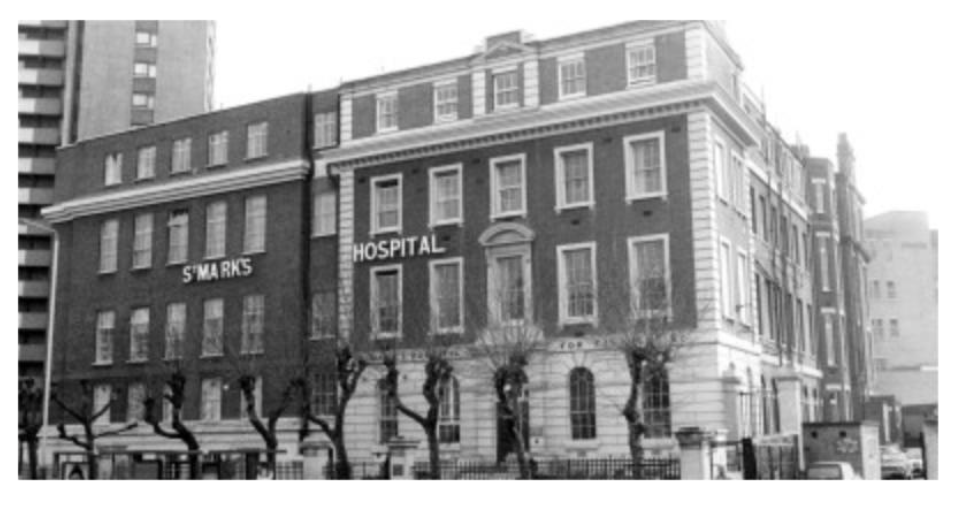
The Friends of St Marks is a group of volunteers who support the work of the hospital in myriad ways. The group began its life as the Samaritan’s Society in 1868, and its remit was ‘for the alleviation of some of the many distresses among the patients for which no provision can be expected to be made in the parent Charity [of the Hospital]’. Initially, the group was mainly comprised of wives of consultants. But over time the group has expanded, and volunteers from all stripes have joined the cause. Through its history the Friends have helped to provide clothing to patients, raise funds for medical equipment, and take patients out for day trips to the seaside. As much as anything, the Friends provide a warm and caring touch to the hospital; a home cooked meal from a volunteer and friendly chat can often make a big difference to patients.
What would one day become St Mark’s was originally established in 1835 as “ The Benevolent Dispensary for the Relief of the Poor Afflicted with Fistula and other Diseases of the Rectum”. It was a pioneering institution: the founder, Frederick Salmon, was an expert in colorectal diseases, and the hospital was one of the first to focus on this specialist area of medicine. As a charity hospital, St Mark’s aimed to treat those who were particularly disadvantaged. This noble project started with 7 beds, and treated 131 patients in its first year.
After three years, the number of patients had tripled, and it was decided that a larger facility was needed to handle the increasing caseload. In 1838 the site was moved to 38 Charter House, creating space for 14 beds and improved facilities for outpatients. The site was also near Smithfield Meat Market, and it is recorded by Frederick Salmon’s family that, rather gruesomely, the original operating table was an old butcher’s slab.
In 1840 a large legacy of £1000 was bestowed to the hospital, allowing them to expand their services by employing more staff. It was also at this time that one of Salmon’s private patients, Charles Dickens, was being treated. He was operated on by Salmon for a fistula, which had been afflicting him ‘for years’ according to his diaries, to the point where he could ‘scarcely bear it’. The treatment was thankfully successful, and in his relief and gratitude Charles Dickens gave 10 guineas to the hospital. He also gifted Salmon several autographed copies of The Pickwick Papers, his latest work.
Through the 1840’s the hospital’s increased renown and increased demand led them to look for an even larger facility. The proposed site was on City Road, in the parish of St Mark’s Church. In 1851 the hospital then became St Mark’s Hospital for Fistula and other Diseases of the Rectum or, for short, St Mark’s. This was in part because it was easier to appeal for funds under this name as opposed to the ‘Fistula Infirmary’, and this was certainly a factor that came into consideration as the hospital’s debt grew.
Following the opening of the new facility, financial troubles continued to plague the hospital, and even with generous patronages from 1000 supporters (including Prince Albert) the hospital was still struggling to make up the running costs of £2000 per annum. The advent of the Samaritan Society in 1868, the forerunner to the League of Friends, couldn’t have come at a better time. The group helped to fill gaps in the funding and support patients and their carers, raising money towards the costs of food, clothing, and equipment.
By 1885, Samaritan’s fund was in full swing. It was suggested that ‘well-to-do patients who may be sent to the beds at the seaside may, if able, pay 5/- per week, such payment to go to the credit of the Samaritans Fund’. The money was used to buy jackets for the female patients, and the matron was instructed to give 5/- to any patient leaving the hospital who needed it.
In the late 19th and early 20th century, cancer care became an increasingly important part of St Mark’s work. In 1909, it had become such a specialty that the hospital was renamed ‘St Mark’s Hospital for Cancer, Fistula and other Diseases of the Rectum’. The surgeon Mr Lockhart-Mummery, who joined the hospital at the turn of the century, was a leading figure in the establishment of the British Empire Cancer Campaign. This charity, as well as the Imperial Cancer Research Fund, were significant contributors to the hospital and its work, and maintain close links to the institution to this day.
Though the hospital managed to hold strong during the first world war, it suffered during the second: there were staff shortages, incendiary devices, and in 1944 a bomb fell through the nurses’ home. It was following the war in 1948 that the NHS was established. The Minister for Health and pioneer of the NHS, Aneurin Bevan, was himself treated at St Mark’s years prior, and is quoted as saying that the hospital should be a ‘crown jewel’ in the new health service. In 1949, the administration of the Samaritans Fund was passed to the Ladies Association.
The pioneering reputation in the field of colorectal diseases only increased in the following decades, and many new techniques used to treat cancer, colitis, and Crohn’s have all developed from St Mark’s work. In 1986 the Imperial Cancer Research Fund established two units at St Mark’s, the Colorectal Cancer Unit and Nuclear Medicine Unit. It was at this time too that, in 1971, the Ladies Association was officially renamed the Friends of St Mark’s.
By 1989, it was clear that the hospital was going to need a different site if it was going to continue and expand. In 1995, St Mark’s merged and joined sites with the Northwick Park Hospital in Harrow, and its international reputation in the domain of intestinal and colorectal medicine remains. The League of Friends too, have continued their work. Since the move, the Friends established a garden as a retreat for patients and staff, set up a tea bar, and financed artwork for the hospital. Though the recent move of patients to Central Middlesex Hospital presents new challenges, the Friends still aim to create a homely place in which to heal.
Listen 00:13:40
Story: - North West London
Listen 00:11:53
Story: Helen Shorter - London
Listen 00:12:55
Story: Pat Moreno - North West London, Stanmore