
Once I got used to the fact I was retired, I then thought it was payback time.
Listen 00:13:40
Story: - North West LondonStories of volunteers supporting the health service since 1949

Helen Shorter - London
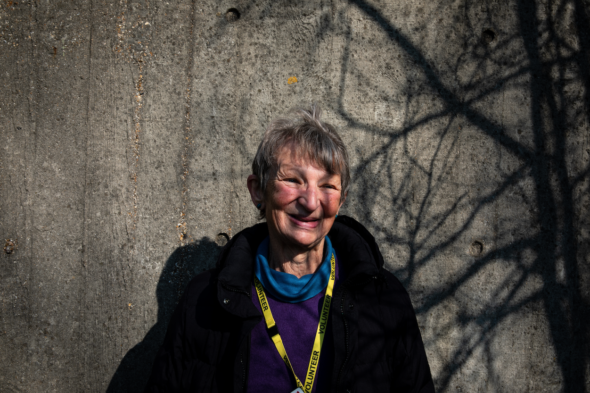
When recently retired, Helen was doing a neighbours garden when a friend asked her to volunteer with the Friends. That was over 20 years ago, during which time supporting the NHS has become a significant part of Helen’s life.
I’d finished work, and I chose the hospital because I thought it was different, and there’s lots of different things I could do there.
Helen is justifiably proud of the specialist work that St Marks has an international reputation for, and also the ways in which the Friends are able to help the patients.
Interviewer:
Hello, lovely to meet you. Could I ask your name?
Helen Shorter:
Helen Shorter
Interviewer:
And which friends group you’re involved in Helen. And could I ask your age?
Helen Shorter:
78.
Interviewer:
Thank you ever so much. So what first inspired you to get involved in the friends group?
Helen Shorter:
I chose the hospital when I finished work, but I actually, and I did three different things there, and one of them was the Friends because my neighbour over the road, saw me doing another neighbor’s garden and discovered I wasn’t working anymore. So she, she got me in and I started off as secretary.
Interviewer:
And had you done secretarial work, or was this a completely new thing to you?
Helen Shorter:
Transferable skills, but I’ve never been a secretary, no.
Interviewer:
And had you volunteered at all before you finish work or was this a new adventure for you?
Helen Shorter:
I’ve done one or two things. I used to have students come. It was an international charity called Host. I can’t remember exactly. I mean, it’s a long time ago.
Interviewer:
Absolutely. So I’m guessing that you retired what, 18 years ago or so?
Helen Shorter:
I started with the Friends in the Autumn of 2000, and I finished work in the spring of 2000.
Interviewer:
Okay. What was it that attracted you specifically that the Friends were doing that you thought, “oh, yes, I can help.” Or was it literally the secretarial work? That was the draw?
Helen Shorter:
As far as the friends go, rather than the Trust or the Northwick Park League of Friends, my neighbour over the road said something or other about a secretary, and I said, oh, “agenda and minutes. I can do that.” Which is true. So it wasn’t, I didn’t really know anything about the Friends.
Interviewer:
But you, you say you were doing two other things at the hospital. At the same time?
Helen Shorter:
I was doing the shop trolley for the Northwick Park League of Friends. And I could have got headhunted to there, but they lost out. They were too slow. At the Northwick, I was asked to do the book trolley, which I did for a year and a half. That was for the Trust. But I mean, when I finished work, I had a lot more energy.
Interviewer:
Well, it sounds like that you managed to fit in quite a lot of things, I have to say,
Helen Shorter:
Well, I’d been working full-time so…
Interviewer:
And what, what drew you to volunteering? Was it something about the NHS that drew you to all of those different opportunities or?
Helen Shorter:
I knew I didn’t want to sit at home on my backside because I’d finished work, and I chose the hospital because I thought it was different, and there’d be a lot of different things I could do there, and I can get there. Well, I can walk there in half an hour or less. So it was convenient. Something where I wouldn’t have, oh, I can’t come in today, if you know if the weather is bad or what.
Interviewer:
So it sounds like you got really quite involved in the life of the hospital?
Helen Shorter:
To some degree. Yes. It’s very complicated.
Interviewer:
Absolutely. And do you have a favorite memory of being part of the friends group?
Helen Shorter:
I was thinking about today and I thought about a couple of things. I used to go around the wards with a trolley, with a committee member and in one of the full bed bays, a man beckoned me over, and he was sort of pulling down his leggings a bit and I was slightly dubious, but I wasn’t on my own. And he wanted to show me that where his stoma was, he had tattooed St Mark’s, because he wanted to make quite sure anytime he was taken ill, that he got taken to the right hospital. I thought that was lovely. He was a very nice man. I mean, I knew another man who was a Northwick Park patient, he did the shop trolley for the Northwick Park League, And his wife drove like mad across London because he was taken ill, but he knew where he wanted to go. Yes, no, very nice people, very nice patients, lots of stories.
Interviewer:
Another one perhaps?
Helen Shorter:
There was a woman who was operated on somewhere on the south coast and the surgeon messed her up or some of the other patients, and she was going to complain to the GMC. So she got sent up to London, and the London Hospital couldn’t deal with it. And they sent her onto St. Mark’s in a taxi, and the taxi driver was no help. And she was too ill, very unfortunate experience and apparently St. Mark’s, phoned up the other hospital and blew them up. But it just, it just showed the importance of… I didn’t understand when they said it was, tertiary referral? I mean, somebody locally apparently, they got crowd funding or something, and went all the way to America, and when they got to America, they said, “oh, you know, well, you should really be at the hospital up the road, St. Mark’s.” So it really is special. I’m glad that was the one I got involved with, because it’s a lot more complicated, and alot more interesting and very rewarding too.
Interviewer:
And so you’ve seen, as you say, over, over 20 years been involved in the friends group and one imagines, it must’ve changed quite a bit. How would you see the friends group is being different today?
Helen Shorter:
Well, for one thing in the committee members and for another thing in the activities. When you get this attachment, it used to be consultants wives were expected to join the committee and nowadays consultants wives are out busy getting another job and so on. And when I took over secretary Yanina was on the committee, I think for 26 years altogether. And she was the last consultant’s wife. So mostly nowadays the composition is more ex-staff. So it, must be about 9 or 10 of us, and 3 are local people and the rest are Ex-Staff and the activities, I mean, the artworks gone,it’s difficult to remember, so much has changed with the virus that it’s difficult to even remember what we used to do. I mean, at one time, it’s a lousy constitution. And at one time we used to fund, I think they called Toronto exchanges. You know help with staffs education, but funds, I mean we don’t do that kind of thing anymore. We just concentrate mostly on, on helping patients. It’s difficult to get a perspective.
Interviewer:
No, well, and I think we are talking at a point for many Leagues of Friends where they’re trying to work out what the future might look like and what, what the whole break, I suppose, that COVID has enabled us to do is to actually sit back and take stock and decide, well, what would we like to do rather than just carry on doing
Helen Shorter:
Interesting. You’ve got an overview that I obviously haven’t got. That’s interesting.
Interviewer:
Certainly I think that there are many friends groups that I’m speaking to. I was speaking to a conference down in South Wales recently. I was at Bart’s only less than a week ago now. And it feels like it’s a really good opportunity to decide what the “best differences” are that we can make in the hospital and what they really need us for. So if you’re out doing your gardening now, and one of your neighbors said to you, oh, where’d you volunteer? What you do? What would you say to encourage them to get involved in the Friends Group?
Helen Shorter:
Say how much you get back for it. You can actually see the result. You can see the patients on the ward, you hear about the stories of what they need and whatever you do as far as volunteering goes, we’ll end up with, with helping those patients. I mean, say, say there’s a patient with Crohn’s disease, who keeps getting leaks. I mean, they need a new mattress, new washing machine, it’s practical help. So you raise money or you, you actually go and see them to find out.
Interviewer:
So in your view, there very much still is a contribution that could be made by Friends today?
Helen Shorter:
Yes.
Interviewer:
Excellent. Thank you. So when you were thinking about this, was there anything else that you thought you might to tell us about that I haven’t given you the chance to say?
Helen Shorter:
No.
Helen Shorter:
It’s just such a change. I mean, we can’t go and see patients. I haven’t, I’ve only been to Central Middlesex once and I don’t know when we’re going to be able to. I mean, the problem we’ve got is that the staff have been so preoccupied with the move, which must be a big change. They’ve only just started putting in requests for help. I mean, we have asked them, I’m only risk assessed to go office work, but I, I mean, I don’t think I’d be allowed to go near anything anyway with the virus, so all we can do is email. All right, we need to fundraise, but we need to be asked more for, you know, give us some money for this, that and the other.
Interviewer:
So it’s about raising the profile again that you’re still there?
Helen Shorter:
Yes, yes. And communication? Yes.
Interviewer:
Okay. Well, I, I think I understand that, again I was at a meeting, a Friends group that actually, I’m involved in practically and a member of staff came up to me yesterday when I was there. And she said, we did wonder if you were going to come back? And I think there is probably that thoughts people’s minds, are they going to come back? But what I say, what I see in you is not somebody quite yet, who’s ready to give up. You look like you’ve still got a bit of go in you. And so I think in terms of the patients, I’m sure they very much would appreciate it, if we can get something back up and running.
Helen Shorter:
I’m planning on February.
Interviewer:
Okay.
Helen Shorter:
I think, I think it’s been a problem that I tried to resist, being a perfectionist, but I’ve done, I’ve kind of done everything, Gillian had to leave off when her husband was ill, the one before left suddenly, and I ended up doing the lot and they, the, we need a handover period. I don’t know if you’d be interested we’re having a zoom AGM on the 1st of December. So I’ve got loads of emails about it, slightly dreading it, but I think, it will be 22 years. I think that’s time enough. And I don’t have much energy and Trish…Things will change, but some things she’s picking up very quickly and she’s great. I’m so pleased. We’ve got her, we’re very lucky, finding a chairperson is always very difficult.
Interviewer:
Absolutely. As far as I’m concerned, I’ve really, really enjoyed meeting you, Helen. So thank you ever so much. And do feel free now that we’ve had this bit of a dialogue and keep in touch? Thank you ever so much. Thank you for being prepared to stand up for this. And we look forward to catching up with you again soon.
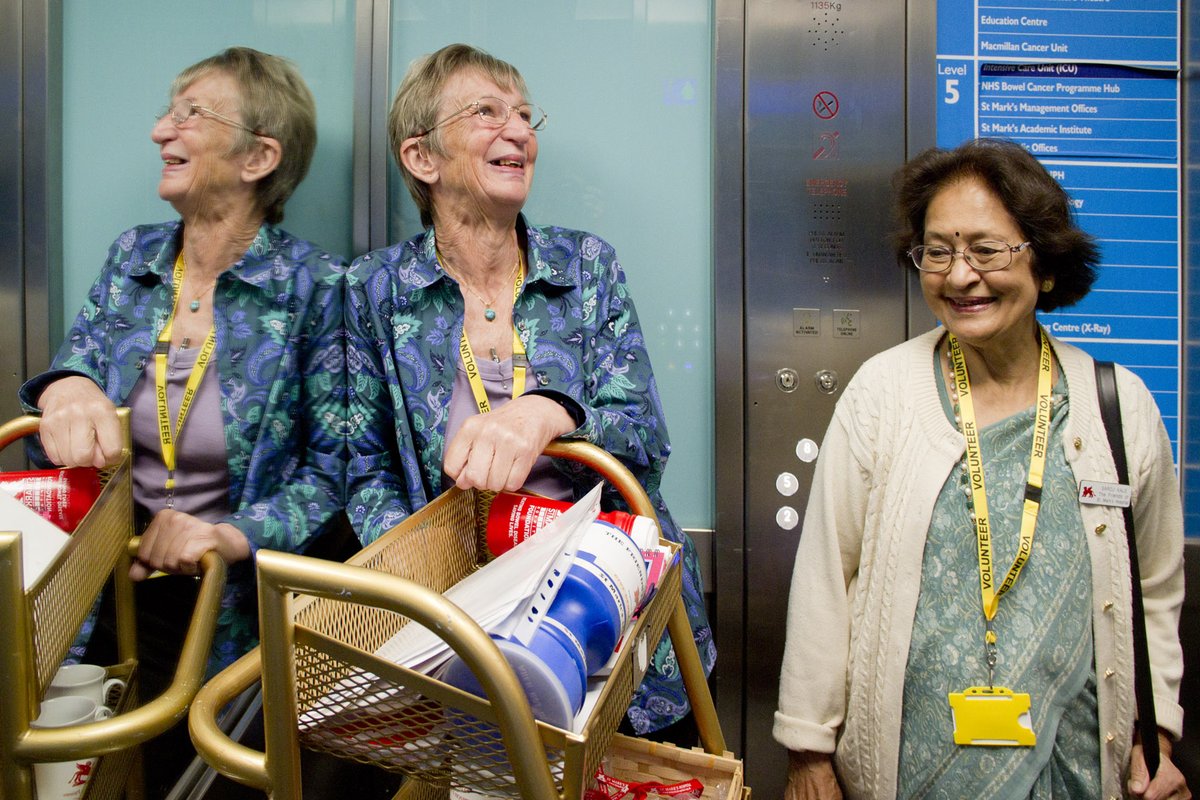
| Contributor: | Helen Shorter |
| Recorded on: | 21 January 2022 |
| Role: | |
| Setting: | Hospital |
| Organisation: | |
| Hospital: | |
| Location: | |
| Themes: | |
| Decade: |
Listen 00:13:40
Story: - North West London
The Friends of St Marks is a group of volunteers who support the work of the hospital in myriad ways. The group began its life as the Samaritan’s Society in 1868, and its remit was ‘for the alleviation of some of the many distresses among the patients for which no provision can be expected to be made in the parent Charity [of the Hospital]’.
Listen 00:12:55
Story: Pat Moreno - North West London, Stanmore