
Living locally and receiving superb treatment at the Hospital, Jenny felt that volunteering with the League was a good way of saying thank you for the care she received.
Listen 00:06:15
Story: Jenny Davies - ShrewsburyStories of volunteers supporting the health service since 1949
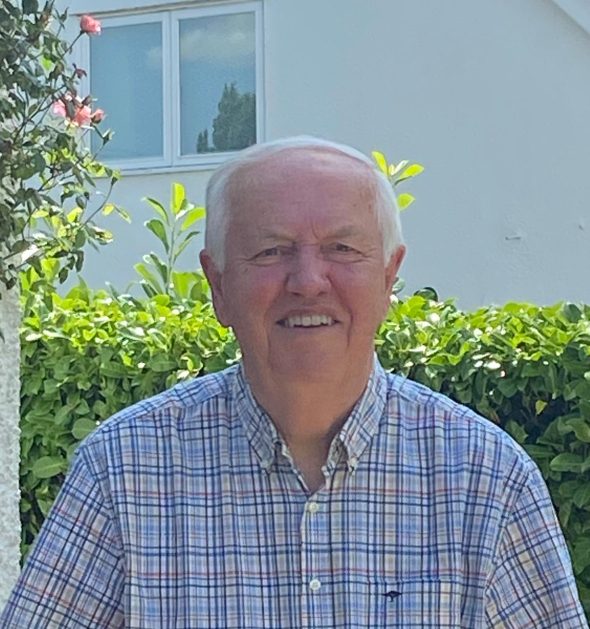
James Hodgson - Shrewsbury, Shropshire
James Hodgson has been involved with the League of Friends of the Royal Shrewsbury Hospital for nearly 50 years, serving as treasurer from 1975-1987. Over the years, the organisation expanded, opening multiple outlets and raising significant funds, contributing nearly £1 million annually before COVID-19. James highlights the challenges of maintaining the organisation volunteers and training from cash to card payments. A key memory for him was receiving the Queen’s Award for community service. He expresses concern about the decreasing number of volunteers, but remains optimistic about the organisation’s future.
Interviewer:
Could we start by me asking you your name?
James Hodgeson:
My name is James Hodgson.
Interviewer:
And could I ask which League of Friends we’re talking about today?
James Hodgeson:
I’ve been a member of the League of Friends of the Royal Shrewsbury Hospital for nearly 50 years.
Interviewer:
And could I ask how old you are?
James Hodgeson:
Just turned 79.
Interviewer:
So interestingly for me in that story, you started quite young, you know when you got involved 50 years ago?
James Hodgeson:
Yes, I was a partner in a local firm of Chartered Accountants and obviously knew quite a few people in the town, and members of the League of Friends Committee. And I was approached by, I think the Chairman at the time, would I be interested in becoming Honorary Treasurer. And that’s, that’s how I came to join the League.
Interviewer:
And had you been involved in any volunteering or anything before that or was this your first go volunteering?
James Hodgeson:
Mainly the first major one I got involved with. But I’ve been interested in various other charitable organisations within Shrewsbury.
Interviewer:
So, they invite you to become Treasurer. Tell me, what was the League of Friends like 50 years ago?
James Hodgeson:
Well, I was Treasurer from 1975 to 1987, which was a long time ago. And at that time when I first joined, the hospital was across the road from where it is now. Soon after I joined, the new Royal Shrewsbury Hospital was built, and the first shop opened in 1971. I think the takings on that day were 28 pounds. Since then, they have risen to pre covid, they got to nearly one million pounds, because in the meantime with the new hospital, we actually opened four outlets, three sort of coffee type restaurant type outlets. And it also had a shop as well. And the turnover in I think 2019 pre covid was just short of a million, which is huge.
Interviewer:
So, what I’m thinking is, you’ve got this big business realistically, so how are you managing that? Is that all with volunteers or would you have paid staff or how does that work?
James Hodgeson:
When I first started, the number of volunteers rose over the years, and I think with the four outlets, we were up to about nearly 200 volunteers. It’s not the same now though, it’s much different. Not as easy to get a hold of volunteers as is the case with a whole load of charitable organisations. I think we’re down to about 70, plus paid help, to run the shops.
Interviewer:
I’m thinking that probably from your early days to your million-pound turnout, we must have done lots of transitions from sort of cash transactions to more credit card transactions, or how’s that worked for you as an organisation?
James Hodgeson:
It’s been mainly cash up to about the last five years that we’ve gone to offering a card payment basis. But that is now becoming how majority of how people pay for their goods. I experienced that on another company that I’m involved with. They were transferring from cash to card. You know, it’s a changing society.
Interviewer:
Absolutely. So, when you were taking a million pounds a year in cash, how did that work? Did you have volunteers who did banking, or did it go through the hospital, or how did that work?
James Hodgeson:
Well, we’ve always had a full-time manager for the four outlets, and he was obviously assisted by a cashier to help out with the accounting of the cash. And we also had somebody else who went and banked. So that helped enormously. We’ve also got the Treasurer doing his work as well in the background, collating all the information for the preparation of monthly figures to the Executive Committee and obviously, annually preparing the accounts ready for checking by the accountant and the auditors.
Interviewer:
So, we’ve got a massive turnover from shop as Treasurer. Was there a lot of fundraising going on in other ways?
James Hodgeson:
Well, beside the Treasurer, we have always had the Executive Committee and then we’ve had a shop committee, a fundraising committee, and marketing committees as well. Subcommittee fundraising side has been fantastic as well. Income had been generated in the cafes and the shop, I think we raise about 40,000 pounds a year or more in fundraising activity. I think it was when it was pre-Covid, the net profit from the shops was about 167,000 pounds. So, if you add the fundraising net profit, we were generating quite a bit of income each year. The benefit of having the shops is that the actual people who use it, the patients and their family, they found the service benefited greatly from some substantial legacy over the years. I can remember when I was Chairman, I got called by somebody from Ludlow, which is about 25 miles away. I went along to see the solicitor with the local League of Friends from Ludlow. There was a lady who said “Well, regretfully one of our clients has died, and she’s left a will, she’s left monies to each of the League of Friends and I’m just really having you in to make sure it’s going to be spent wisely.” I said to her, “Well that’s great, what sort of legacy is it?” She said, “You’ll be having about 400,000 pounds each.” That’s the beauty of the service that we give to the patient. It’s the reward we get back.
Interviewer:
And why do you think people might choose to leave money to, say, the League of Friends as opposed to anybody else?
James Hodgeson:
I think most of the people who leave it, have regretfully little family or nobody to leave it to. They’ve just been in hospital, maybe a few times, and had the comfort and support. We used to have a trolley service as well. I think they just felt what a marvellous organisation it was, trying to support the patients and staff at the hospital.
Interviewer:
No, I agree. I think they trust the League of Friends; they feel that they’ll spend it on things that they might have been happy to fund themselves?
James Hodgeson:
I mean over the 50 years that I’ve been involved; I think Royal Shrewsbury Hospital League of Friends donated equipment and to other buildings that are needed for staff and update close 10 million pounds.
Interviewer:
That’s very commendable and also makes a substantial difference to the local hospital, doesn’t it?
James Hodgeson:
Well absolutely. I mean, I’ve always keep saying at the meetings when it comes up for requests from the hospital, “Is it going to be up to date?” So, we can give patients the best equipment to try and treat them, and be of benefit to the doctors and surgeons.
Interviewer:
So, do you think what’s required of the League of Friends, today is different to what was required of the League of Friends, say nearly 50 years ago?
James Hodgeson:
I don’t think it’s a great deal of difference, because I think at the end of the day, the aim of the League is, to provide the benefit in the most up-to-date equipment and service through the shop. I don’t think it’s changed. The actual manner of making the grants maybe changed because, I have to say over the 50 years, it’s the bureaucracy within the NHS unfortunately that makes decision-making quite painful at times.
Interviewer:
Yes. It can be a lengthy process to get something.
James Hodgeson:
Absolutely.
Interviewer:
And do you have any particular favourite memory of your time at the League of Friends?
James Hodgeson:
Well, I think when I was Chairman, I was very pleased. The League was awarded the Queen’s Award for Community Service. I think there’s only 100 awards given each year. I thought the League was really deserving of that award. That was a highlight during my time as Chairman.
Interviewer:
That is a fantastic achievement. Does that the Lord Lieutenant come and do that?
James Hodgeson:
Yes. It’s put forward by the Lord Lieutenant. We’ve had some tremendous campaigns. We’ve raised a million pounds or more for ultrasound and, the latest equipment. I always remember you said your offices are at the King’s Fund in Cavendish Square. I always remember, we once had a campaign to fund 100 King’s Funds’ beds at Shrewsbury Hospital. It was just the right amount for them to raise to fund one of those beds. We achieved success in that very quickly, in obtaining funding for 100 Kings Funds’ beds at the hospital.
Interviewer:
That’s fantastic. Now, when you knew we were coming today, is there anything that you thought you might want to tell us, you haven’t had the chance to say yet?
James Hodgeson:
You talked about volunteers. It is becoming increasingly difficult now to obtain volunteers. I don’t know whether it’s the society we live in, but it’s the same for all other charity organisations. That does concern me a bit because, you know, we need volunteers to help us run the cafes and the shop. The actual aim of the League is still there. And let’s hope it continues.
Interviewer:
I’m sure it will. Thank you very much.
| Contributor: | James Hodgson |
| Recorded on: | 28 October 2024 |
| Role: | |
| Setting: | Hospital |
| Organisation: | |
| Hospital: | |
| Location: | |
| Themes: | |
| Decade: |
Listen 00:06:15
Story: Jenny Davies - Shrewsbury
Listen 00:08:56
Story: Richard Steventon - ShrewsburyListen 08.43
Story: Sally Davies - Shrewsbury, Shropshire
Listen 00:14:33
Story: Jayne Mott - Shrewsbury, Shropshire
Listen 00:14:20
Story: June Whitaker - Shrewsbury, Shropshire