
Living locally and receiving superb treatment at the Hospital, Jenny felt that volunteering with the Friends was a good way of saying thank you for the care she received.
Listen 00:06:15
Story: Jenny Davies - ShrewsburyStories of volunteers supporting the health service since 1949
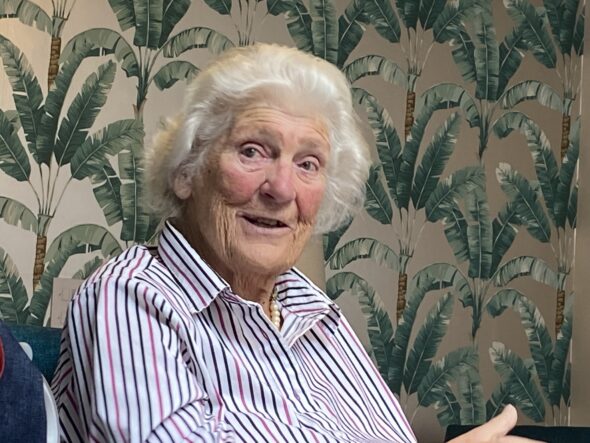
June Whitaker - Shrewsbury, Shropshire
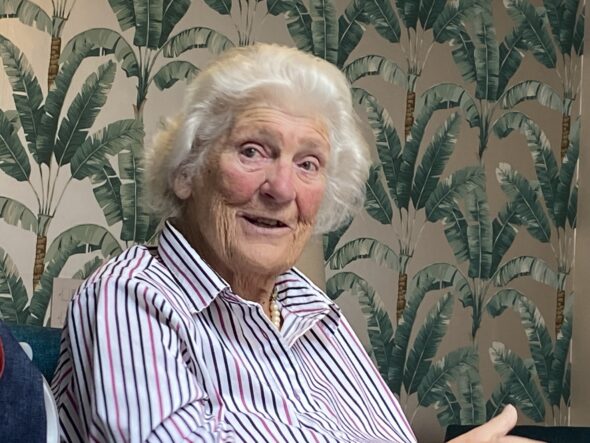
Being part of the local community, supporting charities that help people who live round and about are all part of the values that June has lived her life by.
For over 50 years, June has been involved in the Friends (and many other charities). Being involved means everything from hosting events, opening up the grounds of her home, and attending fundraising functions. It means being President, Chair, Committee Member or supporter.
Interviewer
So first of all, could we start with your name?
June Whitaker
My name is June Whitaker.
Interviewer
And could I ask which friends group you have been involved in?
June Whitaker
I’ve been involved for over 50 years with the Shrewsbury Hospital League of Friends,
June Whitaker
Royal Shrewsbury Hospital League of Friends.
Interviewer
Thank you. And could I ask how old you are?
June Whitaker
I’m 88.
Interviewer
Excellent. And looking fantastic I have to say.
June Whitaker
<Laugh>.
Interviewer
So first of all, I’m really interested in what inspired you to get involved in a friends group in the first place, 50 odd years ago?
June Whitaker
Well, my husband and I moved back to Shropshire and a friend of my mother-in-law said, “I hear you are on all sorts of charity committees in Shropshire. You really ought to be on the League of Friends. It’s the most important charity in Shropshire.”, I didn’t know anything about the League of Friends at all. So I joined, and that was over 50 years ago. And I now realise how important the League of Friends are to all the hospitals.
Interviewer
So my experience of League of Friends is they take on very different forms. What did the League of Friends do 50 years ago?
June Whitaker
Well, 50 years ago it was a very small group of people and they literally just had coffee mornings and a Christmas fair, and a summer fair. It was all very low key. Now it’s very high powered. We make hundreds of thousands of pounds and we spend hundreds of thousands of pounds. In fact, we bought a scanner for a million pounds, two years ago. And the local community know that if they give us money, the money goes immediately for projects, and does not go for administration because we have four shops in the hospital. And I believe it’s the only hospital in the country that has four shops and the profits from the shops pay for our administration. And we still have at least £30,000 left over from that to go for projects too.
Interviewer
So I’ve heard that you did a lot of fundraising in the early days. It was mainly about fundraising to buy pieces of equipment. Nowadays we hear a lot about people practically volunteering. Do, does your League of Friends do, sort of have volunteers doing things, or is it mainly running the shop and fundraising?
June Whitaker
To be absolutely honest, since Covid, it’s rather curbed our freedom to go around the hospital. And the only contact we have with people now is when they come to our shops and the, we have volunteers in all the shops, but we also have to have paid staff to supervise because we’re dealing with complicated tills, and rotation of food, and orders of food. So each shop has to have a paid person for the shift and then they have two or three volunteers too.
Interviewer
Excellent. So clearly you’ve been involved for a long time, but equally I can remember reading a, a write-up that you have quite a lot of younger volunteers at Shrewsbury as well?
June Whitaker
We do. I don’t think we’ve got nearly as many as we would like, and I think that’s all over the country now. But we’ve got some wonderful young people who really do work hard, but it’s getting increasingly difficult. Yes, we used to originally attract young wives of about 30ish, which was terrific, but now those young wives of 30ish have all got jobs, and it’s very difficult to find young people. So it’s normally sort of retired age at about 60, and we’ve got a lot. And my goodness, they’re good.
Interviewer
They certainly, I think ‘old age’ seems to be sort of being pushed up and up. And so that sort of active age, there are more and more people who, who can put in quite physically demanding efforts into things. So that’s great to hear. Thinking about all of the things that you’ve been involved in, I know that you’ve used your own home as part of that. So can you tell me a bit about how you’ve used your home and the events that you hold there?
June Whitaker
Yes. Well we have a county organisation in structure, which involves, I think sadly now only nine Leagues of Friends in each little market town. We used to have 12, but they’ve all fizzled out and their hospitals have closed. And we meet in the Spring in one of the acute hospitals, and then we meet again in the Autumn in another hospital. And then in June or July, we have a bring and share lunch at my home. I happened to marry a chap with a big house and we put it to use, so all the Leagues of Friends from over the county, whether they bring two people or 10, bring enough main course salad and pudding for the number of people. And we have a bar, and we have a raffle. But the whole point is that we all meet up in a social meeting
Interviewer
And I have a sense that you become more than just fundraisers for a hospital, and you become a community together of people?
June Whitaker
Yes, I think all of the Leagues of Friends are a community for the people. Okay. I really do. And they work jolly hard. I wish we could get more people.
Interviewer
Absolutely.
June Whitaker
It’s very sad because it’s very satisfying when you know that what efforts you are putting in to raising money. You actually have a choice with the League of Friends. When you have your money, you control it, and you don’t have to send it, like most charities send their money up to London, to Head Office. The League of Friends does not. We are all independent and we raise our money for our hospital. So it’s very important that the people in the County support things because they’re going to benefit.
Interviewer
So do you think there’s still a need for Friends Groups today?
June Whitaker
Oh, definitely. Definitely. But not in the way we started out where we went round the wards and we took trolleys around the wards. And when you knew the patients, and you knew the staff, now all that’s gone since covid. Okay. The library’s gone. We used to take a mobile library round it. Very sad.
Interviewer
Okay.
June Whitaker
Very sad.
Interviewer
But there’s still in need for fundraising?
June Whitaker
Oh goodness me. More so than ever.
Interviewer
And if there’s somebody listening to this today, who lives locally, and has never thought about volunteering, what would you say to encourage them?
June Whitaker
Very difficult. I mean, I, I’m so enthusiastic about this charity because I think it, wherever you live, I think it is the most important charity in your county because you make the money, you control it, and you decide how it’s spent, and we’re all going to get old, and we’re all going to need hospitals, and we’re all going to need all sorts of things. And the National Health can’t afford half the equipment that we bought. So it’s terribly important that we can do these things.
Interviewer
Okay. Is there anything that you feel that you particularly want to tell me that you haven’t had the chance to say yet?
June Whitaker
No. Did I stress the importance that we supported a local charity?
Interviewer
Yes you did. You did really well.
June Whitaker
I do feel really strongly about this.
Interviewer
I, I loved the way that actually you emphasised that the money doesn’t go to London, that people are controlling because that’s the difference between us, RVS, all of you know…
June Whitaker
Well, I was on the St. John Council
Interviewer
Right.
June Whitaker
And I was President of the NSPCC, and I’ve been in involved with all sorts of charities, and I’m not now because I don’t like raising money to go to London. No, you don’t know who’s using it.
Interviewer
Well, we do know who’s using it.
June Whitaker
And you have a successful lead making lots of money, and then you have one that’s can’t be bothered, you know? Yes, And when you do these things, I mean, actually what I really love is when we buy things and then we go to the presentation, and it’s really satisfying. And the staff are always thrilled. We’ve just re kitted out the Ophthalmology unit and we’ve, I can’t remember how many hundred thousands we’ve ploughed in, but the equipment there and the staff come up to you and say, “gosh, you know, I can’t tell you how happy we are. We’ve got everything we need.”, And it’s all from us. It’s really, it’s quite, it’s good. You feel good.
Interviewer
And you had Baroness Finlay here last year?
June Whitaker
I did indeed. And now this is a lovely story. I asked her if she could come again, or you, through you and the message came back that her husband wasn’t very well or something. And she didn’t want to do the driving. “Oh, I thought, now who can I ask?” Ah, the new High Sheriff, whom I know, I don’t know intimately, but she’s been a chum of mine for many years, I thought, “Right.” So I said to Jane Mott, who’s my Chairman of the Shropshire Leagues, “Would you phone up Mandy, and ask if she’ll be our guest of honour at the lunch at Winsley on the 4th of July?”. Which she did. And Mandy said she would love to come. Super, all fixed. Then of course I go into hospital, get this diagnosis, no way can I have the lunch. So I phoned up Jane the my Chairman and said, “Look, it’s all a no go I’m afraid.”
June Whitaker
“You’ve got to cancel it.”, “Oh”, she said, I said, “I’m really sorry.”, She said, “well, surely you’ll be well enough?”, And I said, “Well actually Jane, I won’t I, I’ve got terminal cancer. I don’t know how long I’ve got and there’s certainly no way that I’m going to be there. You better phone Mandy, the High Sheriff immediately and tell her, because they have a very busy season.” Anyway, Jane got back to me and she said, “June, you’ll never believe this.”, I said, “Come on Jane, tell me.” She said, “Well, I phoned Mandy and I told her that you would not be able to hold the lunch. And there was a long pause and she said, well, I’ll hold it at my house!” And Jane said, “what? You know, it’s quite a lot of work because you have all the china, and the plates, and the cutlery, and the glasses with a bar. It’s a hell of a lot of work.” And she said, my project for the year as High Sherriff is volunteering.” And she said, “It’ll be a wonderful project for me.”
Interviewer
Okay. How lovely is that?
June Whitaker
Absolutely wonderful. And furthermore, the next thing is she’s got the Lord Lieutenant. Isn’t that great?
Interviewer
It’s really great.
June Whitaker
Absolutely. Super. I’m so thrilled. I thought really lovely. I was very upset that I wouldn’t be holding it. I’ve had lots of lovely cards from people saying, “Oh, I’m so sorry. We did love coming.”, But they’ve got a good, High Sherriff, so that was good luck.
Interviewer
Absolutely. Well, luck? I think it’s a lot to do with who you are actually, that you’ve encouraged it.
| Contributor: | June Whitaker |
| Recorded on: | 10 April 2024 |
| Role: | |
| Setting: | Hospital |
| Organisation: | |
| Hospital: | |
| Location: | |
| Themes: | |
| Decade: |
Listen 00:06:15
Story: Jenny Davies - Shrewsbury
Listen 00:08:56
Story: Richard Steventon - Shrewsbury
Listen 08.43
Story: Sally Davies - Shrewsbury, Shropshire
Listen 00:14:33
Story: Jayne Mott - Shrewsbury, Shropshire
Listen 00:10:09
Story: James Hodgson - Shrewsbury, Shropshire