
Charitable, witty and courageous, and she didn't mince her words!
Listen 00:09:20
Story: Connie Foster, Sue Boram - Barking, East LondonStories of volunteers supporting the health service since 1949
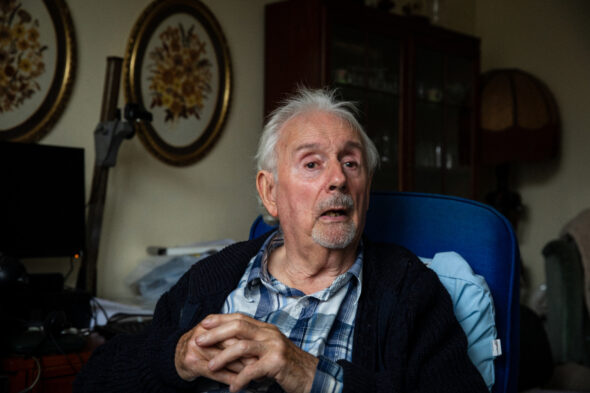
Eric Feasey - Barking, East London
Eric has been involved with the Friends of Barking Hospital for a decade. Describing himself as a bit of a “Del boy” he initially began by helping supply stock for the Friends table sales, with up to 10 trestle tables, that took place every week in the entrance area of the hospital.
It was a real family enterprise, with his wife volunteering for the friends too.
Helping wherever he could, that fitted around his work as a builder, one of the key volunteering roles Eric took was as Father Christmas every year.
…and this little girl has put this little toy on top of the radiator. And she’s given it a kiss. I felt like I was the real Father Christmas.
Still doing all he can, Eric has taken on the role as Archivist as the Friends are tracking their story, alongside the history of the hospital, and the area.
Interviewer:
So, first of all, could I ask your name?
Eric Feasey:
Eric Feasey.
Interviewer:
And could I ask which Friends group you’re involved in?
Eric Feasey:
Barking Hospital, which was originally an infectious diseases hospital.
Interviewer:
Okay. Thank you. And how old are you Eric?
Eric Feasey:
78, getting towards 79.
Interviewer:
Excellent. So, the first thing I’d like to ask is what first inspired you to get involved in the Friends group?
Eric Feasey:
I’ll pause when I say this because it was very interesting.
Eric Feasey:
We moved from East Ham to Barking. A couple of my neighbours in East Ham used to work for Barking Hospital. One was a cleaner first and then worked in the lab, after they had the big strike of cleaners.
Eric Feasey:
And her husband also worked there, he worked on the first boiler house because that was all coal in them days. And when it changed over to oil, when they built a big new part of Barking Hospital, he used to drive the van between that. So, I knew it from when I was a child.
Eric Feasey:
Over time I moved to Barking. I’d also married a neighbour, and we got married late in life. And she had spent a lot of time in a TB hospital. So we know a lot about TB Hospitals as well, and everything.
Eric Feasey:
My stepdad, he also died of TB when I was nine, so you can understand why I’m interested in helping the Friends and all that. But I’m now going to say something I probably shouldn’t say. I used to help the Friends group again as a bit of a Del Boy. So, I used to get bits and pieces, go to the markets.
Eric Feasey:
So, I know all the market traders. And so one day I went to do a job for another person. She was already helping the Friends and she was called Mrs Brundle. And she said, “Oh, you’ve got the poster of a jumble sale up there.”
Eric Feasey:
I said, “Yes, I’d come over one day and left some costume jewellery I’d got on the side for you. I’ve got a lot more in my loft. Do you want it?”
Eric Feasey:
You know, just like Del Boy would have said he got it. And she said, “Yes. I’ll speak to Mr. Warrick, who is in charge,”
Eric Feasey:
I said: “Well, my wife is just looking after my mum. It’s alright with me. I can do building and get around. Would you like her to help you?”
Eric Feasey:
She said yes. So my wife starts helping. And then I’m a bit spare one day, so I go over, and I said, “Well, I’ve got some wooden things I can sell on the end of the stall. So, I did.
Eric Feasey:
I told her, “Well, all I want is what I paid originally, everything else goes to the hospital.”
Eric Feasey:
Brilliant. And then I said, “Well, I tell you what. We could do this more.”
Eric Feasey:
She said, “I’ll have a word with Mr. Warrick, the Chairman.
Eric Feasey:
So, promptly we started this stall ourselves, first me and the wife. And at that time I got a job lot of stationery. So we called it the stationery stall. It grew fast. It ended up spanning 10 tables, not 1…10! Selling everything from stationery to scrubbing brushes. And so some I bought at wholesalers and the wife kept the book work for me, but I was troubled at the time. I was asked, “Eric, can you run it separately? Because we do want to run trolley shops and other stuff, but it’s comes with VAT.”
Eric Feasey:
So, I did it separately and just donated the money, So in other words, a not-for-profit making business. That’s what we did. And Yes, we made quite a few thousands of pounds over the years.
Interviewer:
And when did you start doing that? What year? Roughly?
Eric Feasey:
Well, it was just about the same time as the cleaner strike, which is probably 30 years ago now. I’ve been a member of the Friends for 35 years altogether. I was asked to come on the committee, but I always took a back seat because I’m a dyslexic.
Eric Feasey:
I always wanted someone on the committee who is more comfortable being visible and who can use a pen. Because I believe the pen is mightier than the sword. But Yes, I’ve always been in the background.
Interviewer:
And it feels like you’ve always done quite a lot as well. Is that fair?
Eric Feasey:
In the past? Yes.
Eric Feasey:
It’s all changed now. Don’t forget Barking Hospital then got made into a smaller hospital. As a member of Attend, you will perfectly understand this….the lost hospitals of London. Over 50 Hospitals.. sorry, 500 Hospitals have been demolished since the NHS came into existence. This is why I take it Attend had to go to Connect? You know, you had to become Attend because your expertise would be able to help all these other groups.
Interviewer:
Absolutely. So, you started off helping out with running some tables and was that sort of monthly? Annually? How often?
Eric Feasey:
It was two days of the week.
Eric Feasey:
And that was to fit in with the other people doing other things. I can list some of the things that were being done. There was one group knitting, making stuff, they even made little hats for the newborn babies at night, and they were on a trolley shop, they were doing bits and pieces.
Eric Feasey:
Then there was the thing I also told you about, Sid Westbrook, a brilliant bloke. He joined about the same time as me, because Warricker died, and he took over the plant stall because we were selling hundreds of plants as well. So, they had one some days.
Eric Feasey:
So, we always had something, and we had one table that actually showed the Friends of Barking Hospital and all that.
Interviewer:
Where did you do this? Was it inside the hospital? Outside?
Eric Feasey:
This was in the main tower block.
Interviewer:
Okay.
Eric Feasey:
It was in the main tower block that was built in the sixties. But we also came together. This is where I said about how I would like the community in Barking and Dagenham, where Margaret Hodge was MP for, be noticed.
Eric Feasey:
Because I think now the people who are using the services are from different ethnic groups. Brilliant people, some we’ve had helping us. It’s fantastic. I introduced one at the meeting where I was getting an award for 30 years from Margaret Hodge.
Eric Feasey:
So basically, jumble sales and stalls, and these other things, that’s where it started. We’d all come together on these things. And fetes especially, everybody knows Barking Hospital fetes over the years.
Interviewer:
But I assume that some of the people must have just come to the hospital site to buy your goods at the table. So, they wouldn’t have all been coming in to see patients.
Eric Feasey:
No, don’t forget. That’s why the big hospitals now have companies working for them. See, this is the difference. Tea bars now are run by companies. Margaret Hodge said, we make a cup of coffee better than some of them companies and I’ve got it on film to prove it. See, I took lots of film as well.
Interviewer:
So, the Friends groups, they clearly had a big “business” in selling all sorts of different things. Do you know what else the Friends groups did when you first got involved?
Eric Feasey:
In the work, they were of course using all that money to buy equipment.
Interviewer:
Okay.
Eric Feasey:
Very important again, even now. And we’ll bring it up to date. We’ve just spent some money on shielding for our own tea bar and for one or two other departments as well. People do not realise the amount of what Friends do for the hospitals.
Interviewer:
So, what in your view, do people not realise that your Friends group does?
Eric Feasey:
The amount of equipment we’ve sourced for hospitals.
Interviewer:
Okay.
Eric Feasey:
Can I quote a couple that stick out in my mind? In this area there was two twins born, both needing the special baby incubator for newborns. It wasn’t available. One baby might have to go somewhere. And the one that would have to travel the furthest would have died.
Eric Feasey:
So, we were asked if we could buy one of these special incubators? It’s so many thousands of pounds. Of course we can, absolutely brilliant thing to buy. So, we bought it.
Eric Feasey:
But at that same time as well, there’s another organisation called Bliss. And they actually bought one of the same incubators for Barking Hospital. But I don’t know how many people knew that we bought one as well previously. That’s one good example of our impact.
Eric Feasey:
Another one you might like is when we bought a defibrillator. In this main block, there was a doctor and he goes through the department and he has heart attack and dies. So when they come to you afterwards and say can you buy a defibrillator? Of course, you say yes.
Eric Feasey:
So, I can give you another example, which again, you would never think of. And even the doctor at the time, didn’t say anything about it. It was a sexual health section and this doctor came and said to us and said his section was getting a lot of patients that have been raped. Because the law has changed they don’t see these patients at the police station doctor. They have to go to an infectious diseases’ unit, you know, before.
Eric Feasey:
So, they come, but sometimes they’re on the road and they have to bring their children and we would like something so the children can play with. So we set up a little place where they could play with toys and everything, and we also supplied dressing gowns and toiletries, so the women would feel better. So that’s about three examples. Also, I’d play Father Christmas at Christmas.
Interviewer:
Okay.
Eric Feasey:
I played Father Christmas. First, I’ll go round to the maternity ward and then the rest of the wards.
Eric Feasey:
But we always put a couple of little bits aside in case for some of the older people that had young children visiting them. So I’m walking down with the group ready to go up to the wards. I was walking along and I look over to one side and I see this little girl in this unit, with her parents, she’s only about three years old. So, I said to the gang who were dressed up as Elves,
Eric Feasey:
“Yes, look over there’s a little girl. Should we go and give her a present?”
Eric Feasey:
And I had been previously, down to the market and I had these squeaky toys, sort of like a reindeer, nothing much. So I took it across and gave it to her. So I always stand back because you know, some children, love Father Christmas and some start screaming. So, I’ve given her this reindeer and thought no more of it.
Eric Feasey:
I went off down the ward to do a full round. Done all that. I’m walking back, and all of a sudden I look over to this unit and this little girl has put this little toy on top of the radiator. And she’s given it a kiss. I felt like I was the real Father Christmas.
Interviewer:
Lovely story. So do the Friends groups do the same sort of stuff today? Does your Friends group do the same sort of stuff today or does it do something different?
Eric Feasey:
Well, the big hospitals are gone. It changes from a tea bar, where the old dears will make the sandwiches and a mug of tea, to a cafe. We are much more refined these days. And again, younger people managed to take the baton from us and run.
Interviewer:
Okay.
Eric Feasey:
This is it now. So now basically we run a cafe, a Friends cafe, not a tea bar. But again, I’ve got pictures of about three or four of the tea bars and movies I made of them as well as well because again I do that. I’m very interested in history these days and of course all these new computer systems make it possible.
Interviewer:
So, is there a new generation of volunteers who’ve got involved in the Friends group now?
Eric Feasey:
Yes. We’ve been going for quite a long while, I’ve probably been involved for 35 years, but you’ve got to go back to when the Friends become all connected together, which, from what I read was after the war and the captain.
Interviewer:
Yes.
Eric Feasey:
That made sense. Because he thought, well, now you need to be more organised. I don’t know if you know much about the history of Friends. I’m talking about before you initially got involved. It starts out that they were the wives, mostly of the doctors. There’s a picture out there of them all sitting by the first infectious diseases huts, they were on the Barking site. They’re all sitting out there, the ladies in their finery and everything. That’s how it all starts in most cases. And I think that the Royalty gets involved in hospitals, but then the of course it comes through to then, and that’s when the captain realises the importance of the organisation.
Interviewer:
Okay. So, who or what sorts of people do you have involved as volunteers now at Barking?
Eric Feasey:
They’re all, they’re mostly elderly. As we said, when you become a volunteer, when a lot of people become volunteers, it’s does as much good for them as it does for the hospital and their organisation. Because they’re meeting Friends there and they all tell you this, it actually stops them ending up in the hospital as a patient, because you know, they’re being active.
Eric Feasey:
But it varies, we try to get more younger people. We had one come over when she was not that well herself. But Trish, I won’t say her age because she was only young, she was brilliant. She was polite, really a lovely young lady. I think she managed to do a little job afterwards for a station or something, but they’re the sort of characters you want. But it’s mostly older volunteers.
Eric Feasey:
When, when they retire, that’s it, you need to get something to do. You don’t just sit in doors and die as a lot of old people do; you know when they’re retired.
Eric Feasey:
But you do need to get the bank managers too as we’ve done in the past from the bank down the road, because you do need accountants and everything else.
Eric Feasey:
We used to get the young ones in the past when we’ve done these great big fetes and jumbles, because you’ve got all the community, you’ve got the Scouts and Guides. Also, the British Legion, they used to do the gate and then collect that money coming in and all that. So they all took roles. Some of them actually then come over to us, join us and work on that with us you know what I mean?
Eric Feasey:
I will say one thing, when you work with loads of youngsters, big ones, and you do things like the fete, we learned some things about how to get the most out of them. You could have the youngsters but you separate them. Put them with an older person. Don’t keep the youngsters together because if you keep them together, they tend to sort of quite wander a little bit away. They lose focus, which I think happens.
Eric Feasey:
Whereas when you pair them up with someone older, they virtually get a mentor.
Eric Feasey:
Sorry, If I’m going on too much. But the older ones work as mentors and you get the best out of them and they benefit from it.
Interviewer:
So, do you think that the hospital still needs Friends groups today?
Eric Feasey:
Yes. When people come to a hospital they get very uptight, very nervous. I know I do. I don’t know if I’m the only one, but I don’t think so. But if you’ve got someone to talk to, can have a cup of tea, and something like that, you calm down. You’re not afraid.
Eric Feasey:
I’m of the generation that can remember hospitals when it had a smell of its own. And it was the disinfectant they was using. You might be too young to remember that, but anybody of a certain age will tell you, yes, that’s the hospital smell. You don’t get it now. But Yes, I didn’t even live near a hospital. I never thought I’d be doing all that. This work in the hospital for the hospital Well, I don’t mind helping. I prefer that to being in them as a patient, I’ve had to be in them a couple of times.
Interviewer:
Okay. And do you think the hospitals still need and value the money that the Friends group raised to pay for things?
Eric Feasey:
They must do, but I don’t know how much. The thing I will say on this as well. Some of our people may know better. And I can think of one who was one of our Chair ladies, Connie Foster. You might even know her.
Interviewer:
Yes I knew Connie. Yes.
Eric Feasey:
Yes. But as you know. I don’t think you’d argue with Connie too much. Anyways, I’m now going to make this point. We made sure that when we bought stuff for the hospital, we got it as the right price where I’m afraid sometimes, I don’t know whether their hospitals do value it because of their “easy come easy go” attitude they have with equipment sometimes.
Interviewer:
Okay.
Eric Feasey:
Whereas when you gotta earn the money and buy it yourself, you are a bit more aware of it. Does that make sense?
Interviewer:
Yes, absolutely. And what would you say to people to inspire them, to get involved in their local Friends group?
Eric Feasey:
Well, I think this COVID has done it for us don’t you?
Eric Feasey:
Look at the amount of people volunteering now, you know. I’ve seen a film in the past, on television about how you’ve got two kinds of people.
Eric Feasey:
You’ve got people that want to volunteer and do things for other people. Then you have those where all they think of itself going on holidays and not helping anybody else. However, that can’t be done right now because travelling too much on holidays has helped to spread it round the world and they’re never realising that you do need to help each other.
Eric Feasey:
But a lot of us, my generation and before me, had already learned this because of the war. You had to help other people. So, you see the difference between now and then, but I do think COVID has made a difference to the amount of people helping.
Interviewer:
Absolutely. So from my point of view, I think this has been an excellent interview. I found it really helpful.

| Contributor: | Eric Feasey |
| Recorded on: | 18 January 2022 |
| Role: | |
| Setting: | Hospital |
| Organisation: | |
| Hospital: | |
| Location: | |
| Themes: | |
| Decade: |
Listen 00:09:20
Story: Connie Foster, Sue Boram - Barking, East London
Listen 00:19:23
Story: Irene Thompson - Barking, East London