
So in a way, I always seemed to get involved somewhere or other. And my biggest thing I did, was when I used to organise the hospital fete. I really enjoyed doing that.
Listen 00:19:23
Story: Irene Thompson - Barking, East LondonStories of volunteers supporting the health service since 1949

Connie Foster, Sue Boram - Barking, East London
After a lifetime of living in, and service to the community, almost by accident Connie found herself volunteering for the League of Friends in the local hospital. She threw herself with enthusiasm into every aspect of the life of the friends group, and was the energy that was behind much of the activity for decades.
Charitable, witty and courageous, and she didn’t mince her words
Initially interviewed in 2010, Connie sadly died in February 2015, aged 92. Her story is told by Sue Boram, a current committee member at Barking, who adds in fond recollections of her own.
Interviewer:
So Sue, it’s lovely to meet you today. Thank you for inviting us to come and have a chat with you. So today we’re going be talking about Connie, and it’s a slightly different approach from that point of view. So could you tell us a bit about how you knew Connie?
Sue Boram:
Well, when I first joined, I just retired, and there was a constituency meeting that I’ve gone to because we just moved into this area, and sitting opposite me, at the table, was Connie and Irene Thompson, who were great mates, I found out later. And they were saying, you know “have you’ve been here long?” And, and I said, “well, I’ve just retired from work.” And they sort of knowledgeably looked to each other, and then they said, “well, have you thought of volunteering?” So I said, “Well, yes, you know, I have thought about it.” And all of a sudden there’s a bit of paper with a phone number on. So that’s how I got involved. And I started, it was the tea bar. It wasn’t obviously the community hospital that we’ve got here. There was a little tea bar, and just a walk-in centre. So I started in the tea bar, doing half day a week, and then it got to two half days a week. And I got very friendly with Norma. She was the one who organised all the goods, and I got quite friendly with her, and started going with her to Bookers, to pick the, pick the stuff up, and it sort of mushroomed a bit. And then I got asked if I’d like to go on the committee.
Interviewer:
So they drew you in?
Sue Boram:
I got drawn in. Yes. So I’m on the committee. And at that time there was quite a few people on the committee. Connie of course, was in charge. And that’s really how, how, you know, I got to know them.
Interviewer:
So I probably met Connie about 10 years ago now. I think I’d met her a few times before then, but there was just a bit around our 60th anniversary where my path crossed with her a little bit. And I recognised, I think, how instrumental she’d been in keeping things together in Barking. And as part of this history, we, we want to try and capture some of those marvelous stories of what predominantly women, I have to say, have done in their community to help them out, keep things improved and particularly around hospitals and the NHS. So you knew her quite well. If you were to summarise some of Connie’s achievements in her life, could you just give me some thought around that?
Sue Boram:
Well, I think she was very proud of what she’d done with her Friends. Because they’d started off when it was the old hospital, before they pulled it down, and apparently it was quite big, and they did a lot of work then they used to have, they used to have fairs and, and they used to sell all sorts of things. They used to sell clothes. They had people making baby clothes. They had flower stalls, it was quite the event. And then, of course, they pulled that hospital down and they, they ended up with that tiny little walk-in centre, and Connie sort of retired, just as the community hospital was getting started. So I didn’t know her very well, because I came in almost at the end really.
Interviewer:
So you volunteered today to tell her story. Yes. So perhaps you could read out her story for us and tell us anything else you’d like to let us know.
Sue Boram:
Yes, I would. This was in the Post, and this was part of her obituary, which I think is very relevant to the story here. It says, “She was made an MBE by Prince Charles after serving as Chairwoman, Secretary and Treasurer at the Friends of Barking Hospital and was awarded a Sydney Russell Award in 1999 for charity work, and was recognised with an Order of Mercy for her contribution to volunteering.” So I think that’s quite relevant to start off with.
Interviewer:
And personally, I also quite like the headline “charitable, witty and courageous.”
Sue Boram:
Yes. That’s very good. And “she didn’t mince words.” She really didn’t. No, she was very straightforward.
Interviewer:
Yes. I, I, I just felt like that that whole image was… whoever wrote this obituary, did a good job.
Sue Boram:
They did. They did. They obviously found out and I think that’s that’s what journalists do they find out about the person don’t they?
Interviewer:
So to the story,
Sue Boram:
Okay. “Connie was 17 at the outbreak of war. She had met her intended husband when she was 15, and at her future mother in-law’s suggestion had lived at their house during the week, to save the traveling from Manor Park to Wembley, where she worked. When her fiance volunteered to join up in 1940, they decided to marry. And this took place in February, 1940. This caused consternation on both sides of the family. Connie and her husband Len ended up sharing a house with her parents until 1953. Len was stationed in Palestine, protecting the oil wells for four years of the war, and Connie was left to make the best of life in East London. Connie remembers the day after the Germans began their intense bombardment of London. She had gone to visit her husband in Newbury, and returned to Victoria Station. Next evening, the bombardment was continuing and London was alight everywhere, with flames.
Sue Boram:
She boarded a Number 25 bus. The driver tried to find a route through the burning streets and falling masonry, but found it impossible to continue. He found his way back to Victoria. With many other people. Connie was trapped there. A cab driver appeared, and became a good Samaritan. He said he was going towards Ilford, and offered to take some passengers. Connie shared that cab with five absolute strangers. They were dropped off at various stages, en route. The bombs were continuously falling. Eventually Connie was dropped at Rockford Road, Manor Park opposite where she lived with her parents. It must have been about 3:00 or 4:00 AM, when she finally arrived home, and joined her parents in their Anderson shelter in the garden. It was an unforgettable, terrifying experience. The cab driver’s courage and tenacity was remarkable. His war spirit was emulated by Londoners, and the rest of Great Britain.
Sue Boram:
The blitz, and doodle bugs, followed later. It engendered defiance, not fear, and people became better neighbours as they endured it. This spirit continued until the Germans were finally defeated. London of the war was very different to London of today. Main front doors were often left open on to the street, and the people knew each other better. The area was heavily bombed. And from day to day, you would never know if your windows would be in, or out. However, everybody just carried on as normal, sweeping up glass as part of the normal routine. Above and beyond this, as people lost everything, the rest of the community replaced the essentials from their own homes, even when it was for people they didn’t particularly know.
Sue Boram:
Connie began a career in the Post Office, which was a reserved occupation. She stayed for 33 years. She worked in a variety of departments at the Head Office in Ilford. This was largely shift work, which made it difficult to do much else, particularly in terms of volunteering. Connie found herself as one of only three women in management positions, and then appointed to run her own Sub-post office. In those days, you had to find your own shop and convert it. It was due to open after Christmas. On the 15th of December Len, her husband, had a heart attack and died. Head Office offered to rescind the opportunity of running a Sub-post office, but Connie decided to go ahead on her own. Connie remarried, having taught her new husband, Jim, post office work. He opened another one in 1961, his health deteriorated. So she sold her own post office in September, 1972. Later when Jim was diagnosed terminally ill, during 1981, they sold his one, so that Connie could give him full care. He died in October, 1982 .
Sue Boram:
On her own, and with time on her hands, a friend at the British Legion asked Connie to occasionally take her position on the local friends committee. At her first meeting. Connie was asked to be Secretary, but she said she needed to know more about the work involved, before making a decision. The beginning of the second meeting was the December AGM, and she deferentially took a place at the foot at the table, being a very junior member. She couldn’t really hear what was going on. Everyone was saying “I”, and suddenly they looked at her, and she was congratulated. She had been voted in as Secretary, and her time with Friends had officially begun. Connie describes taking up everything, as people gave up, and has done everything from library duties on Sundays, to stalls around the fish pond, to running the tea bar. Connie has chaired her group. She has also been the London representative on the National Committee linking together some 60 or so other groups.”
She died 14th of February, 2015, age 92.
| Contributor: | Connie Foster, Sue Boram |
| Recorded on: | 31 August 2022 |
| Role: | |
| Setting: | Hospital |
| Organisation: | |
| Hospital: | |
| Location: | |
| Themes: | |
| Decade: |
Listen 00:19:23
Story: Irene Thompson - Barking, East London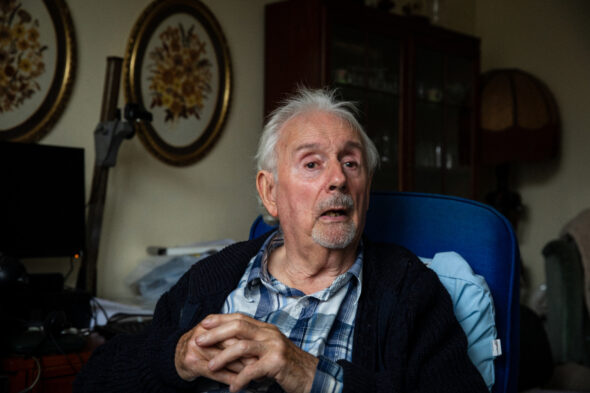
Listen 00:23:06
Story: Eric Feasey - Barking, East London