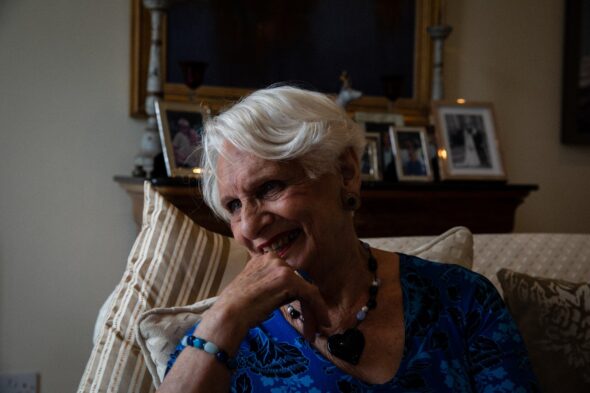
I had been in hospital for an appointment, and I was coming down the stairs, and I thought "what on earth? why don't I do something for this wonderful hospital?
Listen 00:14:31
Story: Clare Johnstone - Central LondonStories of volunteers supporting the health service since 1949
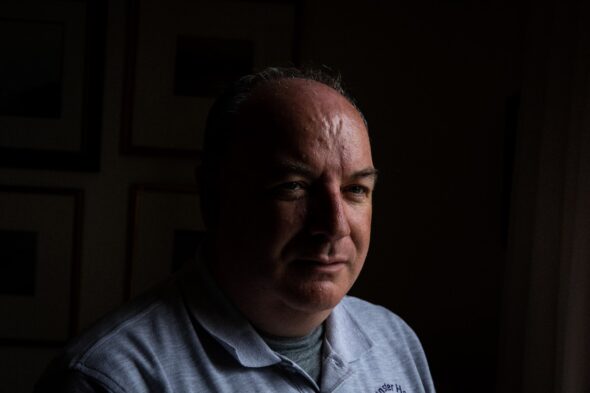
Richard Rooney - Central London
Richard was looking for a change in his life. Having retired from an all-consuming and demanding career, he wanted to do something that not only made a difference to his life but made a difference to others too.
At the Chelsea and Westminster, he has become a well-known face running the book stall and library service. During lockdown this has creatively been developed to include “Friends parcels” up to all the wards, and established a book club which also includes staff.
It’s a craft, it’s slowly done…it’s a comfort thing, and it gives them comfort and warmth. They realise the difference, it does make you feel good.
Interviewer:
Good morning. So my name’s David. Could I ask you your name?
Richard Rooney:
Yes. Richard Rooney
Interviewer:
And which friends group are you associated with Richard?
Richard Rooney:
Chelsea and Westminster.
Interviewer:
And could I I’ll ask him how old you are?
Richard Rooney:
52.
Interviewer:
Excellent.
Richard Rooney:
Thank you.
Interviewer:
So, you’re involved with the friends group. What first inspired you to get involved?
Richard Rooney:
Something, I was looking for something different.
Interviewer:
Okay. So what did you do before?
Richard Rooney:
I did 27 years in the justice sector. I was an employment law specialist. And after about seven years in the justice sector, there was a department, they tried to shut down and because I was a manager in the department, I was asked to try and keep it open and I failed. And, what happened was I joined the Trade Union afterwards, and I learnt employment law. And I went up the ranks, and studied. Suddenly after about 10 years, I became the President of the Union: 10,000 members.
Interviewer:
Excellent.
Richard Rooney:
Hundreds of reps. And I learned all about employment law, pay, terms and conditions. And I learned that the next time that we were going to put up a sort of campaign, I’d understand how to do it properly. And, um, I didn’t plan it. I didn’t really want this, but it kind of just gravitated towards me and I became particularly good at it. And I’d be particularly good at the people side of it, the people skills. And also, I think I was particularly good at communicating with all, all ranks: top floor, shop floor, a job that, it wasn’t a job. It was a vocation, it was, it never stopped.
Interviewer:
And in some ways there are lots of parallels between that and volunteering?
Richard Rooney:
There is, it simply was a paid job that you did to volunteer, because I represented all the personal cases. I did all the employment tribunals. I did everything, every single position you could hold, but basically it was all around representation of people who had fallen on bad times, and had fell foul of regulations, and representing people at a corporate level, you know, 10,000 people, pay terms conditions. And then I finished up in the Commissioner of the Police’s Command. I was on his Special Command. He was the person I negotiated with, and I was on his Command as a representation of them. So I was in his boardroom for, for years.
Interviewer:
So lots of passion, lots of commitment. Yes. And lots of determination, which pushed you really to the pinnacle that you could get to. Yes,
Richard Rooney:
I did. I could go no higher.
Interviewer:
And then you changed?
Richard Rooney:
Completely.
Interviewer:
So why did, what did, what encouraged that?
Richard Rooney:
I gave a year’s notice, but I went to the conference, the annual conference, and I stood up and I made a speech, and I told the guys that I wanted to go, and I’d been re-elected the President five straight years, which was quite a difficult thing to do. But I stood up and said to them, “look, guys, I missed the first nine years of my son’s life. I’m not missing the next nine.” And I gave them my notice and resigned on the basis that I knew there was lots of redundancies coming and I was offered the opportunity to leave. And I knew that if I didn’t go, then I wouldn’t, and I wouldn’t do something I wanted to do. And I wanted to do something completely and utterly different, take this skill set and move into somewhere completely different. I wanted to stop feeling like I was so important, because I’d walk in a room and people would call you “Mr. President”
Richard Rooney:
And I wanted to go back to not being so important and help people, perhaps who needed help more, more in other ways. And so everyone thought I was crazy mad, but I really also felt that 12, 15 hour days, seven days a week, you know, living it, taking phone calls at four o’clock, three o’clock in the morning, looking forward to taking these calls. And then I never attended one sports day for my son. I missed every Christmas thing. I missed everything. And that’s why I genuinely thought I missed the first nine. I’m not missing the next nine.
Interviewer:
So you wanted to do something. You wanted something with more space for the family
Richard Rooney:
I wanted, I did. I wanted something also for myself, almost something for me.
Interviewer:
Okay, and you found yourself at the Chelsea and Westminster, was that? Did you see a job and apply for it or no?
Richard Rooney:
Well, actually what happened was when I left the Met, I walked down towards Fullham Broadway. Then came home past North End Road, and on the right hand side was the Citizens Advice. And it said, “why don’t you consider volunteering?” So I went in there and I became a volunteer, thinking it was a good skill set across. So I became an unpaid volunteer and took quite senior position with them, still with them. And then I took a volunteer position with a college in Acton, helping older students who had severe disabilities. And I took my skill set there for a year and a half, where I had a student who had a severe learning difficulties. And I had took, I was his carer and his learning assistant for a year and a half. And I really, really enjoyed that. And actually they promoted me after six months.
Richard Rooney:
I didn’t want to be promoted, but they did because it was a youngster. So, I sort of took a lot of them under my wings. And what happened was my other son, Matthew, played quite a lot of football when he had a knee operation. And he said that he was going to have a checkup done, and being Dad. I did the wrong thing and went to the wrong hospital. I went here, instead of going to Charing Cross, and I sat here and there was, the Friends were outside where I sat, and I knew I was at the wrong hospital, but I thought I’m going to sit here for a few minutes, and then decide what I’m going to do. I figured the 211 bus would take me all the way. While I sat there. I saw the Friends sign on the wall, and I also saw the book stall was going on behind me.
Richard Rooney:
And then I sort of equated the two, took the details, went home, looked up on the website because I was quite a keen researcher of everything, I still am, and they had a job available and it kind of ticked the boxes where the things I was looking for, something quiet, something where I could think, but also something where I might be able to use my skill-set, you know, sales, innovate, and slow down a bit. And I applied for it, and got the job.
Interviewer:
So how long ago was that?
Richard Rooney:
I think it’s about four seasons ago, 4 and a bit years ago.
Interviewer:
Okay. So you’ve been doing it for awhile. You obviously had a huge number of skills. You also had quite a lot of voluntary sector experience. You’d worked in lots of different organisations?
Richard Rooney:
Yes.
Interviewer:
So what would you say is different about being involved in a friends group, as opposed to some of those other experiences?
Richard Rooney:
I think in my words, “nobody’s looking for a medal. nobody’s looking for recognition.” It’s done purely because of the self-satisfaction of trying to make the patient experience a bit more. And also the by-product is we have lots and lots of senior people who are volunteers who have great skill-sets, who’ve been forgotten, as in they had years and years of doing something really important. So the thing I like is that we got so many senior citizens, people helping out and feeling valued. And at the same time, we are providing a magnificent service for patients quietly, not looking for recognition, always in the background, and consistently just making sure it’s about them, never about us.
Interviewer:
That’s a lovely description of a friends group, I have to say. And I think also that the very term friends group often describes the relationship between individuals who come to volunteer. They find new relationships, new friendships, and, and it’s more than just a volunteering session for a few hours a week. It’s part of a community that they’ve joined. Is that your experience too?
Richard Rooney:
Definitely. Definitely. I don’t. I don’t have a watch. I don’t ever, I don’t look at my time. I come in and, and go home. The time goes fast, really fast, every day. And I’ve noticed with the volunteers, they never seem to ask what time is it? They’re always seem to just look forward to attending. Don’t want to go home half the time, and just look forward to what they do. There isn’t a clock anymore. There’s just the “doing” side of it. And the next thing seems to give you a bit more energy for the next thing and the next thing.
Interviewer:
And do you have any favorite memories of things that have happened as part of your experience?
Richard Rooney:
The most recent is October. I was the only person here that was there like, it was like the Mary Celeste. I was the only person here, just keeping an eye on the post and everything. And then I got a cold email from a lady in the Burns Unit. She was a physiotherapist or psychologist, one or the other. And she said to me, ” Richard, could you drop me up a magazine for a patient somehow? I know you can’t come in, but can we find some way? “, So I dropped her off a magazine, a book at reception, and then the following week, I dropped up a magazine and a book to the Intensive Care Unit. And then I decided to put them in envelopes and start dropping them up. And since then, that has spiraled to every department, every ward across the entire hospital each and every week, based upon people donate in magazines, books, crosswords, and now we call it the “Friend’s parcel.”
Richard Rooney:
It is delivered every single week and we’ve delivered over 150 parcels every single week to you name it, we’ve done it department wise, anti-natal, all the different wards. I’ve gotten them ready for tomorrow, donated by the public. And each week I meet the nurses or the doctors. I get a phone, I get a photo every single week of the different departments we meet. It goes on, on Twitter. And I’ve now got contacts right across the hospital, asking me for different things, every week. Last week I met with a lady in the lift who said to me, “Richard, I heard you’re doing your parcel service.” I said, “that’s right.” This lady was a sensory physiotherapist. And she’s agreed now to deliver them at the same time they’re doing their sensory treatment. The communications and the contacts I’ve made are that we kept a service going right through the whole of the pandemic, but we didn’t plan this service.
Richard Rooney:
It just was organic. And also with my Friends, Hilary and Lucy, I went to them and said, “look, how can we upscale this?” Because it suddenly became bigger than I could manage. And that was a good thing. There wasn’t any discussions. It was just, yes, we’re going to do it. And we did it. Excellent, no costs, nothing. And we keep it going now. And these are departments we could never get into because of the sterilisation of the wards. So we found a way of getting into the receptions and we’ve met new people and we provide some comfort by reading and different things.
Richard Rooney:
The feedback is really good, and the second one I’m going to give you is: I’ve been here about a year and I was working downstairs and I have a lot of banter, a lot of jokes and enjoyment with different people. The Padre, I was have a bit of a joke because he reads my books. He never buys anything. We have a stall and he’s a really lovely bloke. And then one day said to him, “Richard, I need a favour.” I said, “what do you want more books?” He said, “no, I need you to be a witness at a wedding.” And so I said to him, “you gotta be kidding me?” So he, he asked me to go upstairs and be a witness, a wedding. And so I went upstairs to this older lady who was getting married, and when she was in her eighties, and I went up, and they played the music on the phone. Um, it was something like out of a film. And I remember I went in the room, and the vicar was quite old. And at one point, he almost thought I was getting married, and I had to be careful that I didn’t get married!
Richard Rooney:
And then, It was a bit like, a Carry On film, the music where it played, “dearly beloved.” And I went and I did the wedding. And it was, it was a great moment. And I still can’t believe I witnessed the wedding up stairs at the bedside. I was the witness. The funny thing was from that. I, I’ve got a great relationship around the corner from the library down the ground floor from the Mortuary. I know the guy really well. You’d say, Well, why? I’ll just do because he’s around the corner. And I talked to him saying, “I really had a fun day this week.” And I said, “believe it or not, I actually, I went to a wedding.” He said, “I know, you said the lady passed away the next day.” He knew because he had heard about it. And I thought it was quite poignant to him. She put, she seemed to be, to have a lot of energy in life for that small moment of her last thing. When I heard she passed away, I thought, “well, good for her.” You know, that, that kind of stays with me cause it was quite a fun thing. But also I thought, “wow,” you know,
Interviewer:
So, I’ve also heard that you run a book club. Can you tell me a bit about the book club and how that works?
Richard Rooney:
Basically, a forerunner of the parcel service, because what we thought is what could we do for those people who don’t want to read a magazine? So what we did was each week, I asked people to pick out three books and then we post them online on Twitter and then we offer them up and we say like, if you can’t come to us, we will deliver to you. And the idea is really to get all of the volunteers to pick books. But now we’re moving into a new area. We’re going to say, Nurse Jones, or Nurse Jackson’s books of the week are or, or Larry, the guy who cleans the, his books of the weeks are, and we suddenly started this a month ago. I picked the first book. I went safe. I went Jane Austen, and I went To Kill a Mockingbird. And then there was a little bit of reaction to say, “oh, you know, this, isn’t what I, I wouldn’t pick this as my book of the week.” And what we’ve got now is interesting books being picked each week. But more importantly, we’ve got ourselves a little book debate going, which within the book communities is really interesting. And the numbers on Twitter of, because of the, the parcel service and the book club, I’ve gone into the hundreds and hundreds when we had less than 10 people when we started this in October.
Interviewer:
That’s excellent. I know. And I wouldn’t have necessarily thought a book club, big thing that would stimulate Twitter.
Richard Rooney:
Yes, it does. Because what I’ve discovered within the book services and community, they’re very, people are very, possessive about their books: what they like and what they don’t like. And also this debate between what’s a classic and a modern classic. You’ve only got to start that off and away you go.
Interviewer:
And what’s interesting for me is in my role, I meet lots of different Friends Groups. And many of them would say that if you looked back historically, they would have run a library trolley service. And that library trolley service would have sort of gone round the wards. And people were in the wards long enough to sort of have a book for two or three days or a week, and then hand it back and borrow another book. And then they’d carry on going around. And people say, well, they don’t see that there’s really a role for a library service, but it seems to me that you’ve sort of developed a slightly different approach to it. Was that intentional or did that just happen?
Richard Rooney:
I thought to myself, some people are in for a really short time, so you just have to provide what they need, when they need it. And, and don’t, don’t over, don’t overthink it, just make it available. And, the library service we do provide, and we do have people who have long stay, but also I thought to myself, what about all the staff? Don’t they want to read a book, aren’t they interested? So what I’ve done was turned it on its head, and said to myself, as well as the patients, what about the staff? And so we’ve included all the patients, but all the staff as well. And we find a lot of the staff get a lot of really got a lot of enjoyment out of it after a long day in the hospital, maybe having to read on the tube or the bus or for free.
Richard Rooney:
And then they donate and then they tell me, “oh, Richard, there’s such and such on my ward. I was talking to her. She would really love a book on such and such. Can you bring it up?” Yes. So we do a delivery service and on many, many occasions I’ve been up there where a patient did not want to read a book. They just wanted a bit of company. And I encourage my trolley people to take as long as they need go upstairs and sit down and have a chat. You know, I’ve had cases where people have had, I’ve raised other issues where they’ve had housing and concerns, and I’ve had to bring those issues to the relevant authorities, the sister, or the ward sister. But sometimes you see the patients and they feel like they haven’t got anyone, you know, they’re busy or so we fill that gap of sometimes being a communication or, or sometimes someone just sit with and I get it a lot. I sat with such and such a day for half an hour or, and we can follow that up as well, because we’ve got a lot of volunteers and I’ll say to one of them that go upstairs and call them and start a conversation with, such and such too see if he needs anything. But I also say the light touch when someone wants to be left alone, leave him alone. When someone wants something, provide the service and then I’m in the background. Not like I said, no medals just quietly provide the service and then back off.
Interviewer:
Yep. Again, it’s all about being a Friend. Isn’t it?
Richard Rooney:
It is.
Interviewer:
So you’ve already touched a little around how actually very recently, because of COVID the role of friends have changed slightly. Some groups I go to, they might feel they’re criticized for staying the same. It doesn’t feel like at Chelsea and Westminster, you stay the same. It feels like you’re constantly evolving. Is that fair?
Richard Rooney:
I think thats true, I think we, I think it was just a by-product, but I think we could have just sat at home and done nothing. But what happened was, once you provide a service, you have to keep it going because someone else wants it, then you have to develop it, but then you have to make it interesting. You have to make it fun and you can’t stand still. You have to keep providing something different for different audiences. Some people like a book, but we thought the book club would, would stimulate debate and discussion and maybe get people involved. It will, you watch, the by-product will be we’ll get some volunteers or have been in a hospital and they’ll come back and say, “well, I really enjoyed it so much. I would now like to volunteer” and don’t forget what I said at the very start. This service, particularly for retired people means they feel valued. They’re doing something of interest. So, the friends provide that service sort of on a twin plane to the to the patients.
Interviewer:
Sometimes the impression I’m given when I talk to some hospital managers is that Friends are for bygone era. They’re not for today. Do you still think there’s a need for friends groups today?
Richard Rooney:
I think that’s true, I definitely do. And I think it’s because it’s, so much like almost like having a tradesman or tradeswoman, it’s, it’s a craft, it’s slowly done. It’s not fast. It’s, it’s, it’s a comfort thing and it gives them comfort and warmth and then once people experience it, they realise the difference, it does make you feel good. And I think that we’re able to make people feel good and we take a little bit more time. We’re not rushing around and we’re not doing it because we want to gain a work experience for our next job we’re doing, because we know that it makes a difference. And I see the people, I get everyone I’ve got, I don’t have a single primadonna not one, they’re all in it because they want to make a difference.
Interviewer:
I really feel you’ve answered my next question, which is what would you say to encourage people who perhaps haven’t got involved in a friends group to get involved?
Richard Rooney:
I would say experience, asks for a short attachment, experience it, and then see the service that you provide, and then ask yourself, would you like that service for your relative or your family member? Would you like to think that when you’ve gone home after visiting to them, that’s it or is there something else? Is there something else? And if you was to go home and know that somebody else is taking the time to do something for them, make them feel a little bit better. How would that make you feel at home? And I’m pretty certain, if it was your family member, you would feel a little warm glow thinking. I like that. I really like that. And if you go in next day and they’re talking to you saying, “oh, I’ve got a nice book yesterday and I had a chat with the thing”. You’re going to think. Excellent. I think the value added is a, is a nice touch.
Interviewer:
I have to say the stuff you’ve described to me today that is a slightly different angle, the stuff around the book service in the library than perhaps I’ve seen in other places. And I think it’s a real tribute to your determination and enthusiasm. And also I would probably say to the leadership of the Friends Committee that they’ve allowed you and supported you to enable that to happen. So I really congratulate you on all the efforts you’ve put in. Now, when you knew that we were going to be chatting today, is there anything else that you wanted to tell me that you haven’t had the chance to say yet?
Richard Rooney:
I suppose I would just say that the teamwork of within the group within the committee and the people is the reason I stay. So I suppose within the element of the Friends, the teamwork is the key you have to have, almost when, when the day starts and we start the operational element of it. You have to hang your rank at the door and go for what operationally is best for the patient and the service. And what I like is it’s all about, you know, doing it the right way, making something, making people feel value added, everybody. And I also think the follow-up and feedback is crucial because for example, when we run the book service and the sales, we put up a sign that says, what I’d like to know is when I go to a sale, I changed it, which is “where does your money go?”
Richard Rooney:
And so we put a picture of particular equipment that has gone, and I’m able to say, and I know for a fact feedback, people like to know where did it actually go on a special seat for a child, or a piece of equipment that’s now being used for X. And I’m able to say, “well, X bidded for that equipment, you paid for it.” And that thing is able, you’re able to attach the, the book sale side to, you bought a book today, and because you bought that book, it’s made a difference to this person, and you see people take a moment. And when there’s a picture as well, big picture on a sort of board, which I’m going to do in a couple of hours, it doesn’t make a difference. Where does it go? And I think people sometimes like to know where does it go?
Interviewer:
Excellent. Thank you. Well, that’s been really helpful and I’ve really enjoyed the interview. Thank you for your time.
Richard Rooney:
You’re very welcome.

| Contributor: | Richard Rooney |
| Recorded on: | 21 January 2022 |
| Role: | |
| Setting: | Hospital |
| Organisation: | |
| Hospital: | |
| Location: | |
| Themes: | |
| Decade: |
Listen 00:14:31
Story: Clare Johnstone - Central London
Listen 00:07:16
Story: Gordon Dempster - London