"I've always wanted to help the hospital because they helped me. I mean if it wasn't for them, I wouldn't be here."
Listen 06.20
Story: Marion Faunch - Burton-on-TrentStories of volunteers supporting the health service since 1949
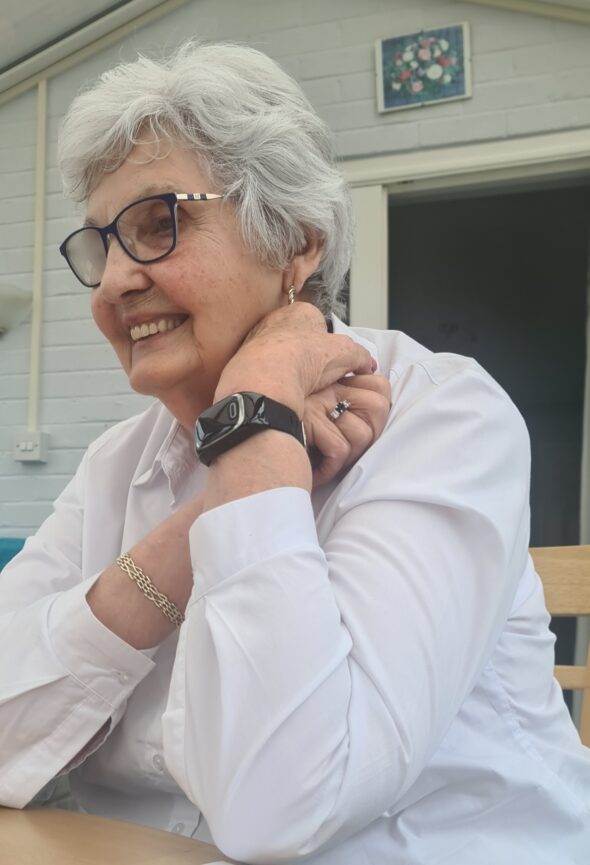
Pauline Spratt - Staffordshire

Pauline Spratt reflects on her 40-year commitment to volunteering with Burton Hospital League of Friends. Inspired by a lifelong interest in nursing, Pauline joined the League in her late 30s, organising community fundraising events such as fun runs, golf tournaments, and charity balls to support the hospital.
As I say, the type of fundraising is changing, but people still want to know what’s going on and if they can get involved in the hospital in any way, especially volunteers. If they come to us as young people, they can find it as an interesting avenue to look at all the different posts and jobs that there are available in the hospital.
Her entire family became involved, with her husband Bill contributing by leading Phoenix Hospital Radio. Pauline also championed a hospital shop, providing both revenue and volunteering.
Interviewer
First of all, could I ask your name?
Pauline Spratt
My name is Pauline Spratt.
Interviewer
Lovely to see you again today, Pauline. And which hospital are we talking about today? Which Friends group?
Pauline Spratt
Burton Hospital’s League of Friends, and Barton Cottage Hospital.
Interviewer
Could I ask how old you are?
Pauline Spratt
Oh dear. You shouldn’t ask a lady that, but I’m 83.
Interviewer
Excellent. And I have to say, not looking it at all. So, what first inspired you to get involved with volunteering in hospitals?
Pauline Spratt
Well, I suppose you could call me a frustrated nurse. I always aspired to be a nurse. I was into St. John when I was very tiny very many years ago, but life got in the way, and I never quite made it. Marriage and two children later, I finished up being an occupational therapy helper on the wards, and that showed me the different aspects of work in a hospital.
Interviewer
So, was this when you were quite young, you were doing this, or was this something you took on later in life?
Pauline Spratt
St. John, I think I joined that when I was 12, but with the League of Friends, I think maybe I was 38-40. I think the children were growing up, and I needed to look for something else to keep me busy.
Interviewer
What then made you transition into getting involved with either the Friends or volunteering?
Pauline Spratt
My mum had always volunteered. She worked with the Red Cross a lot, and I carried on from that.
Interviewer
This was over 40 years ago. You started to think about volunteering, and it seems to have grown. Would you agree?
Pauline Spratt
Yes, yes. Definitely, it is not the League when I left it, it is not the League that I started with.
Interviewer
What was volunteering like then? What was volunteering like 40 years ago?
Pauline Spratt
I don’t think even the word had been used then. It’s certainly not the same. It was doing your bit and people enjoyed getting out, and about meeting people. It was just so different.
Interviewer
So, there was a lot about fundraising. What was fundraising like 40 years ago?
Pauline Spratt
I think it’s something that everybody did. We all got together. I lived in a small village, and it was soon heard that I was involved with the hospital, and people were eager to help me with any fundraising. I managed to get some more members together, and we built it up, by this time, I was living in Burton, so it was handy to get to the hospital and meet up with new members.
Interviewer
So, I gather that one of the things you did was organise a fun run. Can you tell me a bit about the Fun-Run?
Pauline Spratt
At the time, I think it was the government was trying to get us involved in activities, but my son was involved in running, and I followed what he was doing. He helped me with advice, what I would need, and that sort of thing. I got together with a group of his friends, and the members of the League of Friends, and we managed to get the team together because it’s not just runners. You needed the first aider or people manning the water stations. We organised a 10-mile run, which to me seemed a heck of a way to go, but they were all for it, but we did get people from all walks of life. I know my daughter-in-law had broken her leg, so her sister pushed her around in a wheelchair. Then, we got the very keen athletes that wanted to get the best time, and they all merged together. We had a group of men get together from the local pub, and they couldn’t make their mind up whether to continue pushing the beer around the town or to drink it because it wouldn’t be so heavy. They managed to do that. The runners we started off with maybe 30-40, but by the time we ran our last 15 years later, we were up to 500 and something runners. We got the police on board as well. They were very kind, gave us their services for free, but again, rules and regulations came into it.
Interviewer
Reading through my notes, I can see that there was some cycling going on. Can you tell me about that story?
Pauline Spratt
Oh, this was interesting, to say the least. I had a gentleman come to see me, saying that he wanted to take part in the Fun-Run, but it was difficult because that was on a set day. So, he wanted to do something slightly different. He wanted to cycle to Skegness with some like-minded friends. I said, “All right, yes, we can manage that. We’ll sort it, but what are these like-minded friends?” “Oh, they just happen to be nudists and they’re prepared to cycle to Skegness. Yes, they’d be quite happy to do it.” Well, they did it, they raised an awful lot of money, and they also came back to five years later to do it again. Thankfully they didn’t ask me to join in.
Interviewer
So, tell me a bit about your last fundraiser in 2015, I think it was called Project 35?
Pauline Spratt
Yes, Project 35 was 35 because League of Friends had been around for 35 years. At that time, we didn’t quite know how to celebrate it, but I happened to be talking to the manager of Burton Albion FC, our local football team, and he allowed us to use his function room. So, we organised a dinner with a raffle, got to have a raffle, and followed by music and dancing. It was a really brilliant evening. We aimed to raise along with other smaller fundraising events. We had this larger one which raised 7,500, which was marvellous. It went towards replacement items in the ophthalmology department.
Interviewer
Excellent. So, it feels like when I’ve heard these stories that this has become something really important as part of your life?
Pauline Spratt
Yes. I was always working towards the next event, and I think the fact that I’m slightly disabled, I couldn’t go to work because I didn’t know what the next day was going to bring. With this, I could rest when I needed to. Then, I’d be feeling great the next day, and I was all for it, and we’d get going again. What can we do that’s different?
Interviewer
So, I’ve already heard that your son’s got involved as runner. Did the rest of the family get dragged into this?
Pauline Spratt
Well, sort of, my daughter followed me, and she decided to become a nurse. So, she did her training in Leeds. So, I didn’t see an awful lot of her, but she did run the fun run sometime. She advised me that I was dreaming too far, and I couldn’t do it that way. She was very practical. I said earlier on that we needed to have a first aider on board, but we were lucky that we only ever had to use him once in the 25 years. That was for a sprained ankle when someone fell off the kerb. I think that was a good record. My daughter also helped me, and my son doing the administration work involving the computer, which I was hopeless at. They could help me. My husband Bill, he always drove the lead car claiming that he was first in every year, we began to see through that joke. So, when I first got involved about 20 years ago in the organisation, I can remember the first time I met you. Was at an East Midland conference?
Interviewer
That’s correct. It was at the Conference Centre in Derby, if I remember, and Bill was with you as well. I feel like this was a bit of a project that Bill your husband was always involved in too. Is that fair?
Pauline Spratt
He always followed on with what I was doing, and, well, he had to really, because it was the only way he could catch up with me. He always said if he wanted to see his wife, he had to go to the hospital. So no, it wasn’t that bad. He enjoyed it. He enjoyed meeting all the different people and it was amazing, the wide range of people that we did meet.
Interviewer
So, did he get involved in anything of his own, I think you mentioned hospital radio?
Pauline Spratt
Yes. Well, after we’d been going for about 15 years, we decided we would start hospital radio, and we called it Phoenix Hospital Radio. Bill became involved in that. So, when he came home after a day’s work, he was a welder, he’d walk around the wards, talk to the patients about their favourite tune, and he’d go back to the radio studio to play it for them. He once remembered going into the ward asking this lady what tune she’d wanted, and she was an elderly lady, and she said, “Can I have some heavy rock?” And he said, “What for you? Or is it for your grandson?” She says, “No, it’s for me. I like that.”
Interviewer
Excellent. I can remember that Bill was around quite a lot. I think another time I remember Steve, who’s with us today, was running some training in Leeds, and you had come over, Bill drove you, and he sort of waited downstairs. It felt like a real team thing.
Pauline Spratt
Yes, Bill was always our chauffeur. He was our go-to as well, anything we wanted doing, but, yes, he drove us over to Leeds. We had very interesting sessions with Steve, putting us up to date with the rules and regulations of volunteering. Bill would stay downstairs sorting out his computer, but he always managed to join us for the coffee and cakes.
Interviewer
The Spratt team delivered.
Pauline Spratt
I didn’t like the idea of driving through a big city like Leeds. I was quite content with Burton, but no, Bill didn’t mind that at all.
Interviewer
Excellent. So, you started off, you’d been sort of lured into volunteering?
Pauline Spratt
Yes. It was just some kind people said, “Pauline, can you just help us out with this? Won’t take you long, you know?” Half an hour we’d be doing it. 40 years later, I’m still doing it.
Interviewer
In terms of the League of Friends, did you get onto the committee? How did that work?
Pauline Spratt
Yes, I’d been with the league for about a year, and we had our usual annual general meeting, and we had applied to become a registered charity to do this. We required a lot of paperwork and the appointment of a chairman, treasurer, et cetera. I was asked to be Chairman, and I think that was around 1982-83, I’m still there. Two years later, I couldn’t give it away. I was looking for someone with different ideas to move us forward, but nobody wanted to take the post.
Interviewer
That’s always hard. When you do a good job, it’s always hard to find someone to replace you.
Pauline Spratt
Oh, you’ve noticed that as well, have you?
Interviewer
Well, I’m still in post 22 years later.
Pauline Spratt
Oh, there you are. The comment I usually got, “Oh, you’re not standing down Pauline. Go on. You can do it for another year. You know you like doing it.”
Interviewer
I get that. So, when did you actually give up being Chairman? About how long ago now?
Pauline Spratt
I think the pandemic changed everybody’s life. With me, it happened at a time when Bill wasn’t too well. I couldn’t spend as much time at the hospital as I was doing because I was looking after Bill, and the hospital itself changed. Queens Hospital amalgamated with Derby Royal, and a lot of the staff moved over. It’s all so different now. Plus, the fact that by this time Bill wasn’t getting any better, and he needed me at home more.
Interviewer
So, in the conversations we’ve already had today, it feels like the hospital is still really important to you. You still think about it, and you also mentioned about you paying for some things in memory of Bill, for example.
Pauline Spratt
I just wanted to leave a mark. We’d been there, we’d done so much, and at the time, I was looking for something to donate to the hospital. I wanted to donate a shelter because Bill, and I had a session one day where I took him to the hospital in the wheelchair on a beautiful sunny day. There he was with his short sleeve shirt on. We came out of the hospital to pouring rain, and there was nowhere to shelter, and look for the taxi at the same time. So, I thought, they need a shelter here, we’d look for that, but unfortunately powers said, “No, we can’t have one there.” It was too public. So, I had to make do with a bench.
Interviewer
What’s your favourite memory of your time with the Friends group?
Pauline Spratt
There are so many really, and the enthusiasm from the different volunteers. It was always, “Oh yes, I’ll help you with that Pauline, but can you sort it out?” It is true that they do need somebody at the head to point them in the right direction. One lady, a member, was a very, very keen gardener. She grew the plants, and then brought them into our sales table. That turned to be a popular event. I’ve got one story of a nurse who stopped me in the corridor one day. “I’ve got this gentleman who’s been with us for quite a while now and unfortunately, he can’t go home yet because he can’t go anywhere without his oxygen cylinder. We’ve been trying to work out a way of how we can get him home.” “Well, if the League can help, we will.” I went along to meet with him, and it was a very pleasant gentleman, but obviously was fed up with being in the hospital. He told me he missed his wife’s cooking. This would’ve been in around 2010. We were looking at what his problems were, and one of them was the portability of the oxygen cylinder, and all it needed was for us to buy him a backpack. So, we set him up with that. I had a lovely letter from him and his wife saying how much they enjoyed it. He was able to go home one day a week. His wife cooked him a beautiful meal, and he was well satisfied with that. After that, he moved on to going home every weekend, just for one day, then two days. He was able to be discharged from hospital with plenty of care by his side, and his proverbial backpack with him. A small donation from the League, but it made such a difference to him. Another thing we did purchase was a rocking horse. The children’s department was having an upgrade, and I thought everybody needs a rocking horse. So, I found that there was a local company that used to make them for Harrod’s, and I thought, “Well, we can’t go much higher than that.” So, I went to see if I could do a deal. I managed to persuade them to sell us one for half price, which was still quite expensive, but it was certainly well used. 15 years later, I was searching for another maker, because that one had gone out of business, and another maker would be able to repair the old rocking horse. He had some reins, and new hair, new tail. He came back looking as good as the new one. I remember the repair costing was far more than the original cost.
Interviewer
That’s excellent. So, looking across the years of volunteering, what does the Friends group do today?
Pauline Spratt
It’s changed a lot. After Bill passed away, I was not so good myself, decided that it was time for me to stand down. Bill and I used to go out into the community, doing an awful lot of different fundraising activities. One of the big ones we did was the demolition of the Drakelow Power Station. Everybody in Burton knew about Drakelow Power Station, about the dust that it threw onto all the cars when we knew that they’d fired up again. Bill was disappointed to do this one, because it was where he worked most of the time, and he was disappointed we were going to be knocking down his place of work. I never thought the day would come when I’d be standing in the middle of a wet field at 11 o’clock at night, listening to the rustling in the grass to watch the towers be demolished. We had a young man from the power station there telling us what was going to happen. He built us a box with the big press button, but we’d organised a big raffle, and the winner of the raffle prize was to press the button. So, this young man turned up, and stood at the box, and we said, “Right, press the button now.” He pressed it, but nothing happened. So we pressed it again, and nothing happened. Then, this young man from the electricity board, “Hang on a minute, I better go and check the cables.” Half an hour later, he came back, and fortunately, we’d got a caravan there that was serving coffee, and that kept us happy. He came back and said, “I’m sorry, but the rabbits have eaten through the cables. I’ve repaired them so can we have another go?” So, the young man pressed the button again, and blast, it all went down, and it was very, very effective. At 11 o’clock at night, the police were worried that it might stop the traffic, and that was why they turned the time around, because the public wanted us to do it in the middle of the day. So, selling the raffle tickets, we worked with another gentleman who was raising money for our local hospice. He was braver than me, going into the pubs and persuading people to buy the tickets, and not many of our, dare I say, elderly ladies were popular at going in the pubs either. Between us, we raised nearly 17,000 pounds. So, it shows how popular the towers were.
Interviewer
That’s excellent. You seem to have done some great things. Now, I believe also you raised money through a hospital ball and golf tournament?
Pauline Spratt
Oh yes. The golf tournament. We organised that because we went on a trip with hospital radio to Ireland, we visited one of the hospitals there, and I noticed that they had a list of their fundraising activities. One of them was a golf tournament. I thought “That’s an idea, we don’t have those in Burton.” I organised this golf tournament knowing nothing at all about golf, but it did appeal to a different audience. We got a different group of people that came along and raised a large amount putting in teams, and we organised this golf tournament for eight separate years.
Interviewer
And tell me about the Hospital Ball?
Pauline Spratt
The Hospital Ball was another again event that appealed to a different audience. Again, the ladies liked this. It was the opportunity to have a posh frock, and a good night out again that was very popular, very popular with the staff. Made a change from them wearing their nurses’ uniforms, which they were very proud of. One year, the hospital Chairman was also the High Sheriff of Staffordshire, and he arrived in his formal attire complete with his family sword, which was over 400 years old. I also had balloon modelers there, and very delicately, they decided to make him a balloon sword. We felt it would be slightly safer when people had had a drink.
Interviewer
Excellent, thank you. So, one of the things I associate with Burton, and I think this is more towards the end of your period of Chair, was the opening of the shop. Can you tell me a bit about the shop?
Pauline Spratt
Yes. That was probably seven or eight years before I left, but it was something that we’d been doing from tabletops for years. I think the lady with the plants was saying that if we had a shop, then we could sell more, or we could sell books. We started off with a book sale, and we used to have them under the stairs, and it was run by a married couple of volunteers who stored them in the basement. Every month, I would come for two or three days, and set the books out and would sell them to mainly members of the staff. They would buy a book for 50p, read it quickly, bring it back, and buy another book. I could see that if we got the accommodation, we could have a book shop permanently, and then, we could have not quite a charity shop, but similar to it, charity shops not being as popular as they are now. We did get people; we managed to get our shop organised. It took us a while to get it. It slowly turned into a bookshop stroke charity shop. Very, very popular. Members of the public would come to see the doctor, “Oh just a minute, I’ve got to go see if they’ve got any good books in the shop or I want to take this in. I’m sure they’d be able to sell this.” We’ve now built it up, and we employed a shop manager. She was the only paid member of staff that we’ve kept. She organised all the volunteers, and the workers, and kept the shop very tidy and fresh. At this point, Bill worked in the shop every Monday morning, and I came out of the office as a reserve shop assistant. It’s open five days a week, with two volunteers on a rota system and it’s proved very successful.
Interviewer
So, some people think about Friend shops as being all like news agents and sweets, and things like that. And this is a very different style of shop, isn’t it?
Pauline Spratt
Oh yes. We already had Costa Coffee and WH Smith in the hospital that had got contracts with the hospital. Basically, we couldn’t sell anything that they were selling, so we found a warehouse in Birmingham. We used to go over, and get different things, children’s toys, different cards. Again, Bill would drive myself, and our shop manager over on a Sunday morning, varying the stock, and thank goodness it was successful. It gave the volunteers a regular task, and they worked the rota system morning or afternoon, and they were able to say, “Right, what am I doing today? What have you bought in for me to sell? I’m working in the shop today so no I can’t do that because I’m in the shop.” That gave them a purpose as well.
Interviewer
It really does sound like a very good idea. So, do you think we still need the communities to get involved and help improve hospitals and their facilities?
Pauline Spratt
I think more so nowadays. The pandemic woke us all up in more ways than one, but we do need community to be involved with the hospitals. I think they need to realise just how much work the hospitals do, how hard the nurses work and the doctors and everybody else. It’s amazing, when I started to go around the hospital, that it isn’t just hospitals, and buildings, and nurses, and doctors. There are so many other people with different trades that are all needed to make the hospital work.
Interviewer
Excellent. So, is there anything that you felt you wanted to say that you haven’t had the chance to mention yet?
Pauline Spratt
We need more volunteers. That’s for sure. Volunteers are always welcome, and we like to know that the cash that we raise is used for a very practical purpose. We have the nurses coming to us, “We could do with some new Chairs, Pauline or any chance that you could buy us, help with some uniforms?” It’s all sorts of different things that I would’ve thought, well, the hospitals should provide them, but they don’t. As the time goes by, things are harder and harder to keep up with.
Interviewer
So, do you do much around Christmas for example?
Pauline Spratt
Yes. Again, Bill came into his own with that. He liked to be Santa Claus, volunteers got together, and we would wrap up maybe 300 presents, all in Christmas paper with the help of Marks and Spencer’s, and Boots. We wrapped up the presents, and Bill would dress up as Santa Claus, and take them onto the wards. It looked quite the part trying to persuade him to grow a proper beard, but he never did.
Interviewer
Excellent. So, I’ve picked up from this interview listening to you that it’s been a lifetime commitment. Would you agree?
Pauline Spratt
Yes. Never was intended to be, I’ll do it for a couple of years, and then I’ll get a proper job, but I think I found a proper job without the pay. Even so, I thoroughly enjoyed every day that I went out. I used to average four part-time, days a week working in the shop or in the office.
Interviewer
I think it’s been lovely hearing what you’ve had to say today. The commitment isn’t just about this abstract thing called the NHS, it’s all about the little stories of different people that have come through, the way the funding has helped change people’s lives. What it proves to me is that you’re a people person, and I think you’ve also had to be an organisation person in all your organisational skills as well.
Pauline Spratt
Yes, probably, it does need some work like that for the volunteers to get the confidence that they can go out, and do something. They don’t always need me to be telling them that they can do it. They’re a hard-working team of people and the League wouldn’t be the same without them.
Interviewer
You’re also a lady who’s capable in the background, but you are good at standing on platforms, and I think you used to go out and do talks in the locality.
Pauline Spratt
Got to see the WI Ladies. It was always popular because they had a nice cake at the end of it. But no, we could, any group that invited me would go along. Bill would become more conversant with it by then. So, he would help me to do what was the sideshow in those days, and I think that the computers totally befuddled me. That, Bill was definitely needed in that job.
Interviewer
Thank you. Well, thank you ever so much and thank you for your time today.
Pauline Spratt
Thank you very much for coming to talk to me.
| Contributor: | Pauline Spratt |
| Recorded on: | 30 January 2025 |
| Role: | |
| Setting: | Hospital |
| Organisation: | |
| Hospital: | |
| Location: | |
| Themes: | |
| Decade: |
Listen 06.20
Story: Marion Faunch - Burton-on-Trent
Listen 00:15:56
Story: Sheila Jackson - Staffordshire