Anne moved to Basildon after her marriage, and began working at Basildon Hospital as a Ward Clerk, a job she loved, and stayed in for 14 years.
Listen 00.07.36
Story: Anne Hare - Basildon, EssexStories of volunteers supporting the health service since 1949
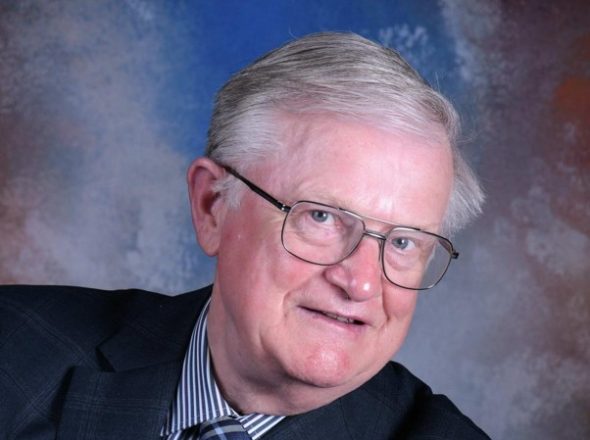
Michael Greenhow - Basildon, Essex
Michaels career began in electrical retail, where he managed shops for many years. Unfortunately his wife suffered a serious stroke and he became her carer for several years. It was after his wife passed away that Michael felt the need to give something back to the hospital which had looked after her so well, and he heard that the hospital were starting feeding buddies. He became a feeding buddy on the stroke ward but felt that he could give more and so became fully trained and he is now able to feed almost anyone who needs help.
It’s made a hell of a difference to my life. You get a good social life because you go, and work on a ward.
When Covid happened the hospital suspended their volunteering but Michael discovered that the League of Friends were still working, and so he began volunteering with the Friends. His experience stood him in good stead as he was asked to take on stock control, which he did gladly.
It has made a huge difference to Michael’s social life and he enjoys training new volunteers and being on hand if any of them have a problem. As Michael says ‘It’s not always easy, but there is always someone to help you.’
Interviewer
Good morning. Could I start by asking your name?
Michael Greenhow
Michael Greenhow.
Interviewer
And Michael, which League of Friends are we talking about today?
Michael Greenhow
Basildon League of Friends.
Interviewer
And could I ask how old you are Michael?
Michael Greenhow
Interviewer
We’ve obviously had a bit of a chat, so have you always been a local boy to here or how’s life been for you?
Michael Greenhow
I started out in Ipswich.
Interviewer
Oh, okay.
Michael Greenhow
I was there until the age of 11, moved to Essex because my Father got a job at the Ford Motor Company down the road here, and was Chief Cashier at the end of the day. And I lived over the back, which I’m pointing to until I got married to Connie in 1965. And I’ve lived here since this house was built and I watched it being built.
Interviewer
Excellent. So proper local, embedded individual? And what did you do for work?
Michael Greenhow
I first started off working for Unilever and I worked for Walls, the sausage company. I worked for them for 10 or 11 years, and things changed there so I decided I would like to work in the electrical business. And I saw a job in the paper one day in Grays. I knew the gentleman who ran the store, went there, got the job as they say. And I worked for him for 20 22, 23 years. And eventually I had my own shop, which I ran with my wife, and we worked at South Ockenden. Did that for quite a while. Then things got a bit tight in the electrical trade, and unfortunately he went bust. We were then taken over by Tucker Brothers of Hornchurch and I went to work for them. I ran their main store at Hornchurch for a while. But I didn’t always agree with their philosophy of running their store, being a family business. And then I finished up, I saw somebody wanted a part-time worker at Stanford Le Hope, running a local retail store. So I went there, and I spent 10, 11 years there.
Interviewer
So there’s been a lot of retail experience? And retail management?
Michael Greenhow
Talking to the public.
Interviewer
Okay. Excellent. So all of those roles sound like, particularly when you’ve got local shops, you get to know your customer base, you get to know the community. Did any of that start to sort of move from just being paid work, and did you do any voluntary work, community work as part of your working life?
Michael Greenhow
Not really. The voluntary work didn’t really start until my wife passed on. Because of the experience I had in looking after her, having had a stroke, and I had to feed her, and generally look after her. I had a lot of help, I will say. But I always used to do the night shift, because she wasn’t able to do anything for herself. But this will lead me back to why I work at Basildon Hospital. They looked after her. They told me they didn’t think she would ever come out. She had quite some serious strokes. The stroke was called a double infarct, which means that the brain isn’t working basically. But they got her better. They said that she could come home or she could go into a home and I said, “no, I want her home.”
Michael Greenhow
And she came home, and I looked after her for seven years. And then when she passed away, I gave myself three months, and I thought, “well, what do I want to do?” And I was speaking to the Head of Nursing, we have a department at a hospital in Long Lane, Grays, which is like a hub. And that’s where all the nurses who work in the community come out of. I knew her well. She said, “well, why don’t you go try for a job at Basildon Hospital as a volunteer?” So I said, “I don’t mind.” And she gave me a very good reference. The rest is history
Interviewer
Okay. So did you have any perception what volunteers might do before you started?
Interviewer
Okay. So did you have any perception what volunteers might do before you started?
Michael Greenhow
Not really. I was quite aware of the fact that at the time we were starting feeding buddies at the hospital. I went there as a feeding buddy because, you know, most things that annoy me in a hospital is when we serve food, the food is left on the table. The nurse moves away because she’s got other people to give food to. And you go back 20 minutes later, and the food is still there getting cold. And as you may know that you’re only allowed 15 to 20 minutes before that food has to be taken away because you cannot serve it to that patient. And that’s where I felt that I could help. But because we were a stroke ward at the time, which we still are, but we are part medical, part stroke now, you are only allowed to do a certain amount of feeding. You can watch a patient, and obviously if there’s a problem you will call a nurse or do the buzzer. But I said to the nurses one day,” I’d like to learn to properly feed people.” And Miriam, who is our lady lead at the hospital, she does all the feeding, and you see her about quite a lot. So she trained me, and I’m now allowed to feed virtually anybody in the hospital within reason.
Interviewer
So for somebody listening, there’s sort of a role I would describe almost as an encourager at meals. Which any one of us could do. Really. We can sit there, and say that looks nice, and push it a bit closer, and those sorts of things. And then there’s this much more developed role that you do. Where you’ve been properly trained.
Michael Greenhow
But also when people ask me, they turn around, and say, “oh, I couldn’t do that.” Quite often I hear “oh I couldn’t feed patients,” you know, because obviously sometimes I might have to sit with that patient for 30 to 40 minutes. Just giving her a mouthful, making sure she swallows. And then obviously another mouthful. You have to know when to say that’s enough because obviously patients can be sick afterwards. Because the stomach can’t take it. And then we end up generally giving them a yogurt or something because that they can swallow very easily.
Interviewer
So you’ve had a really challenging personal time. You decide to give back, and you go back to an area where you’ve experienced the benefit from. Is that where you stay or is that all you do? Or how, how does it work for you?
Michael Greenhow
Over the period of time, I’ve taken on various roles within the hospital. We had a committee within the hospital, a patient’s panel. And that, unfortunately, at the moment it’s probably been disbanded coming up to COVID. And we did a lot of good work because we were privy to what was going on within the hospital. We had people who would come down, Heads of Departments and give us talks. And that I found very interesting, and you got to know a lot of people. I also work on the auditing team, and I go to Southend, Broomfield, and I’ve done a little bit in the one at Bury St Edmunds, West Suffolk. We helped them start their auditing team up. I went with one of our Governors because they had never done it. And we do it once or twice a year. We try to do it before CQC come in, we will be given wards. I work with a lady who comes from Chelmsford. We work as teams, about four of us. And then we will walk, because they don’t know we are coming, we’ll walk onto a ward, and we will look at it, in a professional sort of way. We introduce ourselves when we walk on the ward. At the end, we give them a quick appraisal of what we found, and then a report is written up, which obviously is sent to the heads of the hospitals.
Interviewer
So this auditing team, are you all volunteers or is it a mixture?
Michael Greenhow
It’s a mixture because each team has to have one volunteer.
Interviewer
Okay.
Michael Greenhow
We will probably have a lead nurse. We’ll have somebody who’s a scribe. Generally we work either in threes or fours. And we have another lady who will have, if something we find is serious, she has a phone, she’s straight onto the department that is concerned with that. What we found, and obviously it gets sorted straight away.
Interviewer
So you clearly do a lot of different things. So what brought you into the orbit of the League of Friends?
Michael Greenhow
It happened because of COVID. I couldn’t get back into working in Basildon Hospital. I saw Southend was working because I spoke to Jonathan, and the lady there who’s the Director and she said, “well come down, and we’ll just get you up to date with what’s going on.” Which I did. And still nothing happened. I spoke to people, they said, “oh, we can’t understand why it’s not happening.” So then one of my colleagues on Lister Ward said to me, “you know, they want people in the League of Friends.” So I went there, and asked, spoke to Jean, and she said, “yes please.” So, I mean, in fairness I only did a little bit of work there, and then Alan rang me and said “we need somebody to do the stock control.” That’s why I did a little bit more in there, did the stock control. Unfortunately because of my health I’m not able to lift anymore. So I had to stop that, which I wish I was still doing , but there you are, you have to move with what is happening with yourself.
Interviewer
But you were effectively, they were making use of some of your professional background, and experience
Michael Greenhow
Yes. Then obviously things got better within the hospital. They wanted volunteers back. Now unfortunately we lost a lot of volunteers. A hell of a lot of volunteers. There’s only what I call a hardcore left now, and I’m sure this goes on in every hospital. Circumstances change.
Interviewer
So if I went to Basildon Hospital today and I was to look for the League of Friends, what would I discover them doing?
Michael Greenhow
The League of Friends would be running the Tea-bar, which is their main thing. Although a lot of people know what we do in regard to being able to help the hospital with things that the hospital can’t afford. Or for instance, baby monitors. I know we went, and did them recently, and we do a lot of good, and we used to have, and I’ve asked where it is, we used to have a plaque on the wall, and it showed each year how much we were raising. But it seems to have disappeared. I’ve asked where it is, and nobody seems to know. Because we raised a lot of money over the years, and all the years were listed. But no. And if people come to Outpatients they will see us immediately because we are in the Outpatients Department, and most the nurses come to us, and doctors because we serve good rolls at a reasonable price.
Interviewer
Excellent. Now if I’m listening to this, and I’m thinking perhaps I might like to think about doing some volunteering, as your last elevator pitch, what difference has it made to your life, and why would you encourage somebody else to get involved?
Michael Greenhow
Oh, it’s made a hell of a difference to my life. You get a good social life because you go, and work on a ward. It’s not always easy. And I’m the first to tell people, “you will find days where things don’t go as you expect them to go. You’ve got to walk out of the ward, go home, and try and forget it.” And I always say to anybody, I train up, “if you have a problem, everybody has my phone number,” they can ring me, and I will speak to them. If not, your first port of call is with the Manager of the ward. If that can’t be sorted, come and see me. And then obviously their ultimate Governor who will sort the problem out. But it’s very good. You get a lot of enjoyment from it, and you might be asked to do other roles, and things.
Michael Greenhow
I was walking down the corridor the other day on Monday, and I saw a chap I hadn’t seen for a couple of years, and he said, “oh,” he said, “I keep looking out for you.” And I trained him up. I mean last year we had a cohort of people coming from one of the universities. There must have been about 20 came in, and I trained them all up. We put them all in various departments, and I understand a lot of them are going on to become paramedics. A lot of the young girls, they were all 17, 18, 19 years old, all in various one year, two years, three years. I’m trying to think of the name of the university. It’s a well known one. Anyway, we still get nurses come on there. But obviously we brought them in Sand Valley went to a meeting, and brought them in as volunteers for the hospital.
Interviewer
Excellent. Now when you knew I was coming to see you today, is there anything you wanted to tell me you haven’t had the chance to say yet?
Michael Greenhow
No, I think we’ve covered it pretty well. I think you’ve got a good idea of how I work, what I do. I will speak out if I don’t think things are right and I will tell people, and often people will say to me, “Michael, can you sort this for me?” Sometimes, you know, somebody within the hospital, there’s a way to talk to people. You know, you mention it to them, alright, sometimes I’ll get things done. It’s an enjoyable job.
Interviewer
Excellent. Well thank you for your time today.
| Contributor: | Michael Greenhow |
| Recorded on: | 4 August 2026 |
| Role: | |
| Setting: | Hospital |
| Organisation: | |
| Hospital: | |
| Location: | |
| Themes: | |
| Decade: |
Listen 00.07.36
Story: Anne Hare - Basildon, Essex
The League of Friends of Basildon Hospital was formed over 50 years ago and, through their tea-bar at Basildon Hospital, which is run entirely by their dedicated volunteers, has raised an impressive £1.6 million.