
After that the rest of the week I had all on my own, and I used to get lonely.
Listen 00:05:22
Story: Anita Carrasco - Central London, PaddingtonStories of volunteers supporting the health service since 1949

Maggie Linford - Central London, Paddington
Maggie had a life of supporting people through her careers as a social worker and an occupational therapist.
Once retired, she continued to make a difference in her community through volunteering.
Our Friends are just a little charity, quite different, dealing with small, much smaller amounts of money. They are tremendously loyal.. they are not Trust people, they’re Mary’s people.
When she joined the Friends of St Mary’s, her natural leadership skills were quickly recognised in her role in the shop, where she was made Chairman of the shop. This gave her the additional responsibility of being the communication conduit between the Executive Committee and the shop volunteers.
Her story is not only one of giving, but also one of the mutual support that Friends seem to find from volunteering alongside people who share the same values.
Interviewer
Good morning. My name’s David, could I ask yours?
Maggie Linford
Maggie, Maggie Linford.
Interviewer
It’s lovely to meet you Maggie. And which friends group are we talking about?
Maggie Linford
We’re talking about the Friends of St. Mary’s Hospital. Paddington.
Interviewer
Thank you. And could I ask how old you are?
Maggie Linford
I’m 91.
Interviewer
Fantastic. That was a surprise. I have to say. Well, thank you so much for agreeing to be interviewed. Could I ask what first inspired you really to get involved with the Friends of St Mary’s?
Maggie Linford
Well, I’ve always been, I’ve always been very interested in hospitals. I, I mean, I work. My very first job is in psychiatric hospital as an occupational therapist, I then mentored to become a social worker. And when I retired, I did a lot of, I did volunteering work with, with the Marylebone Centre Trust, set up the library, and had a terrific time with them. And then my darling library was moved to University of Westminster, and I was suddenly out of a volunteering job. And I happened to be in the hospital and saw the leaflets for the Friends, just picked up one, and filled it in, and sent it in, and was then interviewed as if I suddenly thought did I apply to become a consultant? That’s how I became, but I wanted to do something because I had, I have a lot of interests. But I just, as I say, I’m very fond of hospitals, and so I came, that’s just, I just started in very simply in 1999.
Interviewer
So what I’ve picked up is that you probably live locally?
Maggie Linford
Yes.
Interviewer
And you’ve lived locally all your life or?
Maggie Linford
No, no, no. I mean I’m a Scot.
Interviewer
I could sort of hear that.
Maggie Linford
Yes.
Interviewer
So, I wondered when the Scot became a, a Paddingtonite?
Maggie Linford
Well, all my, all my working life, my working life has been either in England or France. So I’ve never worked in Scotland, but I trained in Scotland, and I’ve moved up and down. But, but I have worked, I have lived in Kilburn, well… Maida Vale as well for 40, 50, 60. Yes. About 60 years I suppose.
Interviewer
Okay.
Maggie Linford
Something like that.
Interviewer
So not really a newcomer there?
Maggie Linford
No, no, no, no.
Interviewer
So now of course you mentioned France. What was France all about?
Maggie Linford
Well, I first went as a, I hated French at school. I loathed it! I thought it was disgusting. Nobody ever introduced me to the beautiful country, and the culture, and all the rest of it. And that was at a very po-faced Edinburg school. And I then fell in love with France on a hitchhiking holiday in the fifties, which you could do safely then. And this idea I’d go back and learn the, so I went to be an au pair and the family said, “If you go back now you’ll lose everything. So why don’t you stay on and do a bit more?” And I did. And then they said “If after 18 months,” they said, “if you go back now, you’ll forget it. Or why don’t you get a job in your own profession?” So I did. So I worked in two physical rehab centers, one outside Paris, one of the Mediterranean coast, you looked out of the ward and you saw the Mediterranean. Now that isn’t bad, Is it?
Interviewer
Sounds beautiful.
Maggie Linford
It’s wonderful. It was wonderful. And we were through two villages up from the Spanish border. So that’s what took me to France.
Interviewer
Okay. So back back to the story: they’d taken away your library?
Maggie Linford
Yes.
Interviewer
So how long ago was that? How long ago did you come in to get involved in volunteering at St Mary’s?
Maggie Linford
At Mary’s? In 99, 1999. So 23 years ago – 22 years ago.
Interviewer
Okay. Yes. So, and, and the bit that interest me without it, appearing too personal, is that you weren’t exactly a spring chicken when you first arrived, were you?
Maggie Linford
No, no, no. I was, well, I retired. You see, I retired from work. I retired, I retired at 60/61 because we were going to be reorganised. I was working then as a social worker in Harlesden, in Brent, and we were going to be reorganised for the umpteenth time. And I thought I wasn’t going to put up with it, because I knew what would happen. I just didn’t approve of the reorganisation. And I didn’t feel that as at the stage, I couldn’t apply for a very more senior job because I was so elderly. And I didn’t feel that I would put up with being runabout by somebody else. So I cut that in. And so I decided to retire, but I knew that, I mean, I was still very active. And so I got involved in the Marylebone Centre Trust, which was run by friends of mine. I, friends of mine, and it was fascinating. And I got involved in all sorts of different things there, but then that came to an end and I, I knew that I had to, I needed to have another volunteering job of some kind. And as I say, I love hospitals.
Interviewer
And did you have any preconceptions of what the Friends of the hospital might do?
Maggie Linford
No. No. I had no idea. I thought they would do a lot more work on the wards. And then I realised when I got involved in I was taken around and shown the, the outlets that were fundraisers: the shop, the cafe, the Western Eye Kiosk that we had. And I was told all the other things that were happening, you know like, flag days and bazaar and all the other things to raise money. And you never shown told about what the money raised was used for. So that was, that was all interesting. And then I became involved with the shop and they said, “would you like to work with the shop?” And, and the very first day, more or less the, the person who was the Chair at the time said to me, “would you like to be the Chairman of the shop? “That is, you sit on the Executive of Friends, and you have a role with the, with the shop.
Maggie Linford
And I said, “but I can’t do that. I can’t just come in and do that. Everybody will hate me.” You know, I’ve seen this happen. They said “nobody wants to do it.” So, so I thought, “okay, well it might be a poison chalice, but we’ll see.” In fact it was huge fun. It was also very interesting, because it meant I was on the Executive, which meant, which meets 11 times a year, and have, so I have a role in as well, as well as helping run the shop. I have the role of linking the shop, and its problems into the Executive. But also I have a role in the Executive of talking about the issues that come up, and about the things that we are being asked to do, or to ask the things that we are being asked to provide, and having experience in medical things like, you know, as an OT and as a social worker, that was very useful. So I enjoyed that. So I took that role on, and I still got that role really, although the shop doesn’t exist anymore for, from the Freinds point of view, but that’s the recent history.
Interviewer
So what happened to the shop? How did the…not necessarily about it closing down, but when you were first involved, what sorts of things did it do, how did it operate? What did you sell? And then how did that change over the years, obviously to a point where you now don’t exist?
Maggie Linford
Yes. When we started, there was a manageress of the shop, and the shop at that stage was a counter. And the customers on one side, the volunteers who ran the shop, you know, were serving, were on the other side, and it was a very hierarchical, quite a strict business. So my role often was there, if there were issues. I mean, for instance, somebody, one volunteer came and said, she was sure somebody, the other person had taken money out of the till, and we had to do… the manager and I, I mean the manageress and I had to do the interview, and I was always bad cop. She was always good cop. I was bad cop. My role was very, was apart from taking issues from the shop to the Executive, or other way around, was sorting out this kind of thing.
Interviewer
And, and it’s part of the story of Friends really that I hear quite regularly that Friends actually are all quite sort of bright, intelligent, capable people who bring those outside skills and, and then have really contributed that to running an organisation themselves, rather than having run for them.
Maggie Linford
Yes.
Interviewer
Yes, and you sound like you’re exactly that sort of personality realistically. Yes. Who’s put in all of that effort, and brought in all of your skills. So that’s how the shop was. And you say the shop’s not around anymore?
Maggie Linford
Well, the shop is, but in a totally different. Well, not totally, but slightly different guys. It went through several changes. That manager retired and the next person, so it changed, but also the, we had a new Chair, and someone who came in with a, a real, a much more commercial eye on, on the outlets and decided that it would be a good idea to change the shop and make it self service, which would never have happened before. But it was certainly possible. There was, there was reconfiguring the whole of the, of the foyer and the, there was a little gift shop in the corner, known as the shop in the corner. And that was going to be done away with, and some of their merchandise was coming into the Friends shop, and the person who had been working in that shop ran the shop.
Maggie Linford
And then, so it became, we incorporated things like cards, birthday card, you know, greetings cards, which of some of them we had the best in North London, practically gifts and balloons, and newspapers, and magazines came into the shop as well. So that we incorporated the things that the Friends shop had had, which were fruit, drinks, snacks, all those kind of things. So that the whole lot became the mixture of the two shops. Mm-Hmm <affirmative>. Now that went on very happily. We moved from just beside the door, the front door, which was great. And then they refigured the foyer again, and we were moved to the corner of the back, but at least we were still on the ground floor, which was terribly important because some of the others and the other, other hospitals that Trust are not so well placed. So that was still good.
Maggie Linford
And the, the self-service worked very well. I mean, obviously we’ve had the odd drama, you know, somebody come in and just swept…we had, we had some lovely candles in tins for a while, which were quite expensive. I think they sold at eight quid or something. And they did, somebody just came in and just did a quick shuffle with her arm into a bag and ran, you know. And there was another, there was a woman who jogged past every day, picked up the Financial Times and ran, but we eventually managed to sort her out. I mean, interesting little things.
Interviewer
Unbelievable. Really? Isn’t it?
Maggie Linford
Yes. It was weird. Anyway. So, so we’ve had the self-service work very well.
Interviewer
And then I assume COVID came along and changed everything?
Maggie Linford
Oh, COVID COVID came. And we were all sent home: the shop. Then they decided they got another group of volunteers, volunteers who were ex army. Then we came in, and ran it for a bit. And then they decided that, that the Trust, the Trust has now taken it over. Our staff, our paid staff worked there throughout the, the pandemic. And I’ve now been taken over by the, the hospital… by the Trust rather. And it’s just a different place altogether. It’s just basic, it’s fruit and sandwiches and the stuff that we did, but it doesn’t have cards, newspapers, magazines, books. We, we had secondhand books, we had toys, all and balloons, all the fun things have gone and it’s boring. And, and all the, the volunteers are sad, and miserable, and fed up because they’ve, they’ve, they’re not using volunteers at the moment at all. And okay. That was a safety thing at the beginning because of COVID, but it’s not going to be, it’s going to be run by just staff. And I mean, there was some, we had some wonderful episodes of things that happened in the shop that…
Interviewer
So you had some wonderful things that happened. Could you go on to perhaps some of your favorite memories of things that did happen while you were involved?
Maggie Linford
Right. Well, well <laugh>, there, there is, there are so many things because some of the volunteers, well, volunteers come for so many different reasons. I mean, we have the people, you know, the woman who was very, very well off who came because her, her child had been saved, really saved by Mary’s over a long period. And, you know, came volunteering was one way in which there are other people, there are no several people like that. His husband had died or her partner. So I said, because it was either or, and those kind of people, but there were also the people who came, who wanted to, I mean, we had an Italian pharmacist, for instance, who came, who felt her English wasn’t good enough to even start looking for a job. She wanted to work in her own line eventually. And she came on as a volunteer with us in the shop.
Maggie Linford
And then she went on and her English improved a lot and we chatted and helped her. And then she went on to become a volunteer in the pharmacy. So then she could hopefully move on to, to work, you know, to get a job around that. And we had another girl who came, had a young family who again, wanted to speak, to learn, you know, to be forced in a way to speak English who then wanted, who then went on to do a childcare course and then became an actual worker in a child care setting. I mean, those kind of things, we feel that we’ve helped people to, to move forward.
Interviewer
So there’s quite a lot almost of people using volunteering. I, I wouldn’t say for personal development, but it does help them develop. And you have taken a joy in that as a Friends group?
Maggie Linford
That’s right! Do you want a silly story?
Maggie Linford
Well, not, it’s not silly. It’s fascinating. Our shop looked out onto the area where the people waited for the lift one day, Sue, the girl who, the woman who was in charge of the shop noticed, that she, the lift had all gone up and there was one woman, flowing robes, standing, looking distressed. So she went out to say, would you like a seat, or do you want to drink water? And husband was carrying in a corner, the toddler and she, no, she started keening. And she said, “no, no, no.” And one of our volunteers who is a special needs person followed her out and, and Sue said, go quickly tell them to A&E, she could realise she was pregnant, very pregnant. And she was in terrible state. So she said, right, go and tell them in reception, get A&E down here fast.
Maggie Linford
And then suddenly there was a whoosh of water, and the next moment, the lady started really shouting. And there was a baby, there was a baby on the floor. And the Porters had stopped people going round into the lifts. Suddenly there was a, a trolley and all the people from A&E rushed down. And she said she had never seen so many jaws drop at the same moment. Because she said “look, look! baby, baby” And so, whoosh, they’re off and I said, “the red tops will all say ‘NHS cuts, shop staff now delivering babies’.” I mean, that’s an extraordinary thing to have happened.
Interviewer
Absolutely. You’ve seen a lot of life. I have to say from behind the counter.
Maggie Linford
Yes indeed. Yes. It’s great.
Interviewer
But you touched on the fact that things have changed COVID has changed things?
Maggie Linford
Yes.
Interviewer
And it feels like the, the thing that everybody was happy with has disappeared, i.e. working in the shop. That was a, a sense of community. It was a sense of contribution. It was a fundraiser. So what do you think volunteers might be doing in the future?
Maggie Linford
Well, the, the, the way the volunteers are organised is that the charity, the Imperial Health Charity, which is the overarching charity, big lot of money, do big things, you know, and also pay out millions. I mean, the new kids A& E was £3 or £5 million. They, they work across the Trust. Our Friends are just a little charity, quite different dealing with small, much smaller amounts of money, but have a tremendous loyalty from the volunteers who, who, they’re Mary’s people. They’re not Trust people. And that’s an interesting problem. I think for any of these kind of organisations, which, because we are all Mary’s people, we don’t want to be Trust people. We’re Mary’s people. And I can’t get a, I can’t feel the same feeling of, of loyalty to, to such a amorphous thing as the Trust, but the charity, it’s the charity who actually organise… who organises the volunteers who recruits them and, or at least they all have to go to the, to the volunteer organising group in the charity, and who run training courses, and to become a, to become a volunteer, you have to apply.
Maggie Linford
You have to fill in an application form of course. And fair enough, that always happened. You know, the it’s officially done and they organised the, the help, the, the volunteers within the hospital, the meet and greet people in reception, the people who help with feeding on the wards, who help with young moms to help with breastfeeding, who take people in the fractured clinic from here to there, who, who help on the ward and A&E and all the other things. Now there are hospital volunteers. Our volunteers are married, our friends, volunteers, and the only jobs that the Friends volunteers were doing, we’re working in the different retail outlets. And of course they were also doing other things like that. I ran a monthly book sale. So I had different people working on that. And we had, you know, selling the Christmas cards, helping on the bazaar, doing all those. So, but there’s a different, we’re all, if you like accredited by the, the Trust, but we are actually a different set of volunteers.
Interviewer
So being a different set of volunteers, do you think you can still see that there’s a very definite need and contribution for your set of volunteers?
Maggie Linford
Well, yes, we, we are now… what’s happening is that because, because we are no longer running the, the, the coffee shop and outpatients has been closed which I think is absolute nonsense because it’s terribly necessary. The kiosk in the Western Eye, really unsure what’s happened to it at the moment. So our volunteers are being, they’re being offered the possibility of becoming hospital volunteers. And some, some are doing that, but quite a few are not at the moment. And we’re still in a state of flux, not sure how that’s all going to be at the moment I’m feeling well, pretty fed up that having been a volunteer here for 22 years, I’ve got re redo my application form. They’ve got to do another DBS or whatever it’s called. I haven’t had time to go out pillaging and raping. You know, I’ve been, it’s a waste of time and energy in money. It’s a bit bureaucratic, but still there you go.
Interviewer
We live in a world where risk assessment is an important thing, it would appear.
Maggie Linford
Yes. I know.
Interviewer
And, and we all unfortunately seem to find ourselves, you know, I, I equally can raise eyebrows at some of the bureaucracy that I have to seem to put myself through. Yes. Or even some I even create, I have to say, Yes, I know, but it’s the world in which we live. It feels like there’s; we are feeling our way forwards to decide what the future of the Friends Group’s going to be here?
Maggie Linford
Yes we are.
Interviewer
And if somebody was just listening to this and was thinking of volunteering, what would you say to them to say that volunteering is worthwhile?
Maggie Linford
Well, I mean, I think it’s in incredibly worthwhile. And personally, if I can tell you personally, I was sharing house with, with a woman, who ever since my husband abandoned me, or we split up, which she came in as a temporary measure, you know, because I had a flat, we then 40, 50, God knows how many years later we were still sharing. And then she got dementia, which, and she was, I could maintain her at home for 13 odd years. I don’t know how long it was, but if I hadn’t had the friends then to come two days a week, well, we had the carer in, I think I might have just gone potty, be honest because it was another whole, another whole life to be involved in. I got very, I’m very involved with the Friends, but apart from having the being part of the Executive, which I enjoyed, I enjoy meeting, that sort of thing.
Maggie Linford
There are all sorts of other issues, you know, running my book sales and the people I met when, when, you know, when they were giving hand me book, giving me books and involved with lots of different things. And, but just having that whole group of people whom I could, I could rage sometimes about what was happening too, I mean, it was terribly important. So it became, I mean, it didn’t start like that, but it became like that as my situation deteriorated personally, it, it became more important personally to be part of that, which I always told them, you know, if I hadn’t had this, I’d have gone bonkers
Interviewer
And there’s a bit in that narrative, which again, I can hear in other places where the organisation that’s called, the Friends, became my friends.
Maggie Linford
Yes, absolutely.
Interviewer
And, and that relationship develops. Yes. And that, yes, that loyalty is to the group as well as to the organisation.
Maggie Linford
Yes. And people, and the Friends have helped each other, their friend, volunteers. We sometimes you find that two people are on, on a shift together in the shop and says, then they suddenly find that they’ve got something in common, become real friends. As I told you, the person who with their special needs was, was a very specific placement with us. In fact, and I used to go to case conferences in the local authority. And then one of the other volunteers became very friendly and took on a tremendous nurturing role with her as well. So I mean, those kind of links happen organically. They’re not set up, but they just happen. And that’s very positive. I think,
Interviewer
I think for me, it’s something to do with people of shared values come together. Yes. And your shared, clear, shared value is that you want to support your community in the hospital. Yes. By giving your time. And somehow you find that you’ve got other shared values, which means you do help each other out because you understand each other’s lives and-
Maggie Linford
That’s right. Yes.
Interviewer
How you can work together.
Maggie Linford
Oh, there’s so many instances of the things happening, you know, cross sections of, I mean, I live in a community in Kilburn where I feel we are a village and that how I explain it in my locality is I feel we’re like a wigwam. We all lean into the middle and support each other, you know, all the spokes and so many different people are helping. And it’s, it’s brilliant. And we’ve all, as we all get a bit of the things happen and people need, you know, different, helpful needs, which is great. I feel the Friends is very much, you know, it’s like that as well.
Interviewer
That’s great. Now, when you were thinking about us meeting today, is there anything that you wanted to tell me that you haven’t had the chance to tell me yet?
Maggie Linford
I mean, I really, I really feel that a hospital, they need volunteers. And I mean, I I’m quite looking forward to, to becoming a hospital volunteer because I’m bored with the, the bureaucracy bit. But then, but I think that, you know, I mean, I, as I say, I enjoy working in that and I’ve, I just feel that, well, I’ve got to give something back somewhere, going to keep working, you know, and that’s as near as I can do it. And, and I think the friends have, have a special role because hospital comes to us for, for money for £1000, £2000, £5000, up to £15/£20,000. Not much more than that usually. £25000, maybe for a, for a special project. And it’s more intimate than the, you know, some of the bigger things that are. And also we are quite, we’re in touch a bit.
Maggie Linford
I feel we’re quite in touch with what’s going on. And for instance, I have a knitting project that people knit blankets for the Prem Baby Ward. Now my knitters give me, they’ve been doing this forever. And I just took it on when I came, I think somebody heard I’d be in an occupational therapist, says, “oh right. Well she knows crafts and things.” So they do that. But then, because I’m going up taking my blankets up to the ward, I discover that they, they need a thousand pounds or, oh, I can’t remember how much it was for a, a dryer and it’s broken and they can’t get the person to sign the chitty to get it. They well come to the Freinds. We can get it you tomorrow, you know, and you, you’ve got a bit of a say around the place and which is quite fun, like poking my nose and things. Absolutely.
Interviewer
Well, that’s been great. Thank you ever so much for talking to us today.
| Contributor: | Maggie Linford |
| Recorded on: | 14 November 2022 |
| Role: | |
| Setting: | Hospital |
| Organisation: | |
| Hospital: | |
| Location: | |
| Themes: | |
| Decade: |
Listen 00:05:22
Story: Anita Carrasco - Central London, Paddington
Listen 00:13:08
Story: Sue Rivers - Central London, Paddington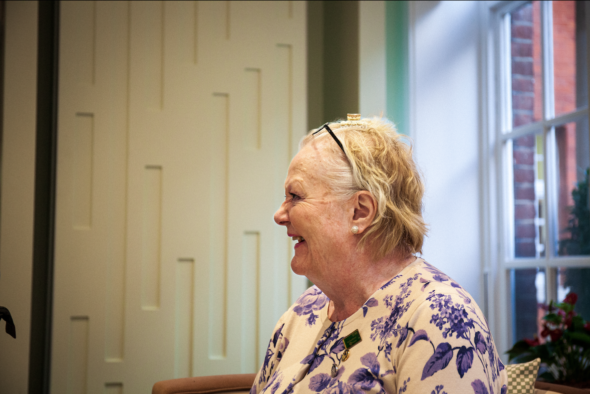
Listen 00:07:33
Story: Shenna Cummins - Central London, Paddington
Friends of St Mary’s Hospital is an independent voluntary organisation providing support and raising funds for St Mary’s and Western Eye hospitals.

Listen 00:05:44
Story: Udo Bauer - Central London, Paddington