
As I joined, the major grant the Friends made for the Middlesex was £200,000 to the new adolescent unit, the first in the country.
Listen 00:26:08
Story: Gillian Vaughan Hudson - Central LondonStories of volunteers supporting the health service since 1949
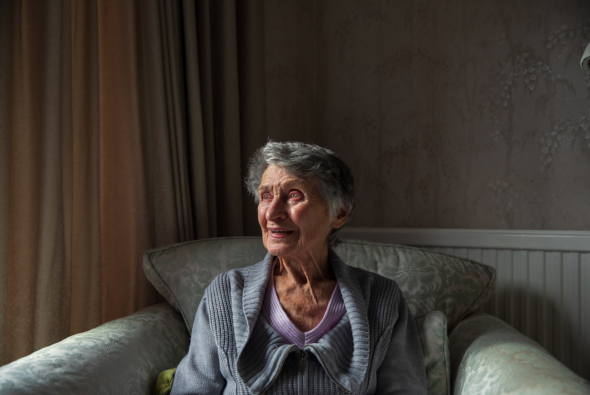
Lorna Citron - Central London
Starting work at UCH in 1945, and being continuously involved with the hospital since then, Lorna clearly has a deep-rooted love of the hospital and the community it serves.
Her administrative skills were seized upon to support the developing role of the Friends in the hospital as the requirements of the NHS of their contribution changed.
I was fairly well immersed in UCH, and when I retired early, I thought “Well what can I do to help the hospital?
At the heart of her story is a real compassion for the patients, and a desire to make their lives easier, and improve their experience while in hospital.
Interviewer
So, first of all, could I ask you your name?
Lorna Citron
Lorna Citron.
Interviewer
Thank you. And could I ask what Friends group we are talking about today?
Lorna Citron
Well it was UCH, and it became UCLH.
Interviewer
Absolutely. And could I ask how old you are?
Lorna Citron
93.
Interviewer
Well, it’s lovely to meet you today Lorna. So could you give us a bit of an idea about what first inspired you to get involved with the League of Friends at UCH?
Lorna Citron
Yes, I first went to work at UCH in August, 1945.
Interviewer
Golly.
Lorna Citron
So that I was fairly well immersed in UCH, and when I was retired early, I thought, well, what can I do to help the hospital? And I thought I’d join the Friends. And I was interviewed, which was very funny. But I passed the interview, at least I think I did, because I had an agenda, and I went to a meeting. I met a lot of people who had been on the Board of Governors. The Board of Governors had ceased, and they’d gone to the Area Health Authority, and they thought they’d continue their relationship with the hospital by joining the Friends.
Interviewer
So, can I just go back a bit? What role did you play in the hospital? What? When you had a job?
Lorna Citron
I was an administrator.
Interviewer
Okay. And that’s interesting, because we’ve met a number of administrators across London who’ve got involved with the Friends group, on retirement.
Lorna Citron
Yes.
Interviewer
And at what age did, how long ago did you retire?
Interviewer
I’m thinking at least…
Lorna Citron
I was fifty…fifty-nine.
Interviewer
So almost 60. So 35 years ago roughly. Okay. And so you’d spent a long time at the hospital?
Lorna Citron
Yes.
Interviewer
And how did, as a member of staff, did it feel like you were part of a community? Did you get to know everybody? How did it work?
Lorna Citron
Oh, yes. Yes. I started very low, as a secretary to the paediatric department, least I thought I had a job in the X-ray department. But when I arrived for the job, they said no, I was going to the paediatric department. Didn’t really matter. I didn’t know what it meant. And so I found myself with a lot of children, which was nice. And then I was upgraded, when I’d been there three years to the office, and the office was the centre of things. And from then onwards, I climbed up the ladder.
Interviewer
You were very embedded, and I imagine lots of people knew who you were in the hospital, as well?
Lorna Citron
Yes.
Interviewer
Lots of staff?
Lorna Citron
Yes.
Interviewer
So you retire, you get interviewed, and you’re allowed into the Friends?
Lorna Citron
Yes.
Interviewer
So what was the Friends like in the mid-eighties? Was it big group? Small group?
Lorna Citron
It was quite elite. That’s why I was interviewed. I think they were members who had been on the Board of Governors. So were retired, or busy doing other things most of the time. And we were, I was trying to think of the Chairman’s name and I can’t, It was a lady who had, had been Chief Medical Officer, to the government.
Interviewer
Okay.
Lorna Citron
And she, she was very elevated and my, the Vice Chairman of the Friends, was I think my ex-boss who had also retired. So I went from being under his guidance, to being under his guidance.
Interviewer
And being paid for being under his guidance, to not being paid to go under his guidance.
Lorna Citron
Yes.
Interviewer
Okay. So you arrive, you go to a meeting, and what sort of things are the Friends doing at that point, from your recollection?
Lorna Citron
I think they were raising money, which is an important thing. These Special Trustees, which I expect has been mentioned to you. We had a link with the Special Trustees, and we got them to agree that they would subsidised large items, which we were giving to people. I think that’s continued. I no longer belong to the Friends, but I get their papers, and I can go to their annual meetings. But it’s quite a, quite a pressure to get up to town, and cross the road, and go upstairs.
Interviewer
Absolutely. So, so they did fundraising. And would that have been sort of a coffee shop, or would that have been?
Lorna Citron
No, we had, we had nothing. We had no facilities. It was difficult to find a room to have the meeting in. So it used to be in different places. So you had to read the agenda before you went, otherwise you wouldn’t go to the right place. It was a bit ramshackle, I thought. And, and I thought, “I think this place needs getting together.” And so did my Vice Chairman. So we gradually got a feature, to get a room for parents of children to stay in. Because they came to London, there’s very little parking at UCH, there’s none at the moment, but there was a little in the old building, and the parents had nowhere to stay. They had to stay in a hotel, and trek backwards and forwards. So we found a room and we had to get the hospital to vacate it, which they managed to do eventually. And we furnished it, which was quite expensive. And we provided money to enable people to stay overnight, have breakfast, and go out to the ward.
Interviewer
So it was a very practical difference, for families.
Lorna Citron
Yes. Because a lot of, well if you are a specialist hospital, and to a certain extent we were, it was essential because there wasn’t anywhere that people could stay. We were vying with the college, it had 7,000 students to find accommodation for.
Interviewer
Absolutely. Accommodation in London is hard to find and very expensive and remains so.
Lorna Citron
I don’t know what they’re doing now. I dread to think.
Interviewer
So. So some very practical stuff that the Friends used to do. Really practical, supporting people. You said it felt like it needed a little bit of organisation? Is that where your administrative skills came in as well?
Lorna Citron
Yes, I think so.
Interviewer
Yes. It’s okay. So it, it was an organisation that took a bit of tidying up. And I have to say that that story about the room is a lovely, lovely anecdote, and I haven’t heard any stories that are similar. You talked about Special Trustees. Now nobody’s given me much information about Special Trustees. So explain how that works.
Lorna Citron
The Special Trustees, when the voluntary hospital ceased to be voluntary, there was still money in the coffers, and we didn’t want to lose it to the government. So we appointed Special Trustees to look after those funds, and invest them, and provide capital for the hospital. The Middlesex Hospital is the same. And at the present moment, our Special Trustees had quite a lot of money.
Interviewer
So this would’ve been, just so I’m understanding it correctly, at the point the NHS was formed, UCH had money, and so that money was ring-fenced for it. And that money still sits potentially as a Special Fund that can be used to subsidise things.
Lorna Citron
Yes, that’s right.
Interviewer
And then picking up on your earlier comment, there’d be sort of almost a partnership between the League of Friends, and the Special Trustees, for certain projects where they would jointly be funded exists?
Lorna Citron
As far as I know, the Special Trustees, at present, provide 50% of big items, which the funds we had started, were at 20%. So they’ve done very well.
Interviewer
Very good. That’s really interesting. And it’s not a relationship I’ve actually heard a lot about, so thank you for sharing that. So are there any other stories of things about your time when you’ve been involved with the Friends, that you particularly registered for you, that you particularly recall fondly?
Lorna Citron
That’s the trouble. My memory doesn’t, has let me down. I must have done something I think, but I don’t know what.
Interviewer
Okay.
Lorna Citron
And I don’t know what the Friends did. I mean, we provided enough chairs to fill the Albert Hall twice, I’m sure. Okay. Because we always, every the end of the year we provided a hundred or more chairs, and I can’t think what, where they can go.
Interviewer
It’s interesting chairs. The other thing that historically, which made me smile, that Leagues of Friends supplied, which seemed to disappear a lot, were goldfish.
Lorna Citron
Oh, we haven’t had goldfish.
Interviewer
You didn’t have to do goldfish. So, Okay. You’ve already shared that you’ve had a stroke and that’s been a challenge. So thank you for seeing us. But do you think there’s still a need for people to give their time to support their hospitals?
Lorna Citron
Yes. Practically yes. I mean, one thing that shook me some years ago was the fact that no one is responsible for ensuring that patients eat their food. Food is put on the plate, put on the…
Interviewer
Thing over the bed?
Lorna Citron
Thing over the bed. And if the patient doesn’t eat it, or is asleep, nobody wakes them up. Nobody offers it to them. They just take the plate away.
Interviewer
Yes. And so there, there, there’s volunteers who help with feeding now.
Interviewer
Okay. So we need to get more interest in our hospitals to help change things?
Lorna Citron
Well, they may have changed them. Yes. I mean, it was years ago, but it seemed so bizarre.
Interviewer
it, it, it sometimes the simple things that the volunteers can make a difference with.
Lorna Citron
Exactly. And going out and buying a newspaper. Well, it isn’t easy nowadays, I know. But going out and buying their favorite fruit or, nobody does it unless there’s a volunteer. But voluntary services can be run by the hospital, which they were at UCH, I had to be careful. I was a volunteer one day, and in the Friends the other, and the Voluntary Services Manager, I was her boss when I was the Friend, but I was her underling when she was the volunteer. And you had to work out where you went.
Interviewer
There’s a degree of politics involved sometimes around volunteering. Yes. And I’ve seen that over the years in many hospitals. So you volunteered for a long time?
Lorna Citron
Yes.
Interviewer
It was a big contribution. What kept you volunteering? What encouraged you to keep going?
Lorna Citron
Going in to catch up with the hospital gossip.
Interviewer
Okay.
Lorna Citron
Going to London. Because I would go into London, and do my volunteering, and perhaps go to the theatre in the evening. It was…
Interviewer
So, it was something about a structure, and being part of it?
Lorna Citron
Yes, I mean, if you’ve worked at the place for nearly 40 years, you get to know everybody, and you get to hear the gossip, and all the rest of it.
Interviewer
It’s nice. It’s being part of that community isn’t it?
Lorna Citron
Yes. It is. And, and I ran the Obstetric Hospital canteen.
Interviewer
Okay.
Lorna Citron
And all they did was serve coffee, and tea, and biscuits…and that was it.
Interviewer
So just before we finish, when you knew we were coming today, was there anything that you thought you might want to tell us that you haven’t had the chance to say yet?
Lorna Citron
Not until the moment you’ve got in the car.
Interviewer
Well, thank you ever so much. Thank you.
| Contributor: | Lorna Citron |
| Recorded on: | 18 December 2022 |
| Role: | |
| Setting: | Hospital |
| Organisation: | |
| Hospital: | |
| Location: | |
| Themes: | |
| Decade: |
Listen 00:26:08
Story: Gillian Vaughan Hudson - Central LondonListen 00:10:48
Story: Jennifer Loehnis - Central London
Listen 00:09:07
Story: Fiona Aird - London, Yeovil