Please let us know what you think of our website by completing our quick one-minute survey Leave feedback

Friends Voices

Stories of volunteers supporting the health service since 1949

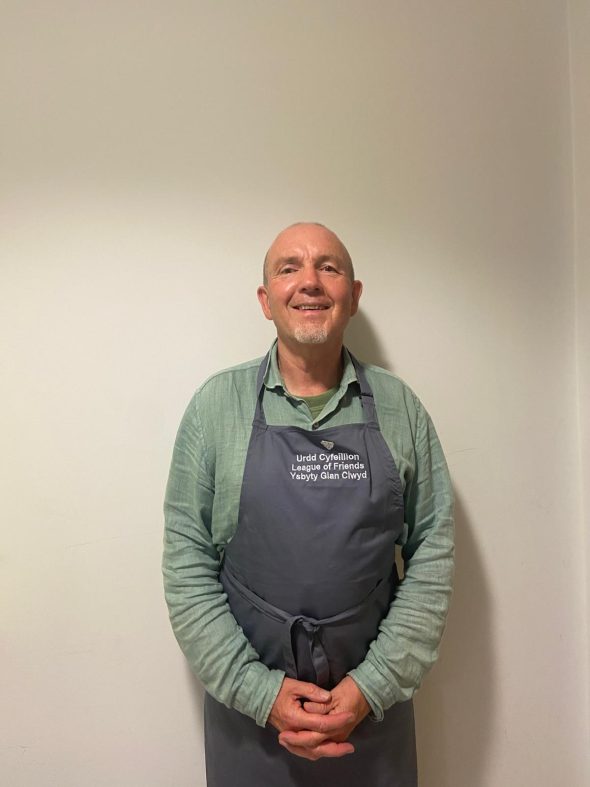
Kate Owen, Glan Clwyd League of Friends - Bodelwyddan

Kate Owen, Glan Clwyd League of Friends

Kate Owen - Bodelwyddan

Volunteering actively became part of Kate’s life when she was 16.

It was foundational to her career as a nurse. Working in both England and Wales, Kate was able to see first hand, the difference a Friends Group can make in a hospital.

We have to move with the times. We have to keep modern, and we have to ensure that we are current in today’s world.

Now retired, Kate has thrown her energies and experience behind the Friends Group at Glan Clwyd, and recently became their Chair. She knows the difference an effective Friends Group can make to the hospital and quietly encourages Friends Groups to continue to be relevant and make the best contribution they can to the NHS

Beginning volunteering at 16 years old

Interviewer

Good morning. Perhaps I could start by asking your name,

Kate Owen

Kate Owen.

Interviewer

And which friends group are we talking about today?

Kate Owen

Urdd Cyfeillion, Ysbyty Glan Clwyd League of Friends at Glan Clwyd Hospital.

Interviewer

Thank you. And could I ask how old you are Kate?

Kate Owen

57.

Interviewer

Nice to meet you. Firstly, what got you involved in volunteering?

Kate Owen

I started volunteering as a 16-year-old. I was wanting to go into nursing. My mum was the local district organiser for the WRVS in the eighties when it was the WRVS, and then she asked the Nursing Officer of our local community hospital in Golden Bay whether I could come in, and just observe nurses. So she agreed, and I started volunteering, and I was volunteering for about two years prior to going into nurse training.

A career in Nursing

Interviewer

Did the volunteering stop while you were a nurse or how did that work for you?

Kate Owen

It did, it did stop. I went into nurse training, did the three year nurse training, and I didn’t volunteer until I was medically retired in 2009, and I started volunteering again for the League of Friends here at Glan Clwyd

Interviewer

So had you known them in that period of time before then or was this just a reintroduction for you?

Kate Owen

I knew.  I worked here as a nursing manager in intensive care. So I was fully aware of the League here, because you always used to come down for our sandwiches or sweets, as I too used to like. And so I was aware, and I knew a few of the volunteers anyway, so they suggested I come along if I had time.

Seeing Friends over the Decades

Interviewer

And so you’ve seen Leagues of Friends in different locations over decades? Realistically,

Kate Owen

Yes. The League of Friends that I was introduced to was the one at the University Hospital Wales, and Cardiff. And they were based on the concord of the hospital, which is the ground floor because it was run by old ladies, you know, I think the youngest age was 80 plus. You know, they were a bit slow compared to how we are at Glan Clwyd. But it did serve a purpose. So that’s where I saw it. And then I moved to London, and they had outside businesses like Menzies, and Smith’s, and  Boots. They didn’t really have such a thing. And then when I went to the Brompton and Harefield, they had a League of Friends, and I saw that back in operation again, which was marvelous.

The Friends of Glan Clwyd Hospital

Interviewer

So when you came here, was the League of Friends as you expected to be or was it different?

Kate Owen

It was, it was more, it was modern compared to what I’ve seen, but it wasn’t different. You had an idea what the whole ethos of it was. It is raising money for equipment to give back to the hospital. That has always been the ethos of the league for us, for me anyway. So, no, it’s just I suppose the modernity of it really. I think it was quite modern here compared to the other places. Cardiff, they closed the League of Friends because they wanted the big companies then. Royal Harefield kept the League of Friends, but they also had other charities as well working alongside them. Brompton, they have their own hospital charity. So yes, coming back to Glan Clwyd, I thought it was quite modern in approach. We had Covid, Covid changed a lot of things. We stopped for a good two years for the League of Friends here. And then we decided to rationalise really with what we needed, and how we were going forward. But at the same time we lost a lot of volunteers. We had about 300 volunteers prior to Covid and, now we are now just up to 82.

Interviewer

So are those numbers going up again?

Kate Owen

Starting to go up. We are having new volunteers in, it’s difficult to get volunteers everywhere nationally, isn’t it? But they are starting to apply to it, and hopefully our numbers will go higher than, you know, we hope we would like 150, but if that’s possible, we will have to see.

Interviewer

I must admit coming in here, as you describe it, the, for people who want to come, and visit.  The coffee shop is beautiful. It looks very modern. It’s very contemporary. Yes. And I would imagine it’s a very popular place for people to potentially consider volunteering because it looks nice, it looks like you are part of something vibrant.

Kate Owen

It is, and we look after our volunteers. Lots of charities don’t look after the volunteers. What do I mean by that?  The communication is good. We inform them what’s going on. We have just sent out a newsletter now for winter. We normally do a newsletter every quarter, but we’ve had a very busy year. We’ve had 50 years of the League of Friends this May, so we had a tea party, and we had corporate management of the Betsi Cadwaladr University Health Board. They came to praise. We opened an honours board in the tea bar so people can see how much money has been raised in the 50 years of the League. Over 7 million pounds has been raised, and it’s been given back in the form of equipment. This year we are giving 300,000 pounds back to the hospital. And the bids have been accepted by the hospital.

Kate Owen

And as you’ve seen on the table, we have a label to say what has, what are the pieces of equipment that we are funding, which the volunteers need to know as well as general public. And then we have a volunteers week in June, National Volunteers Week. So this year, because we were celebrating 50 years, we produced a badge, the League of Friends Emblem Badge, gave it to all the volunteers. And in October this year we are having a volunteers evening, and that’s for all volunteers to attend. And that’s going to be like a buffet and musical entertainment. We might give out long serving certificates from Attend, I need to get a list together, which we haven’t done yet. And we have a Christmas Carol service coming up in December for them. And we also have a Christmas Fair. So really we really look after our volunteers and if they’ve got any concerns or they can’t work the shift, they’re just as good to us. They’ll say, well I can’t work Monday, but I could do a Wednesday shift. So they’re flexible like we are, and we’re grateful for that. And we do look after our volunteers.

Interviewer

You are clearly very proud, and do a great job here. Do you have any other favourite story of your time here?

Kate Owen

Well, we’ve had sadness this year, haven’t we? We  had a really good Chairman, Mr. Brian Roberts, who died suddenly in January. And he had quite a few things he liked to do. Like, oh, he’d come onto a shift on a Friday morning, this is what I used to notice, and how the till was with all the coins. He would change all the coins round. He used to wind us up, but it did. And then the cups, he’d turn them upside down,  and he’d say to us volunteers, “don’t add the hot chocolate powder onto the hot drinks. You know, because it’s sweet enough Kate, it’s sweet enough”. So that was quite funny, really, you know, and we all laughed at that, and we do miss him. We do really miss him. So I’d say, you know, talk about recent events really, and just getting to 50 years,  because we are going to move forward now we are  bringing in new changes.

The Friends have a place in the future

Interviewer

Some people think that League of Friends is a thing of the past. You talk about it as a thing of the future.

Kate Owen

It is part of the future, I think hospitals can’t survive with having companies coming into the tea  Bar offering newspapers like Smiths,  Boots,  or Menzies,  because no money goes back into the hospital in the form of equipment. Yes, they pay a high rent to be able to be part of the hospital, but that doesn’t always work. I think the League will survive, but we have to move with the times. We have to keep modern, and we have to ensure that we are current in today’s world, really. Thank you.

About this story

Contributor: Kate Owen
Recorded on: 5 February 2025
Role:
Setting: Hospital
Organisation:
Hospital:
Location:
Themes:
Decade:

Related

"Just coming out and learning to mix with people again, and actually talking to people, and it just sort of helped me over, given me confidence again, and feel self-esteem coming back in my life again."

Listen 00:03:15

Story: Iris Williams - Glan Clwyd Denbighshire

"I think you've got to be committed and want to do it. There's no point in thinking, “oh I’ll give it a go”, and you have to sort of get involved with a group as well. I think that helps really. It's nice to get involved with the group."

Listen 00.04.45

Story: Colin Griffith - Glan Clwyd Denbighshire

Welsh is my mother tongue and there are so many people who come in here, I think, who appreciate speaking in their mother tongue. It's important here.

Listen 00:04:19

Story: Merfyn Tomos - Glan Clwyd Denbighshire