Stories of volunteers supporting the health service since 1949
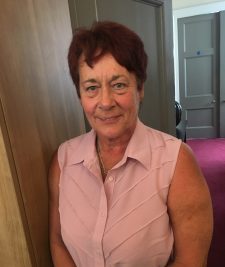
Jean Howard - Harefield, London Borough of Hillingdon
Jean has volunteered for over 50 years. The organisations she has got involved with have mirrored the life-cycle of her family life, be it her children’s school or her mother’s care home. Her consistent ambition has been to add value to the lives of service users. Most recently at Cedar House, where her lifelong partner, husband Keith was to die, she found a place to make a difference.
I take my dog in. They love seeing my dog.
Using her connections, she secured a donation which paid for the purchase of the summerhouse in the garden: a place where residents can truly feel they have gone out.
Interviewer
So, first of all, could I ask your full name?
Jean Howard
It is Jean Howard.
Interviewer
And what friends group are you involved in at the moment?
Jean Howard
Cedar House in Harefield
Interviewer
Brilliant. And how old are you?
Jean Howard
76.
Interviewer
And you don’t look it! Thinking a bit about volunteering during your life. What first got you involved in volunteering?
Jean Howard
First of all, really, it was my son and the school. They wanted volunteers on the PTA ( Parent Teachers Association). I’d done that for many years. I then graduated to the governing body of the schools. I became Chair of Governors for 15 years, stayed with my son and my daughter through their schooling years. And then my mother was taken ill. She went into a nursing home in Slough, I volunteered there, and then somebody approached me to go on the committee of a private care home in Beaconsfield, which I sat on the committee there for quite a few years. Sure, We had to close it down because of asbestos. I then went to see the house, oh, in between times I’ve been to two more care homes, mainly because my husband was taken ill and he went into a care home.
Interviewer
So really almost in every aspect of your life, were your family have got involved in something, you’ve suddenly found yourself volunteering alongside that organisation?
Jean Howard
That’s right.
Interviewer
Yes. And I’m guessing that’s probably at least 40 years worth of time that we are talking about, how long?
Jean Howard
Oh easily. Well, my son is 50 something.
Interviewer
Yes.
Jean Howard
You know, it was when he was five
Interviewer
Well okay. So Yes. 50 years’ worth of volunteering in different locations. Yes. So I can remember that must be the best part of eight, nine years ago. I first met you at Burnham House. That’s when Keith was a resident there?
Jean Howard
No, no, not yet. My mother was a resident there.
Interviewer
Oh, was it your mother?
Jean Howard
Yes, my, my Keith was still luckily, Okay. That is my Mum.
Interviewer
And did they have a big volunteering program, or is it something that you encouraged?
Jean Howard
It was myself and two other people. We had people in there. We made a lot of money. I mean, there was just three of us looking after the bank account. And over the period of time, I think we had about £10,000, which we raised. It was lovely.
Interviewer
And that was mainly doing raffles and that sort of thing? What sort of thing did you do?
Jean Howard
Raffles, I mean, I’d go in there on a Saturday afternoon where they could be a horse race on, okay. “ Come on, everybody gimme a couple of bob for their horse race and see who’s gonna win”, Little things like that.
Interviewer
So a bit like a sweepstake almost?
Jean Howard
That’s right, yes.
Interviewer
Yes. But it, it provides interest.
Jean Howard
All ad-hoc you know, people, when my son was at the school and we used to the school fairs, they’d say, “oh my gosh, here comes Jean again.” You know? But then unfortunately when my husband was taken ill, I’d cared for him at home for four years, still doing volunteering. And then he had to go into care himself. Six years, he was in a care home. But I love it because people look forward to seeing you going in. And some of them have no relatives that, that they’re put into a home and just left and I think it’s…
Interviewer
And, and of course, some of them have relatives, but they live a long way away. That’s right. But some actually have no relatives because they literally they’re the end of a generation, or an end of a line.
Jean Howard
Well, some of them can’t cope. My son couldn’t. My son could not cope to go to see his Dad in either in hospital or the care home. The only time he did come was on our Golden Wedding. And he came and sort of celebrated that with us, you know? But no, people do find it hard.
Interviewer
I know. I’ve got a nephew that struggles, I’ve got family in a care home and he struggles to go because he thinks that it, for him, it’s not the same person. And that the deterioration is sometimes quite challenging for people. Isn’t it?
Jean Howard
Yes. Oh it is. It is. Yes. They don’t know how to cope. They perhaps cope with their loved ones. But when they see somebody sitting next to their loved one, who’s making funny noise is doing funny things, they don’t know how to cope with it. Me, I just go in, and waved to everybody, and make a noise, and they love it.
Interviewer
Well, and you’ve got, created good relationships with the Wellbeing and Activities team, for example, there over the years. They’ve sort of, you’ve almost become like an unpaid member of staff, haven’t you over the years?
Jean Howard
Yes. Oh yes. I had to get my fingers in the pies.
Interviewer
Yes, and done a brilliant job because of that. But then, and, and obviously, you’ve been very constant. And even though Keith’s no longer with us, you are still supporting the home, which is fantastic.
Jean Howard
Yes. And I mean, feathering my own cap. I’ve got a manager of a care homes eager for me to go there.
Jean Howard
But I can’t because I’m at Cedar at the moment. If I have more time, I’ll do both.
Interviewer
And, and also when I think about Cedar over the years, so you’ve been a really sort of constant that we’ve had sort of young kids from the Harefield Academy every now and again, who’ve come and volunteered. You and I have sat outside. And we’ve had youngsters from the National Citizenship Service doing the garden and things. Yes. Thats it, it all brings something to the daily lives of the residents.
Jean Howard
Doesn’t it? That’s right. They love it. They loved seeing the children. I used to take my dog in. They loved seeing the dog. It’s I don’t know, they stroke it and say, “come and sit on my lap.” You know, they actually loved having animals.
Interviewer
Yes. It’s I think, I think the things that they might associate with normal life. They sometimes feel like they cut off from the rest of the world don’t they.
Jean Howard
Although I got as much out of it is what they did, because living by yourself it was lovely to go in and you see them, “Oh, Hi Jean, come and gimme a kiss. Oh, what we gonna do today? Where are we gonna go?” And that is payment in itself for the time that you give up for them, you don’t want monetary or anything. It’s just satisfaction. You know, that you’ve put something into their lives, you know?
Interviewer
So do you have any favorite stories of your times volunteering over the years?
Jean Howard
No, I don’t think so.
Interviewer
Okay. There’s lots of good times.
Jean Howard
Yes. it’s all good. You wouldn’t do it if, if you did enjoy it.
Interviewer
So you mentioned Beaconsfield. Yes. And one of the things that you’ve been really instrumentally in is bringing in a big load of money from Beaconsfield to help build the cabin in the garden. Can you tell us a bit about where that money’s come from and what’s your hope for that cabin is?
Jean Howard
Yes, like there was six of us on the committee, which ran this residential home in Beaconsfield. It wasn’t a nursing home. It was like a five star hotel. I was involved for many years with that. We used to do the hiring and the firing of staff. And then unfortunately we found asbestos in the building and it, it would’ve cost too much money to have put it right, as well as keeping the staff on our books while they were not working. We had to find somewhere for our 14 residents to go. And it was decided, so sadly, to close it down. And because we were a charity, we had accumulated about £30,000 in the bank, which we had to keep for emergencies. And the constitution stated that we could donate the money to like for like, so we couldn’t just go and give it to people abroad. So I put in for the money, I felt terrible doing it. And I got the money for Cedar, for the Log Cabin, whatever you like to call it. Hopefully in the summer they can, the residents in Cedar can, take their loved ones out to talk to them and have a cup of coffee with them. And even if it’s raining, they can still go out there. So I’m just dying to see the, the end…
Interviewer
And I think it’s been really helpful because you getting that money has meant we could afford to buy the cabin in the first place. And I have to say that the care home provider have been very helpful. They’ve built a nice new pathway out to the area and a patio. A bit more discussion after our last committee meeting is they’ve said, they’re going to put power out to it now as well, which is a real bonus.
Jean Howard
That is needed,
Interviewer
That is needed. It means that they can have a fridge out there if they want it don’t they, or in the winter, they can have a little bit of heating out there if, and it extends the season for the, the residents to use it.
Jean Howard
That’s right. That’s right
Interviewer
I think it’s just fantastic that you managed to bring that money in and, and well, Beaconsfield is no longer there. It’s been still used for a similar purpose.
Jean Howard
The actual house long belong to Lord Reith from the BBC. It was, and we actually rented it from Lady Farnham, it was a beautiful place.
Interviewer
Fantastic.
Jean Howard
It was a lovely, it was very sad. The day we had to say goodbye to it. And there again, a lot of the stuff we had to get rid of. So the Dogs Trust had a lot of stuff. They came in their vans to take away all the linen stuff and the furniture which they could sell. So everybody gained from it. I hate to see waste.
Interviewer
So you’ve been involved in… so the, the concept of a friends group be of a cathedral or be it of a school, or be it of a care home, or a whole hospital, is that we add extra value to the main organisation. When you look at the world in which we live today, do you still think there’s a need for organisations like friends groups?
Jean Howard
Even more, even more, to be quite honest, especially now everything’s going up that you’ve got to support them. Yes. Literally have got to support them
Interviewer
And otherwise people would just get the basics, won’t they? Yes. And you know, we’ve talked about a garden room, but equally I often love, but a free packet of chocolate buttons can make the real difference to somebody’s day.
Jean Howard
That’s right. Well, when I was involved in Burnham House, which there’s what 74 residents, my conservatory was like Boots – the chemist, I’d go out and buy presents for every single person. I’d get a carrier bag. They’d all have about five or six year little gifts in it. Toiletries, bed, socks, whatever. They wanted. 75 bags in my conservatory and I’d go around Christmas morning, deliver it all. And it was lovely.
Interviewer
And I think actually, that’s one of the things the public don’t always understand about what should be provided and actually what’s the family’s responsibility. Yes. So the one that always surprises me is that toiletries, aren’t the responsibility of the care home. They’re the responsibility to the individual resident and their family. And there’s sort of a logic to that to me because actually we all want a different toiletry.
Jean Howard
Different, that’s right.
Interviewer
We, you know, we grew up with a product. My dad, you know, grew up with Vosene for his hair. And you know, but he still wants Vosene on his hair because that’s what he had. And so if they offered him strawberry from Body Shop or something, he’d be like, “what”? So I can understand the logic around that. But if they don’t have family going right back to the beginning, then who buys it for them?
Jean Howard
That’s right.
Interviewer
And its down to the likes of you and your fundraising to make that happen. Yes. So that’s fantastic. So we think we still need friends groups. What would you say to encourage somebody today who might be thinking about volunteering to do that? A friends group might be a good place to, to consider?
Jean Howard
To meet me over a cup of coffee, tell them what I do and say to them, come and spend a day with me in the care home.
Interviewer
Absolutely. And I think that that bit that you said in the that somewhere in the middle of our talking about, you’re not looking, you don’t look for money because actually you get paid back in so many other ways.
Jean Howard
That’s right. If, if I didn’t do this, I’d be sitting at home. Well, Keith’s been gone literally five years this year, feeling sorry for myself. And I’m too young to sit at home and feel sorry for myself. I want to do something. I want to put back to what they looked after Keith for six years in two different care homes and they need, they need something put back.
Interviewer
Yes.
Jean Howard
Yes. Literally.
Interviewer
Yes. It’s lovely. Well is there anything else that you thought you might want to tell me about you haven’t had the chance to say
Jean Howard
Yes please. Can we get back into the care homes as two years as I’ve been in one?
Interviewer
Yes, absolutely. Yes. And that process is beginning to happen. So if people do come forward, then we’ve got an opportunity, but thank you ever so much. Thank you.
Jean Howard
You’re welcome.
| Contributor: | Jean Howard |
| Recorded on: | 31 August 2022 |
| Role: | |
| Setting: | Hospital |
| Organisation: | |
| Hospital: | |
| Location: | |
| Themes: | |
| Decade: |