Stories of volunteers supporting the health service since 1949

- Nottingham

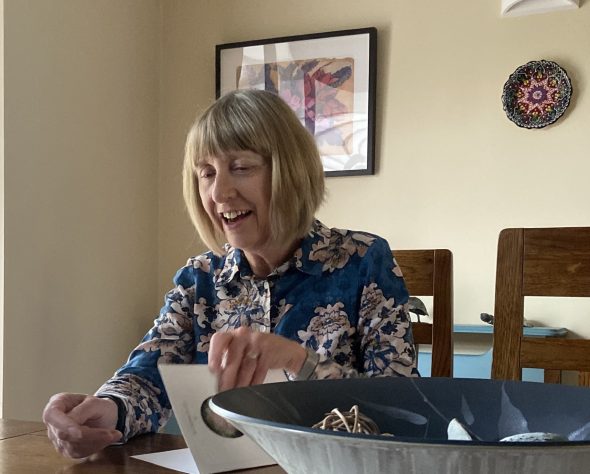
Cathy started volunteering in care homes as an extension of her involvement in the Nuthall Methodist Church as a way to make Acer Court and Alder House feel more part of the community. She started with one-on-one visits, first with Dorothy, a resident with advanced dementia, and then with Tina, a resident who had been a Major in the Salvation Army, and became a good friends before she passed away.
The first person was a lady called Dorothy. And, it was interesting because she had really quite advanced dementia, and sometimes it was difficult to talk to her. I would try to find out about her past, and she couldn’t tell me. So, for example, I asked her where she’d worked because I knew she had worked, and she couldn’t remember. So I would go in, and see her, and we’d explore different areas, find out which of the ones she did remember, so she could remember her family. And I also established that she did use to go to church. So that was a good start, in a way. And then I also established that she liked to sing, which was quite amusing., one day when I was talking to her. and, she started to sing Danny Boy.
After those two enriching experiences, Cathy stayed involved in care homes, leading Christian service of hymns, prayers and readings to groups of residents instead of making personal visits. She is continuing to help residents in a new way and making a true difference in her community.
Interviewer
Good afternoon. Could I start by asking your name?
Cathy Milne
Cathy Milne.
Interviewer
And could I ask what organisation we’re talking about today?
Cathy Milne
I guess it’s the Nuthall Methodist Church. Is the organisation that I belong to, and the the Methodist church that I’ve been part of all of my life. I don’t work anymore, so I’m not really part of anything else.
Interviewer
Okay. And could I ask how old you are?
Cathy Milne
I’m 69.
Interviewer
Thank you. So, we are sitting in your home, in Nottingham. So have you always been a Nottingham girl?
Cathy Milne
No, I’ve, lived in various places around the country. I’m Yorkshire born and bred. So I’m a fierce Yorkshirewoman. but I’ve also spent time in the southeast in Surrey before I moved to Nottingham. So I moved around the country a little bit.
Interviewer
Okay. And how involved in those communities have you been? What gets you inspired?
Cathy Milne
I think mainly it’s always been through the church. So wherever I went, we would always seek out the local church, and be part of that, and do whatever was required there. Was it youth work, for example, which I did quite a bit of or were there other things, that were required? So that was really how we always sort of fitted in the community by seeking out the church, and looking for where help was needed, where input was needed.
Interviewer
And you are currently involved at Nuthall Methodist?
Cathy Milne
Nuthall Methodist
Interviewer
Yes. And what are you involved in there?
Cathy Milne
There are several aspects of it, because as a sort of active member of the church, I do various jobs like running a prayer chain. I don’t do so much youth work anymore. So I’m just really a regular member there. But the other thing that I’ve done recently is to become an accredited local preacher in the Methodist Church. So that means that I go out to preach anywhere in the circuit. In Methodism the churches are organised in circuits, so geographical circuits. So I can be called to go to any one of those churches to lead worship.
Interviewer
And my guess is they’re all quite different?
Cathy Milne
They are quite different. Nuthall is a very active church. We have, I would say a minimum of 60 people on a Sunday morning, and very often going up to a hundred. We have children’s groups, so we have what used to be called Sunday School. We have Boys Brigade and Girls Brigade. So that’s a very active church. Whereas some of the others are very small. There may be 10 or 15 people at the service on a Sunday morning. A lot of them do things during the week, so they might have cafes, or groups that meet during the week that reach more out into the community. But yes, every one is different.
Interviewer
So I can remember the first time I heard about your church I think was when I discovered that some of the residents of Avery Place Care Home were coming to services? They were coming in a mini-bus?
Cathy Milne
Minibus. Yes, that’s right. Yes.
Interviewer
And was that something, a longstanding relationship, or what was that all about?
Cathy Milne
I don’t think it had been going on for so long, but we had one of the founding members of Nuthall Methodist Church went to live in Acer Court. And she was a lady of great faith, a lovely, lovely lady. And I think she had something to do with this, because she would work with the other residents. So she was still doing her mission, if you like, in the care home. And I think she arranged coffee mornings, and things. And so I think it was her who actually suggested that some of the residents will be very welcome to come along to some of our Sunday services. And so they would come maybe about once a month, bring the mini bus and bring any residents who wanted to come and felt able to come. So over time, we’ve had a number of members of the church who have reached that point in their lives when they’ve needed to go into a care home, and being the nearest one to where most people lived, that is the obvious place for them to go. And we still do have people in Acer Court. It’s a rolling situation, as you would expect. So we still have people in there who are members of our church.
Interviewer
So how did you get involved in Acer Court?
Cathy Milne
The Attend organisation got in touch with the person who was the Minister at the time and asked if he thought there was any way that we could get involved with Acer Court to make it feel more part of the community, to increase the community involvement with the home. And he just asked if anybody was interested. And he was quite busy at the time. So I volunteered to take on this task and, I said, ‘’okay, yes, I will take it on. I will be in contact, with Nichole from Attend, and we’ll work through what can be be done’’. We advertised in the church if people would be interested. The suggestion was that going in as volunteers to visit residents would be the easiest thing that we could do, the best thing that we could do, at least to start with.
Cathy Milne
So advertised it. And a few people said, yes, they would be interested in doing these visits. So we set up the training with Attend, and several of us attended, that and started going in to visit people in the home. The person in the home Acer Court, a man who was called Jan was the Wellbeing Coordinator. And he had a list of residents that he thought would benefit from some extra visits. So those of us who went in, we would talk to him and find out who he thought was the best person or people, to make contact with. So that’s how I sort of rallied the troops, if you like, in the church, but also myself became one of the volunteer visitors.
Interviewer
So, who was the first person you visited?
Cathy Milne
The first person was a lady called Dorothy. And, it was interesting because she had really quite advanced dementia, and sometimes it was difficult to talk to her. I would try to find out about her past, and she couldn’t tell me. So, for example, I asked her where she’d worked because I knew she had worked, and she couldn’t remember. So I would go in, and see her, and we’d explore different areas, find out which of the ones she did remember, so she could remember her family. And I also established that she did use to go to church. So that was a good start, in a way. And then I also established that she liked to sing, which was quite amusing., one day when I was talking to her. and, she started to sing Danny Boy.
Cathy Milne
So, it just shows how important music is when a lot of other aspects of the mind have faded away. I wouldn’t stay with her very long. I’d go in and just spend half an hour with her. I’m not sure that she ever remembered who I was. But we would just sit there and chat. One day I went to see her and she always liked to sit in the lounge, so I went into the door of the lounge looking to see where she was, and saw her, and went across, and she looked up and just said, “oh, I thought it was you”. And I really had to smile because I didn’t know, I’m not sure she knew who I was, but obviously there was some recognition there. And that was quite heartwarming in a way for me that I had made some impression. I know she knew me a little bit. She was in her nineties. And, so not long after, she started to deteriorate, and we would go, she would be in her room rather than in the lounge. So I’d go, and sit with her in her room, which was interesting because I could see things on the walls, photographs, and books and things. So actually by being in her room, I could see more of what she’d done, and see that she’d actually been quite a public figure. She’d received some local Council awards. So just by observation I learned more. She was at this point 99, and on one day when I went to see her, I could tell that this, you know, we were definitely on a steep downward spiral. And the next time she really just wasn’t responding, just sitting there.
Cathy Milne
I couldn’t really even talk to her. So I just looked around and there was a Bible on the side. So I picked up the Bible, and I thought, “well, the best thing I can do, just read a few verses from here, and maybe she can hear me. Maybe that will be some comfort to her”. And that was the last time I saw her. I didn’t know any of her other visitors, any of her relatives. But, the Wellbeing Coordinator, Jan, did phone me when she passed away. And I asked if he could give me the details of when it was her funeral so that I could go along. And I actually got there, I did go along to the crematorium, and it was lovely to be there at the service. And interestingly, I learned quite a lot more about her at the funeral than I knew beforehand.
Cathy Milne
But it was a good memory to have. In these times when I was going in to visit Dorothy, I came across a lady who was sitting out in the reception area. She liked to sit there so that she could talk to all people who came and went. And I can understand that that’s probably a lot more interesting than sitting in your room. And she happened to be one of the people who came to the church in the minibus on a regular basis. So I vaguely knew her from that. But I started sitting down with her, and talking to her in the reception area. And, and we became really good friends. She had been a Major in the Salvation Army, so we did have a shared faith, although different denominations, and this lady, Tina, and we became really good friends, and we could have some quite in depth conversations.
Cathy Milne
She was a bit disappointed that the Salvation Army people weren’t visiting her. And sometimes she could get quite down about that. But I think through talking to her, I was able to, to cheer her up quite a bit. So we became very, very good friends and I’d do whatever I could to support her. I was doing the training for my local preaching at the time, and we were talking one day, and she said she’d really like to go to one of the Salvation Army, so, I don’t know, they actually call it a Citadel anymore, but whatever, one of their worship areas. But they were quite a long way away, and it was quite costly to get a taxi to go there. And so I had a thought that I said, well, how would it be one day if I took you to the Salvation Army Service?
Cathy Milne
Because I had to, as part of my training, I had to visit, go to a service at a church that was not Methodist. Different denomination. So this was, I thought, this is a good idea. Kill two birds with one stone. I could take her to where she wanted to go. And I would be able to fulfill that, little bit of my project. So that’s what we did. And we had a lovely morning at the Salvation Army in Arnold. And she was welcomed, you know, by people there. So those were the sorts of things that we, you know, we could do together.
Interviewer
And Tina didn’t have family?
Cathy Milne
She didn’t have, she was never married so she didn’t have any children. She did have brothers and sisters, and her main contact was her sister-in-law, who she would, talk to. They lived down in Essex, Southend, I think. So, they couldn’t visit very often, so she didn’t see much of them. But she would talk to them on video calls. She had an iPad and would talk to her sister-in-law. And sometimes I saw her, because sometimes I’d go in and she’d be talking to her sister-in-law and she’d say, ‘oh, I’ve got to go. Cathy’s here’. Which was really nice that, you know, she was sort of sharing with the family. She did have a couple of other people, local friends who visited her, but she didn’t have any other family. So I tried to do as much as I could to visit her.
Interviewer
How did that work during Covid?
Cathy Milne
That was just, that was my next point, because everything was going swimmingly until, COVID came along. And the other thing that the church had been doing, actually a group of us at the church had been going to have a coffee morning there. And the home would provide drinks, and cakes, and we would go in, and meet a number of the residents. And we were doing this, and we were due to go in one day. And then I got the call that, no, we wouldn’t be able to do this. Because this was in March, 2020 when the Covid Pandemic came along. And of course, I couldn’t go and see Tina anymore. But I did go, I kept in contact, on Messenger, you know, electronically. And I did go and see her a couple of times when I could arrange to do it, which was one time it was behind screens. Another time they’d built a little pod in the garden. And so I arranged, I had to book to go and see her. But nevertheless, it was, it was good that I could keep that going, and keep that contact going. Because then eventually we came out of that, thankfully, and we were able to resume. I was able to resume my visits. Of course, now she wasn’t sitting out in the reception area, because that was definitely not something that was allowed with Covid regulations. So we always had to go into her room. And in the beginning, I had to wear masks and everything. So it changed a little bit, but it was still very good. Sadly, of course, as happens, her health started to deteriorate. I never really knew what the health problems were. And, gradually, she seemed to get worse and worse, and had one or two hospital visits, and then it really suddenly got much worse, and she couldn’t move out of her room easily. And mobility was quite difficult. So I was quite worried about her. And of course, the time came, eventually I’d gone to see her, and I went to leave. I’d been talking to her. Because sometimes I would take her flowers if it was her birthday. I took her birthday card, and things. I’d been to see her and she seemed very down, and not very well. And as I was leaving the room, I just looked, looked into her eyes. And there was something there that I thought, ‘’Hmm, this is very strange’’. And that was the last time I saw her. And I think she knew, I always felt that she knew that she was not going to be around for much longer. So again, I lost my friend there at Acer Court.
Cathy Milne
I also went to her funeral. She had several actually, because she had one at the Salvation Army. I just went to the one at the crematorium. And again, it was lovely to hear more about her life. One of the things that she loved was butterflies. She had a real love of butterflies. And in her room, she had butterflies all around on the walls, on the window. And you could see on the order of service at the crematorium, there were butterflies everywhere. And as we came out of the service, we were handed these little butterfly brooches. And so, as I came out, I spoke to the person who I was pretty sure was the sister-in-law that I had seen on the video calls. So I introduced myself, and she was really pleased that I’d gone because she knew that I was such a regular visitor. So those were the two people that I felt I could help, I could do something for, and in return they did something for me. There’s always some value you get from visiting, and feeling that you are sort of bringing something perhaps of the outside world into their situation.
Interviewer
So for people who don’t know, Acer Court and Alder House are two care homes very closely adjacent to each other, run by the same provider. And I think you’re still more involved at Alder than Acer now?
Cathy Milne
Well after Tina passed away, I found that I couldn’t really find anybody else of the residents who I could feel a connection with. And the whole situation has changed post Covid. And just before that, actually, just after Covid, actually through the Attend organisation, I was put in touch with Peter and Mary Jones, and Peter is a Church of England Vicar. And he had been going into Alder House, this next door Care Home quite regularly to do services. They were a few hymns, readings, some prayers, just like a sort of mini service. And I met up with him, and we decided that we would try to go into Acer and Alder. So try to meet the need, not that it is now. I think recently we haven’t had the minibus coming from Acer to church at all. So I think partly because there are not so many residents who want to come, and demands on their finances, and other things.
Cathy Milne
So I had already had the idea that I’d quite like to go in, do something like that. So we now regularly go in the last Thursday, and the last Friday of the month. We go into one home one day, and one home the next, and run these services. So my involvement has changed. It’s gone from being that personal one to one relationship with residents, to being there for a group of residents. And I think just the way things happen in Care Homes, the residents come and go, and you get different characters. So in many ways now, I feel closer to the people who are in Alder. I have got to know them and I have really good conversations with them and know them all by name. So I suppose I now feel more comfortable at Alder. But we still go in to Acer Court, but I think one of the challenges is the people. A lot of the people who come to the services in Acer are a little bit like Dorothy was. They’re quite badly affected. So it’s quite difficult to communicate with them apart from one chap who’s actually member of our church, but he’s from out of the area. I think he came from the Birmingham area. And he loves to read his stories. He’s got books of religious stories, and jokes, and he always takes part. So that’s my new way of being involved in those homes.
Interviewer
Excellent. So when you knew I was coming today, is there anything that you thought you wanted to tell me that you haven’t had the chance to say?
Cathy Milne
No, I don’t think so. I think I’ve gone through my journey, if you like, as they say, through the going in there. I think, no, I think I said everything.
Interviewer
Well, that’s been really lovely. I don’t think I knew Dorothy, but I did know Tina and it’s been lovely to bring them back to life today, as part of that conversation. So thank you ever so much.
| Recorded on: | 7 July 2025 |
| Role: | |
| Setting: | Care Homes |
| Location: | |
| Themes: | |
| Decade: |