Stories of volunteers supporting the health service since 1949

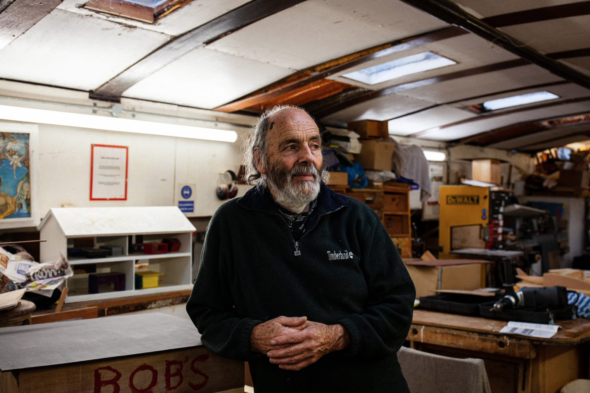
Carl Kirby Turner - West London

Over 20 years ago, Carl’s involvement started when he was trying to sell a boat to the founder. Getting involved then through volunteering has now become something which was an important part of his life.
He describes the project as a community which people move in and out of as their mental health needs dictate.
It’s about human condition, and being in control of one’s life
The benefit of being able to create something, anything in the forgiving medium of wood, without being judged, but supported in your aims, has healing properties.
Additionally, the floating workshop means the project can travel around sharing their experience, both in the UK, and Europe.
Interviewer
So, first of all, could I ask you your name?
Carl Kirby-Turner
Carl Kirby-Turner .
Interviewer
And could I ask which group we’re talking about today?
Carl Kirby-Turner
I’m with Friends of Cathja.
Interviewer
And could I ask how old you are Carl?
Carl Kirby-Turner
71. That’s right. 71.
Interviewer
Excellent. Well, it’s delightful to see you. So what first inspired you to get involved with the Friends of Cathja?
Carl Kirby-Turner
Well, I just happened to meet up with Bob Cornell, who is the person who started the charity. I was selling barges at that time where people lived in, and he was looking for one. And so he bought one through our company. And part of the sale was actually taking the people across to Holland where the barges were, and often sailing the barges back with them through Holland, across the channel to England. So I did this with Bob. I did this with Bob and I think, I I’d like to think that he noticed a characteristic, which was letting the person who had bought the barge get on with doing it, and just standing back and letting him do it. Anyway, he then said to me, when I got back, would you be interested in doing a little evening work, or that kind of thing? So that’s how I got involved in the charity and indeed in mental health, prior to that, I was just a boat builder, broker kind of, whatever.
Interviewer
Okay. So very different background. So when you got involved with the Cathja project, what did it do?
Carl Kirby-Turner
So there it was. So Bob had devised this. This really good idea of getting together a group of people who were then in a, what was called a residential asylum hospital, as people were in the 1980s. Said to them, if you had a workshop, what would you do in it? And they then devised this process where people make, create things. And that’s the whole point in an environment, where they are in control of their, of what they do, how, how they do it and what they do it. And they thought, and he thought, would be beneficial to their mental health and recovery. And lo, and behold, it (A) worked and (B) got funded. It’s from here, there and everywhere for this process, which was the beginning of care in the community, which was just arriving then. So this was people not being treated in the hospital, in groups, but, but being in the community, and taking control of their lives, which is how things are going, or have almost arrived now. But certainly in the 1980s was ground-breaking. So I’ve joined doing the evenings, enjoyed looming around with people, making stuff in wood. And there we are.
Interviewer
So there we are. You sold a man, a boat.
Carl Kirby-Turner
Yes.
Interviewer
Persuaded him to get a barge.
Carl Kirby-Turner
Yes.
Interviewer
And, he’s persuaded you to get involved with this project. And it’s about a workshop?
Carl Kirby-Turner
Yes.
Interviewer
The workshop takes place on the boat that you sold him, or on another boat?
Carl Kirby-Turner
Negative. At that point, it was the workshop that he first worked through. The workshop he got by then was in a school’s IT department, that wasn’t being used, with the machines that you would’ve had then, which enabled people to, who didn’t have skills necessarily, to make what they wanted.
Interviewer
Yes. Okay. So, it’s very, practical, creative sort of workshop?
Carl Kirby-Turner
It, yes. And, and the, the process was then, and still is, identical. Now that you make something, it is not criticised. The people use it for whatever purpose say they want to use it for. And that creative process, and being in a situation where you are not being told what to do, and you’re not being criticised, has a very beneficial effect.
Interviewer
Absolutely. So we start off, and we’ve got people who are fundamentally not potentially going out a lot, they’re in institutions, that sort of thing. And they’re coming out to do this practical project?
Carl Kirby-Turner
Yes.
Interviewer
How many people would come to an average session?
Carl Kirby-Turner
Well, so they worked it out then very well. And it’s like, exactly the same. Now you have eight people, and it’s, it works like a, a workshop, and not a drop-in centre. So you come in the morning and you spend the whole day there, 10am till 15:30pm, something like that. Eight people a day because that’s the good group size. And the people choose which days they want. And then they stay as long as they want. So the nice gentleman, who just came down the stairs into the back cabin, started with Bob in 1988. And he’s still here with us then, because it’s his choice is when to go. And that’s the same, it’s about human condition, and being in control of one’s life.
Interviewer
So we have eight, to use the current idiom, ‘service users’?
Carl Kirby-Turner
Yes.
Interviewer
And, and do we support those with volunteers? How does that work?
Carl Kirby-Turner
Yes, so that, that works. It’s a, it’s a self-producing. So the people there, they do not pay to come, but they, some people in that become the people who run it, who look after. So there’s a, self thing. So the volunteers start there. And that was probably where, when we joined with the Attend, where the volunteers, where they, they were in that group of 35 people, there would be people who, who took on the role of befriending, listening, helping with creativity, et cetera, et cetera. Oh, and also we have a number of charity shops, which fund the whole thing. And, and there, so there we have 60 plus volunteers working and it’s, it is also evolve in that people who attend the barge after a few years, “what else could I do?” Oh, do you know what I could volunteer in the shops? So it’s, it’s a sort of self-producing process, as far as volunteering is concerned.
Interviewer
Well, that’s fantastic. And it’s great to hear again, using another current idiom, a ‘user led and run organisation’.
Carl Kirby-Turner
Yes. Yes.
Interviewer
So we started off in a school…
Interviewer
And we’ve transitioned into a barge. How did that happen?
Carl Kirby-Turner
Well, it started in one Health Authority: Spelthorne. And then the next one, which has changed its name 20 times since then, but the next locality said, “oh, we would like one of those too”, where upon Bob as he was, I think he suggested that I might run that workshop. We were looking around for premises and finding none, when this large barge came available, and the trustees, much to their credit, decided to buy it. And so the second one since 1994, since 1990 has been on a barge. And in fact, actually the school one has, has, is no longer, but the barge is still here now.
Interviewer
So I have this sort of image of people making sort of, sort of little wooden boxes, and things like that. What sort of thing do people create in the workshops?
Carl Kirby-Turner
Well, there is a range of skills among the, the people who work. And we have, we have two really excellent community artists! In other words, artists who work with people in the community who attend regularly twice a week. And so they enable people to make works of art as well as furniture, which is the other side, but their skill allows people to succeed in that. So you’re not actually driving yourself crazy by <laugh> trying to make a work of art. You are producing something which, which has a, the process and the end product, both of which are, are, are very affirmative to people. So yes, we, we now have a range of artwork, art pieces, which we sometimes exhibit. I’m sure we’ve exhibited with you. Sometimes exhibit, because that’s a nice experience to, you know, to exhibit your work is a pleasant experience as well.
Interviewer
So one of the things that always seems to be an advantage, and I can remember, as we’ve known each other for 20 years now, is that the barge doesn’t stay necessarily in one place. And I’ve definitely seen you up on the Embankment. And I think, I remember you going abroad. So does the barge move around a lot? Do you have any memories of moving the barge about?
Carl Kirby-Turner
Mm, yes, those are a very memorable memory. We, we restrict ourselves to one trip a year because if it was off the whole time, then the people who needed a bit of stability would not really be able to have that. So yes, we, we were invited to Belgium, which was about three weeks going round to various mental health institutions up the canals, showing how it worked really. In those days it was quite whatever it is on the, on the front line of mental health. And that was actually, that was really excellent for the attendees, as that’s not a very good name, but that’s all we got at the moment for the attendees who were able to show their process, and be recognised as somebody who were, had, were working in and had created and were holding together a process. So we, we did Belgium, France and Southend.
Interviewer
Southend?
Carl Kirby-Turner
No, I don’t mean Southend. I mean, what’s the other one beginning with S? Shoreham.
Interviewer
Shoreham-by-Sea.
Carl Kirby-Turner
Yes. Yes. Southend would been good, but no, we haven’t done that.
Interviewer
Okay. Not yet anyway.
Carl Kirby-Turner
Not yet. Yes.
Interviewer
So, so the bit that I’m taking away about the trips is that actually some of the people who benefit from the support of the charity go on the trips with you?
Carl Kirby-Turner
Oh yes, absolutely. Absolutely. Absolutely. And, and, you know, we, we probably have more than half, so, you know, 10 or 20 people coming, not for the whole trip, and maybe for one week out three or, that kind of thing. Yes. Yes.
Interviewer
It sounds fantastic. So what I’m sort of hearing is that you are a community more than a therapy. Does that feel fair?
Carl Kirby-Turner
Mm mm. Yes. I mean, if you, if you’re working in a, in a workplace, you get to know the people you work with, and that is a, that’s a community and it’s supportive. So yes. And in some places it can feel a bit like a family, can’t it? A workplace. So, so there’s, that’s very much a part of, of the process, part of the process. Yes. That, that everybody there sort of, it’s a, of a very nice group. Everybody there has experience the really awful side of mental health being sectioned, which is just awful. So if you’ve done that, it’s a bit like being in the war, you tend not to have little niggles about, you know, how tall is your neighbor’s garden, and that kind of thing. And so it makes for a very pleasant, coherent group, changing all the time as people come and go.
Interviewer
So we we’ve covered some really nice bits and pieces. Do you have any favorite memories or stories or even people that you’d like to mention as part of this interview?
Carl Kirby-Turner
Well, people, of course, you know, the whole lot, you know, whatever, couple of hundred people who stand out, of course, Bob Cornell, who was the person who facilitated it coming into being. Two, are now three artists who worked with us for 20 years, Liz Lay of the Concrete Cows, and Martin Cottis. They’ve just produced this wonderful, diverse ability for people to create it in, in an artistic way. I mean, it shouldn’t really bring individual people of the five people, who work now with us. Two of the artists, one is me, and the other two are people who were attendees, who are now, now helping actually here on the payroll, you know, running a place in, in that, that way. Yes.
Interviewer
Excellent.
Carl Kirby-Turner
Yes.
Interviewer
So if I was listening to your interview, I was somebody who lived locally and I was interested in getting involved. What would you say to encourage me?
Carl Kirby-Turner
Okay. So the, the charity is, is set up for severe and enduring mental health, whatever that means nowadays, it had a meaning, you know, 20 years ago. So if that is your position at the time, then contacting us directly is absolutely fine. A lot of our referrals come from Social Services and the NHS and, and, and sort of, there’s always room. Once you’ve joined, you can go away for five years, and come back again. It’s, small enough to be loose like that. So there’s, there’s pretty much always room. If, people think that it might be of use in some way to them
Interviewer
Good. Now, when you knew we were going to be speaking this afternoon, is there anything that you wanted to mention you haven’t had the chance to say?
Carl Kirby-Turner
You know, I think we’ve, covered most of the general areas. Wood, not your good self, but the, actual bit that comes from trees is, is a very forgiving medium to work with. It’s pleasant to make mistake. So that fits very well. That’s really why, why it started, you know in that area, there’s a very nice video, which I hope is still on the website, which was made by another artist, which gives you quite a nice insight into the whole process and, everything.
Interviewer
Okay. We’ll see if we can link that in.
Carl Kirby-Turner
Yes. Wonderful. I hope it’s still on, on, on the thing. Yes. Yes.
Interviewer
Thank you. Well, thank you so much.
| Contributor: | Carl Kirby Turner |
| Recorded on: | 18 December 2022 |
| Role: | |
| Setting: | Community |
| Organisation: | |
| Location: | |
| Themes: | |
| Decade: |