
We stay where we feel most loved, most appreciated, most looked after...
Listen 00:16:45
Story: Rin Roach - West LondonStories of volunteers supporting the health service since 1949
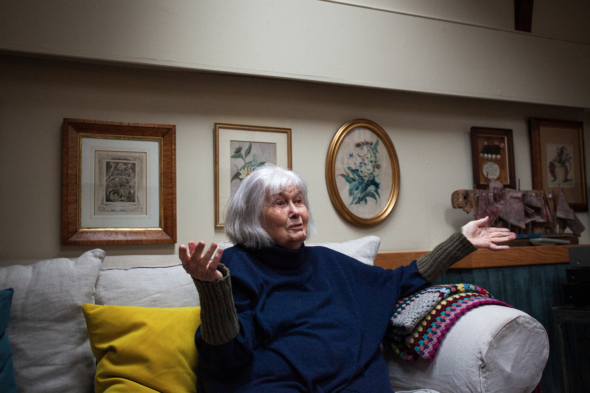
Ann Bowden - West London

Ann’s career as a GP, and a doctor at the Royal London Hospital for Integrated Medicine, are practical expressions of her clear love of the local community, and her desire to help people both positively and creatively with their health issues.
This is a provision for mental health. It has these aspects, of growing there, and being yourself, taking ownership, having ownership, making decisions, not having six weeks treatment, not having this, not being judged
The Cathja Project offers Ann so many synergies with the rest of her life. She can make a difference not only through her training, experiences but also her chosen lifestyle.
Interviewer
First of all, could I ask you your name?
Ann Bowden
My name is Ann Bowden.
Interviewer
And Ann, what organisation are we talking about today?
Ann Bowden
The Cathja Project.
Interviewer
Okay. And could I ask how old you are?
Ann Bowden
84.
Interviewer
Well, it’s lovely to meet you today. So could I ask, what first inspired you to get involved with the Cathja project? What was your life that had brought you to that point?
Ann Bowden
Well, it wasn’t so much an inspiration, it was just how things happened. And it was to do, I mean, if you actually want where it started, it was to do with me buying a barge in Holland, and Carl, who was a barge broker, bringing me over here. And then we became friends, and then he was working for the charity, and at some point they needed to have another outlet in, in Hounslow. And first of all, started at the back of the West Middlesex Hospital in a porta cabin. And I used to go along there and talk about things and didn’t do much then. And then they bought the barge. And at that point we had a little organisation, which was a Friend’s organisation. So I began to get… sort of making tea and cakes and doing some car boots, selling and things.
Ann Bowden
Little things, little hands on things. But at the same time, the whole, the whole project was developing. And then we developed a full Friends organisation to begin with. We, and we have been separate from the Connect. I mean, I don’t know if you have the information about the Connect Foundation was the beginning. And we always had the association here, which was just the Friends of, so we would meet here for meetings at about six, I think that was where we met Molly. Molly, Rick became interested and our Friends, our Friends organisation became a charity in its own right. So as far as I’m concerned, this was something that I, I was interested in. I loved the…I had my own boat. I had those, all the things and the development in getting grants, and just being interested, and a little bit hands-on, and actually being quite useful in one or two things at the beginning where we were applying for a sort of planning permission, helping, I called a few shots in, of the people who were my patients.
Ann Bowden
Because I was a GP then. So there were some very useful things I did. And then if there was anything particularly sticky, or difficult, that came up with some of the people at the workshop, sometimes I was asked to go and sort of represent that. So things like that. But I think perhaps what happened over the years was I used to go there quite a lot. We started to have the Christmas parties, and we had them here for years, and years, and they were really great fun. So that sort of hands on, but also becoming a trustee. And then I got the label ‘Chair of Trustees’, which I’m a bit stuck with. It doesn’t mean anything very much except people come here and, and yes. And I have a very, a very good knowledge of what’s actually going on about what’s going on with, with the barge, and with the people, and who’ve been there for years.
Interviewer
So how long ago was it that you, you got involved in this project?
Ann Bowden
93 94. When? When I left.
Interviewer
So 30 years ago?
Ann Bowden
Yes.
Interviewer
30 years ago. So you’ve been involved for a long time. And you mentioned that you’ve been a GP locally. I mean it’s interesting because in your narrative it feels like the boat was something which really drew you to the project?
Ann Bowden
Well, yes, it, well, yes, it was, it was Karl brought my… I bought a boat to live on, not this one, another one.And Carl was…Carl was the person who was the barge broker who used to bring the barges over. So I got to know him then. And then got a friendship sort of, and then became interested in the Cathja project, which was on, how can I put it on my patch, which is, that’s my own practice was. So a lot of the people roundabout were, you know, I knew lots and lots of people, so I, I could call in one or two little favours to get started with planning permission to use the Barge and so on and so forth. That was in the early days. I mean now it’s, it’s different.
Interviewer
It, so one of the things I find interesting having been to the barge today is that it provides almost a complement to traditional health.
Ann Bowden
Yes.
Interviewer
And you I gather that you also were involved in homeopathic medicine as well? So how do you see that complement that the Barge provides to the traditional health service?
Ann Bowden
Not the problem is, but the problem is, is you probably realise the Barge is absolutely unique as, as is the person who runs it, and the people who run it. So it’s, you know, it…one of the difficulties is that this, certainly is a one off. There’s nothing like the ethos. There is nothing like the situation. Not only that, there’s nothing like where it’s situated. That is the most, beau one of the most beautiful spots on it. So these things have come together. The great thing about that, and why this is more, more than complimentary to the conventional provision for the people. This is a provision for mental health. It has these aspects of growing there, and being yourself, taking ownership, having ownership, making decisions, not having six weeks treatment, not having this, not being judged. And so, and you can see that that makes its own ethos, but it has, over the years, it’s attracted very, very interesting people.
Ann Bowden
And the, the artists who’ve been attracted there, and work there, are exceptional. So what the people who go there have, are exposed to, if they choose to, the most incredible expertise. And then there’s also the social thing. It’s had wonderful trips. I’ve taken this when we’ve been down to, we went down to Ramsgate, for a big sort of, mental health thing. And I took this boat down as well. And we next to each other. And some of the people stayed on here. Some of the people in the barge stayed on here. So I’ve been involved in a lot.
Interviewer
So I’m now curious, where does your love of boats come from?
Ann Bowden
Well, as the, you a difficult one because I come from Barrow In Furness, which is, which is the sea, you know, it’s the, it’s the Irish Sea. We didn’t have a boat, we didn’t really have anything to do with boats, but it was a ship building town.
Ann Bowden
And whether this is, this is right or not, when I was a, a little girl just in Barrow, it was after the war. And the shipyard built these incredible P+O liners and every time they built one, we had a half day off school to go and watch the launch. So these wonderful ships, we used to watch that. And I think when you are very young, these things go in somewhere quite deep down, and they sort of a… So I didn’t have any sort of great things apart from rowing on the park lake when I was a kid. But what happened here was, which this is a very personal thing, okay, when I so I have a family grown up, well taught, almost grown up family. And my husband and I decided to go our separate ways.
Ann Bowden
So we had a big house, and I had to think of something else. I didn’t really want just to have a sort of half what I had at that time, in my general practice in St. Margaret’s, which is just down the road, there was a thing called Thistleworth Marine where it was, was just coming. That there were people who were going to live on boats, and they made it into a company. This was 70 something. And so anyway, all, most of the people who lived on the boats, registered with my practice. So I knew about this, and I was interested in this. And every now and then, I was called to do a visit and I had to sort of walk over the gangplank holding my little bag. And I was shouting “ahoy there”, you know, sort of thing. So this, this was, this was a sort of in, so when it, when it came that I had to find a new life, I thought, I’m not going to say bugger…I’m going to say “blow me. I fancy something different.” And I knew about Thistleworth and Thistleworth, which is just down from the Richmond half tidal lock. And I thought, I know what I’m going do. I’m going to buy a boat and live on Thistleworth Marine. Fortunately there was a space. So then I bought a boat through Carl’s company. Went out to Holland, found a boat, brought it back, stuck it there. And and that’s, I mean, that was just…
Interviewer
So is this the best part? 50 years ago?
Ann Bowden
No, this is what time am I talking about? 88.
Interviewer
Okay, so that’s what, more 35 years ago?
Ann Bowden
30, 35 Years ago.
Interviewer
So you’ve lived on a boat for 35 years.
Ann Bowden
35 years. Yes. Yes.
Interviewer
And you obviously like it?
Ann Bowden
Yes. Well, the other boat was, was lovely. And then this boat was being sold, which wasn’t like this. It was completely unconverted. And I just got a wind that I’d like to buy it and convert it cause I’d fallen in love with Dutch barges and I just thought they were just wonderful. And I just would like to convert one inside, so that it was wonderful inside, but looked like a working boat outside both, you know, I made a bit romantic like that. So this is all me, and this is how I came to Carl. And, and he was instrumental in helping the design of doing this, and some of the work. And you know, we called in all our, you know, our barge Friends and of course we were by Robbie Wood’s boatyard. And that, and he has been, he has, he has been when he died a long time ago, but the Robbie Wood’s boatyard has been a very important part of the barge. Excellent. You know, you know where it is. It’s opposite. Yes.
Interviewer
So it seems to me that you’ve had a sort of a, a strong association with the community in this part of London. Would that be fair?
Ann Bowden
Yes. Yes.
Interviewer
Yes. So when did you come down from Barrow In Furness?
Ann Bowden
I went to university at Manchester, and then from Manchester, I came to London.
Interviewer
Okay. And what attracted you to London?
Ann Bowden
Do you really want to hear this?
Interviewer
It could be entertaining!
Ann Bowden
My father used to tell us when we were very little, stories of how we went on a trip to London, and this was, this was the thing. And, as small children, we went and we had a dog that towed us all the way. I mean so again, this is something that’s going in very deep that London was the place to get to, a bit like Dick Whittington. So that was in my heart. And I wanted to I wanted to come to, eventually come to London. So I had to go via Manchester.
Interviewer
Okay. So it, it’s interesting. So I’m imagining that your experience in London was probably quite different from Barrow and Furnace. A different world.
Ann Bowden
Yes. Well first of all, I was a Doctor and working in a hospital and Yes, I came, I came to London, did my house jobs in Manchester, came 64, just the beginning of swinging London.
Interviewer
It must have been a fun time to be here?
Ann Bowden
Yes, I think, well, mind you, I was working the whole time. I mean, if you got an afternoon off, you were very lucky. So that was, that was how we come to be here.
Interviewer
So Lord Fraser, who before he died was President of Attend, described the Chairwomen of Leagues of Friends as formidable women with a deep rooted love of their community. That seems to fit to me, for you. Do you think that’s a fair description?
Ann Bowden
I think I, my deep love of community was very much in my practice. I mean, always in my family. I’ve got grown up children, and grandchildren and great-grandchildren and all that. But in, in terms of community, an incredible loyalty to my practice and my, and you have your practice area and that was absolute at the hospital, which of course is in Great Ormond Street. Have you been there? Any hospital where you work for any length of time is, is a, is a big community. And that, that was probably, so there was the practice here. And then when I left that, there was the community of the hospital. I have a…I have big things, about wanting, I can’t do very much enough because I’m very limited. But I suppose wanting to do things at, at the Barge as much as I could. I mean, used to go and do odd, odd bits and pieces and make cakes and make sandwiches for the trips and things like that. And we went on a trip taking this on a trip for the…for the barge down to, I think we went to Greenwich. So very much that, whether that was a sense of, I think it was a sense of community. I, I think it probably was a bit, it’s got a bit thin now cause I don’t really get out very much.
Interviewer
Well that’s one of the challenges of advancing years, isn’t it?
Ann Bowden
God, you tell me about it!
Interviewer
It. So, so do you have any favorite memories of anything that’s happened on the barge, Cathja?
Ann Bowden
Well, the trips. The trips. The trips where were, Yes, I mean, not, not just the trip, the trips. There was the trip that I went on, I went on quite a lot of trips down the river. Went to the one in Ramsgate, I mean, actually getting thre and took my own boat. There we go. But the, the one that I think I remember best is the trip on the Somme. Have you heard about that one? Oh, you haven’t heard about that one? Oh, well, so most years the, the boat has gone on an adventure. It’s been across to Belgium, I think twice? At least twice. One year there was this tie up with the mental health services in France, Northern France. And we had this thing and not quite sure how it came about that we were to go on the exchange trip to Abbeville and Amiens.
Ann Bowden
Yes, Amiens in Picardy. So the barge crossed the channel. It met up with people in, not was it Ville, I think it was Abbeville. San Valley, They had a trip. So people were coming and going, but the best bit, this is the bit that I remember it took, this is, this is Carl, nobody else would do this. Took the barge along the Somme, the river Somme. And nothing like this had gone along the Somme like, I don’t know, forever. The Canal, It wasn’t a big canal And we took foliage with us and all sorts of things. We took the, to take the Wheelhouse down and it was absolutely amazing. And then eventually got to Amiens and moored up on the key. That was, that was quite, quite remarkable, that trip while I was on it. I mean, the other ones have been quite remarkable, but you’re asking me, which one?
Interviewer
No, I, and I think part of the thing that appeals to me is that there are adventures in volunteering, aren’t there? Real adventures. You get involved and it, it turns into an adventure. That’s fantastic. Now, when you knew we were coming today, was there anything that you thought you might like to tell us? You haven’t had the chance to say yet?
Ann Bowden
I’ve been part of the Barge primarily, I think I’ve got the pleasure out of it, you know, is it because it’s really, really, I’ve really enjoyed it. So I was thinking, you know, well what were you going to ask me about what I’ve done? Well, not, you know, not a lot except I’ve just been here and I’ve, I know the history, and I know what, what happens in and outs. And I think I have been some support to the people who work there in terms and have been quite useful occasionally. Occasionally being needed to go and speak to particular people, because I’m a doctor and I could do that. So I think I’ve been useful from time to time. It’s a remarkable project. And, and one of the things that makes it, separates it from going having a problem and being prescribed six week course of this or, you know, therapeutic work that is that the Cathja is pretty well self-funded.
Ann Bowden
It is not dependent on funds from the NHS. I mean that has been, well, you know, you’ve been involved in this. So getting money has been quite something. But of course, you know about the shops and you know, about the success of the shops.
Interviewer
Tell me a bit about that?
Ann Bowden
The shops? Well, when I became involved or when I knew about the project it was mostly in it. It was, there wasn’t, it wasn’t a hands load thing, so it was all in Ashford and around there. Because the workshop was in Ashford and you know Bob. Bob with his great skills and, and incredible thick particular qualities that he had to get this going.
Ann Bowden
Had set it off with the first shop in Shepperton, which was Pamela, can’t remember her second name, who started there then about three or four more shops. And somehow Pam was, had an ability, and she’s probably in her nineties now, was the most amazing woman, and got began to get together a, a shop that really worked, which was then a blueprint for the other shops. So they started and the she shop is still amazingly going. And a shop at Walton, which we had the good fortune to be granted the, it was given to the charity, when I say given to the charity part, given to the charity by the Department of Health, I think as long as it was used for mental health works, which it has been done. So it did quite well there. And, and then we’ve got, and then we had this amazing shop in Brentford, incredibly successful and developed a great community.
Ann Bowden
You know, what is really, is actually has the most incredible skills about community work. She is a natural community person with all in all sorts of way, amazingly so. And she, because of her abilities, we began to get, she began to get with the council, get Community Hub this, community hub that, and that community… And so that has been incredibly useful in terms of raising the profile of the barge anyway, making it much more publicly known. Therefore, funding and people knowing and being the recipient of our, our charity money will go there. And that’s, that’s been quite remarkable. And now we have three shops, which, touch wood, are producing all, well to some extent, most of the money that’s lit, they’re incredibly successful. Fantastic. And they have and they’re entirely reliable, rely on volunteers. Absolutely. So the volunteering is, is in the shops. And we have happened to have a particular person, Rose, who is, has incredible abilities at retail work, and she’s now the, the manager. And it’s amazing. Amazing. And the shops are very successful.
Interviewer
So been a great support. There’s been really interesting hearing your story today. So I think we’ve heard plenty. Yes.
Ann Bowden
Heard enough about me.
Interviewer
Oh, that’s the interesting bit. We enjoyed that. So thank you ever so much. And thank you for your stories. Thank you.
| Contributor: | Ann Bowden |
| Recorded on: | 13 February 2023 |
| Role: | |
| Setting: | Community |
| Organisation: | |
| Hospital: | |
| Location: | |
| Themes: | |
| Decade: |
Listen 00:16:45
Story: Rin Roach - West London