I was fairly well immersed in UCH, and when I retired early, I thought "Well what can I do to help the hospital?
Listen 00:15:14
Story: Lorna Citron - Central LondonStories of volunteers supporting the health service since 1949
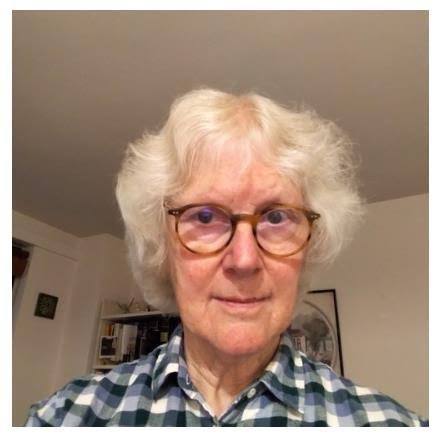
Diana Scarrot - Central London
Diana came to the Friends, following a period as Lead Governor at the hospital. Her vision is of local leadership for a hospital meeting local needs.
The Friends fund extras for patients and staff
Rather than be frozen into inactivity by Covid, it inspired the Friends to think about their contribution and make it more impactful.
This journey of change continues with new approaches to fundraising, administration and community involvement.
Interviewer
So could we start by me asking your name?
Diana Scarrot
I’m Diana Scarrot.
Interviewer
And could I ask which Friends group we are talking about today?
Diana Scarrot
The Friends of University College London Hospitals.
Interviewer
And could I ask how old you are then?
Diana Scarrot
I’m 77.
Interviewer
Well, thank you so much for seeing us today. So what first got you involved with the Friends group?
Diana Scarrot
Well, I, I’d been an elected Governor, and the UCLH Foundation Trust has governors. And I’d been Lead Governor for a little while and the Friends sort of approached me, and said, “Would I be a Trustee?” So I said, “Oh yes. Okay.” That’s when I stopped being a governor.
Interviewer
And how long ago was that?
Diana Scarrot
I think it was 2018.
Interviewer
Okay. So you would’ve come into the Friends really just before the whole Covid situation?
Diana Scarrot
Oh, yes, yes. A couple years.
Interviewer
And from your perspective, what did the whole pandemic mean for the Friends group?
Diana Scarrot
In a way, it was actually a huge opportunity to be useful in a way that I don’t think we had been particularly. We’d been spending fairly small amounts of money, and our decision-making was quite slow, and our application processes were a bit complicated. And when Covid came, we just decided straight away that we had to help in any way that we could, and we would spend money. We created a little newsletter, and we put in, I remember it, right at the beginning of, and I can remember writing: “we will fast track decisions, we’ll get applications for less than a thousand pounds just to help you through whatever it is you need.” You know, little things, microwaves, lip balm. People were very keen on, you know, people needed lip balm, people wearing protective PPE. You know, it was doing horrible things to their skin, things like that. We had a trustee who had a, had a contact who ran a pharmacy chain or something. I, I forget exactly what, but she managed to get hold of some of this stuff, which was quite, quite difficult to obtain because everybody was buying it up. And, we just kept spending money more than our income. But Heaven said, you know, we’d got some money. So it was really just, if you need something for goodness sake, just tell us because you are under a lot of pressure…you know, coffee machines, decent coffee machines.
Interviewer
It feels as though the challenge gave new energy to the Friends group?
Diana Scarrot
Absolutely. I mean, we’d been sort of changing ourselves for about a year. I mean, we’d decided that we really needed to make ourselves much more accessible, make our processes simpler, make people more aware of what we could do. And we had already sort of invented a strap line, which was “The Friends fund extras for patients and staff.” That was how we tried to define ourselves. But we hadn’t defined ourselves so clearly before. We just tried to tell people what we were around.
Interviewer
And, and here we are in the heart of London, realistically. But it feels as though you are very much a local organisation as a Friends group. Would you say that was fair?
Diana Scarrot
We’ve got several Trustees who live very close, and I live very close to the hospital. And as far as I’m concerned, UCLH is our local hospital. It’s where you go for blood tests and x-rays and things. And it’s, where I had my appendix out in January. It’s our local hospital. And, I think it’s really on the lookout for, you know, all trustees. There’s always turnover. And when we look for a new trustee, I look first around here. I want people who are within walking distance of the hospital. And that could be from Islington, or could be from Bloomsbury or, you know, around here. But, easy to get to because in the end, in normal times, you know, not the last two or three years with Covid, but in normal times we want our trustees to, to know the hospital and be friendly with it, and have contacts and know who the Matron in the Labour Ward is, or something, you know? Yes. I do see the, I do see the localness as being quite important.
Interviewer
So we’ve got local people, people who live nearby, people who see UCLH as their local community hospital. We’ve had the energy of the pandemic, and the way that’s brought the community together as well. So what, now that we are supposedly past the pandemic, how is the Friends group bringing itself together today? How does it sort of, how is it seeing its projects, its future? What is it intending to do?
Diana Scarrot
There’s a huge decision to be made, isn’t there about whether we go on spending more than our income, so our reserves will run down. Do we do that because people have given us the money to do things to the hospital. Is that the right thing to do? Or are we trying to keep ourselves in existence in perpetuity? Now, as far as I’m concerned, we should be spending the money, and with a bit of luck as people become more aware of what we do. That would probably generate, I hope that could generate some more money. We don’t have to wind ourselves up, but if we can’t actually generate more income, and there are things that need to have money spent on them now, well then I think we should spend it. And I’m thinking particularly at the time, at this time when the NHS is in real difficulty, Staff are leaving to go and work in supermarkets.
Diana Scarrot
Their pay isn’t keeping up with inflation. Anything we can do that’ll help staff enjoy their work more, and feel more satisfied, and feel more appreciated than it’s worth doing. And you know, although we’ve got a strap line which says “we fund extras for patients and staff.” In the end, what patients need is staff to look after them. And if we can stop staff leaving, leaving the hospital, and going somewhere else and going and leaving, leaving healthcare, well then we are doing our bit for patients too. So I think there’s a real decision to be made there. And I’m not, you know, we haven’t actually got a sort of minute decision by the trustees that we are going to go on spending money. But, but I think actually when we see the applications that are coming forward, that’s probably the way the decision will go.
Interviewer
The need is driving you?
Diana Scarrot
Yes.
Interviewer
So has your increased activity seen any new income, any examples of new income that have come into you that you didn’t use to get before?
Diana Scarrot
For example, we’ve had two really interesting donations just in the last month or two, which surprised me. One was a member of staff who retired who asked that instead of a leaving present, people would give donations to the Friends. And we got about £600 that way, which was an extraordinarily generous thing to do. But you know, that that’s, that’s what happened. And then also we, we were named as the charity to benefit from one of these memorial tribute website things. Somebody had died. Mm-hmm. And mm-hmm. <affirmative>, um, family and Friends gave money and we were the charity that the money came to. So that shows that we are getting a bit better known. And you know, there’s are wonderful examples, it doesn’t take very many of those to, to, to sort of build up
Interviewer
No, no, absolutely.
Diana Scarrot
Build our income back.
Interviewer
And there’s something about the way you’ve described this to me, which makes me recognise that people know that if they give money to the Friends group compared to say another charity in the world, it’s not necessarily going to get lost in admin costs, and it is going to go from what they think is going to be. It’s going to be spent on what they think they’ve donated the money for. Would you say that was fair?
Diana Scarrot
Yes, we make a big thing that we don’t have admin costs. I mean, I, we have 97% of what we spend each year is actually on grants. We have got tiny admin costs. We print a newsletter, we’ve got a few odd things. We’ve done an AGM, but our admin costs and, yes, insurance for trustees and the sort of essentials that you can’t avoid, but really, ask what you give to us, it gets spent on grants and we want people to know that. But, the question then is most of our grants, although we do give some big grants, most of our grants are quite small, and people say working in hospitals, and big organisations, it’s getting your hands on some small amount of money that that is sometimes difficult. It’s not built, been built into budgets, and that sort of thing.
Diana Scarrot
So what we’re doing is actually spending, spending quite a lot of our money on grants of, you know, a few hundred pounds. And the thing about that is there’s a lot of admin, you know, an application has to come in, it has to be, and there’s work for the book-keepers, and the money has to be perhaps somebody buys something, and they have to be reimbursed. There’s a lot of work for the book-keepers. That’s actually done by people on the staff, and the UCLA charity, that’s the main charity. And they give us that, they give us that work, which is very good of them. And that’s, a real benefit in kind and we are grateful. But there’s also a lot of work for trustees. It’s, you know, decisions have to be made, applications have to be sort of logged. One of the things we’ve, we now do is we have a, a central log of all the grants that we’ve given, and the applications that are waiting for decision, on a Google sheet that all the trustees have access to. And also the book-keepers, and account people have, the people in UCLA charity have access to that as well. So every grant has a number and we’re all using the same central system. So, so that does work. And that’s something we’ve sort of developed over the last, well really since start, since our, grant giving started to get complicated around 2020.
Interviewer
So do you have any bigger projects at the moment that you are trying to fundraise for?
Diana Scarrot
Yes, we’ve just launched a very ambitious appeal for us. I mean, it’s, we’re trying to raise jointly with the National Brain Appeal, who have a much bigger charity than us. We’re trying to raise £125,000 to restore the organ in the Victorian Chapel, at Queen Square. It’s a listed building. It’s a lovely little chapel. The organ is an interesting organ. iIf you like organ music, it’s a good specimen of an organ. It’s been silenced since 2019. And, it’s a dreadful shame. So it can be, you know, an organ can be, it can be used for services, but it can also be just music recitals. If we restore when, when it’s restored, it’s going to have a playback system. So that means that you get an organ, an organist to come and play something.
Diana Scarrot
You can imagine some lovely Bach or something. You can actually recreate that particular performance, that particular performance without the organist afterwards. Oh, it’s a sort of recording system. So it’s, we’re going to have a playback system in this, so we could have, you know, listen to some lovely organ music every Friday lunchtime if you want. Come and eat your sandwiches. There, are ways of using an organ, and we are sort of reaching out into networks outside the hospital to try and raise some money. I mean, we’re selling organ pipes, I’m afraid this is how you do it. So we can even have a little pipe, a two foot or a four-foot pipe for £50 or an eight foot pipe for a £100. I think it’s a 16 foot pipe. They’re the biggest ones for £200. And that’s just starting to take off, I think. You know…I hope it will.
Interviewer
It sounds fantastic. So what I’ve heard from you today is about a charity which perhaps has some historic roots about where it came from, that’s really shaping up to try and do something for the community today. And that’s delightful to hear. Now, before I came and you knew we were coming, was there anything you wanted to tell me today you haven’t had the chance to say yet?
Diana Scarrot
I think the only thing that, the bit that we haven’t got right yet is how we deal with administration. I really do like the idea of a charity that’s run entirely by volunteers. I don’t want us to be spending money on staff. As Chair, and somebody who’s sort of used to managing things, I know how to manage things and I know how difficult it is trying to work with somebody just trying to do the clerical bits. But every time they want to do it, every time a decision comes, they have to sort of get help. That that’s, that’s no use, that’s just as much bother for me. As for if I can’t employ somebody like me, then I’d rather just try and get the trustees to do it, and share out the work. But we haven’t got that bit right yet.
Interviewer
Well, volunteer led and run organisations are a very legitimate way of running moving forward. Friends groups traditionally are a great example of them, and as you say, they are usually coordinated by somebody who’s very capable, which is probably why you are in your seat. So it, you know, it’s great to hear and I think it, they do have something to give back to our community. We have seen a lot of professionalisation of charities. I get that. And you know, me included, there are lots of us who are paid money to work in the Third Sector, but there’s, it’s lovely to hear about a real contribution, a tangible contribution of an organisation, which is managing very effectively to run itself without any paid staff at all. So thank you for that.
Diana Scarrot
Thank you for being here, thank you for the interview.
Interviewer
Thank you.
| Contributor: | Diana Scarrot |
| Recorded on: | 13 February 2023 |
| Role: | |
| Setting: | Hospital |
| Organisation: | |
| Hospital: | |
| Location: | |
| Themes: | |
| Decade: |
Listen 00:15:14
Story: Lorna Citron - Central LondonListen 00:10:48
Story: Jennifer Loehnis - Central London
Listen 00:09:07
Story: Fiona Aird - London, Yeovil